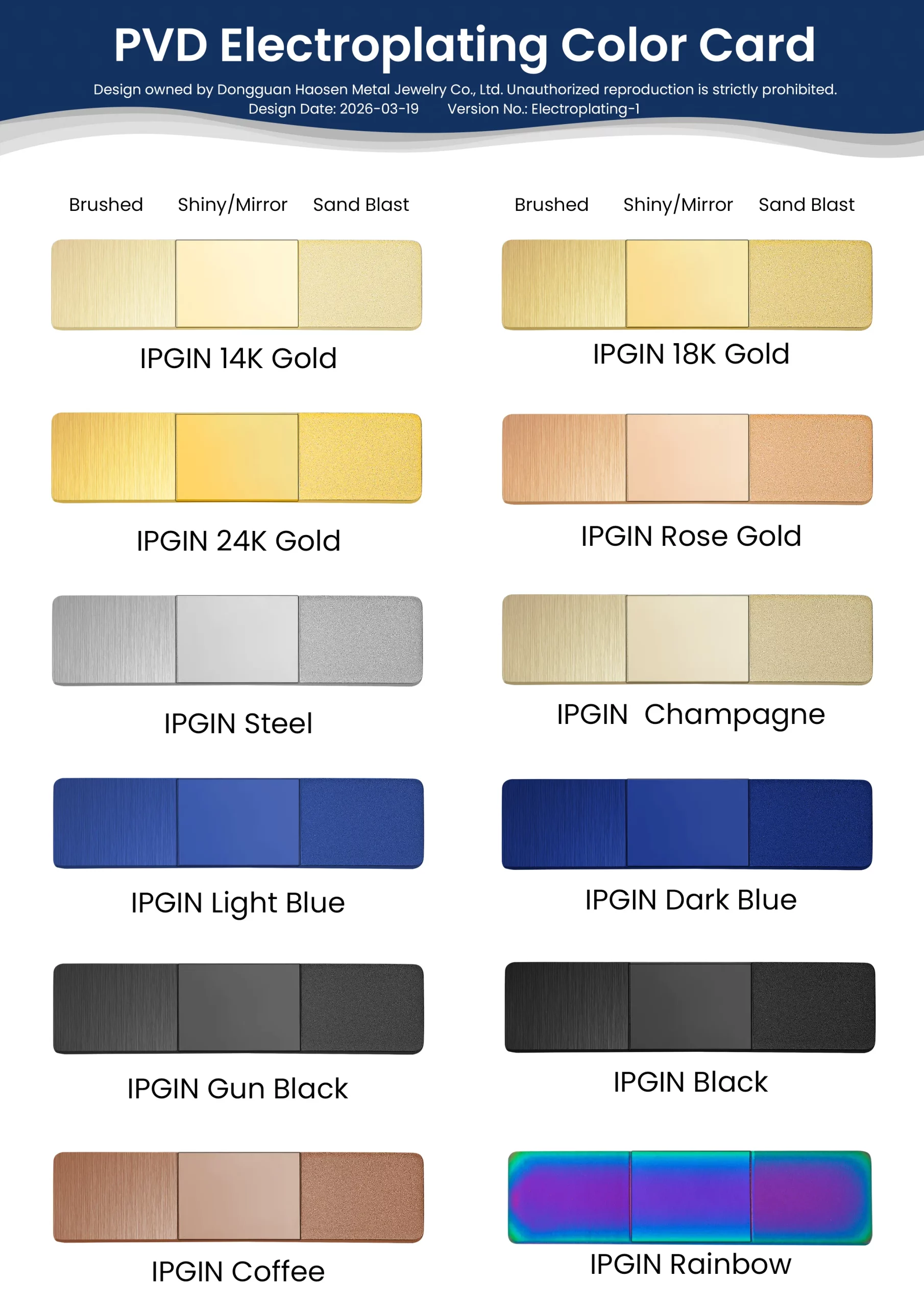

When sourcing tarnish-free jewelry, understanding gold purities and how modern vacuum technology replicates them is critical to delivering what your customers want. Below is the ultimate breakdown of gold karats and the science behind PVD color matching—including how factories actually control color consistency across batches.
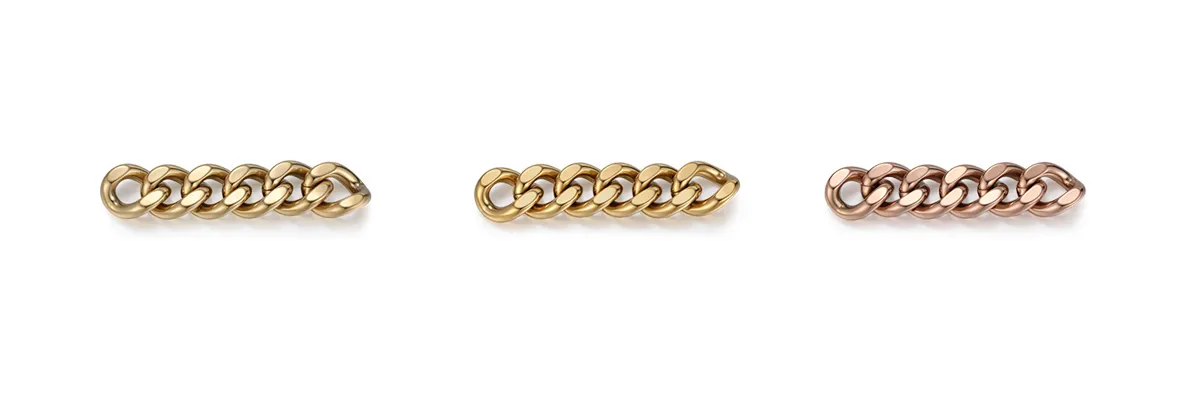
Understanding Gold Karats: 14K, 18K, 24K, and Rose Gold
| Material | Gold Purity | Color & Appearance | Durability / Hardness | Best Use Case |
|---|---|---|---|---|
24K Gold |
99.9% |
Extremely rich, bright yellow |
Very Low: Too soft, deforms easily |
Investment bars, traditional bridal wear |
18K Gold |
75.0% |
Warm, classic deep yellow |
Moderate: Balances luxury and strength |
Fine jewelry, luxury diamond settings |
14K Gold |
58.3% |
Lighter, champagne yellow |
Very High: Scratch-resistant |
Everyday wear, fashion jewelry |
Rose Gold |
Varies (Usually 14K/18K) |
Romantic pink/coppery red |
Very High: Copper adds extreme hardness |
Vintage/fashion designs for all skin tones |
Technical Note
The hardness difference between 24K and 14K is not just about wearer preference—it’s metallurgical. Pure gold has a Mohs hardness of ~2.5, while 14K gold (with copper/silver alloys) reaches ~3.5-4.0. In PVD coatings, however, the coating material itself (TiN, ZrN, DLC) determines hardness, which is why PVD can outperform solid gold in scratch resistance.
The Science of PVD Colors: Plating Without Dyes
PVD (Physical Vapor Deposition) does not use chemical dyes to create colors. Instead, colors are achieved through a high-tech chemical reaction in a vacuum chamber. Solid metals (Target Metals) are vaporized into plasma and mixed with specific Reactive Gases to form dense, colored compounds on the jewelry’s surface.
14K / 18K Gold: Vaporized Titanium (Ti) or Zirconium (Zr) reacts with Nitrogen (N₂). This creates Titanium Nitride (TiN), which naturally possesses an incredibly realistic gold color and extreme hardness.
Rose Gold: Titanium reacts with a precise mix of Nitrogen (N₂) and Methane (CH₄). By tweaking the carbon-to-nitrogen ratio, engineers craft a warm pinkish-copper hue.
Gunmetal / Black: Titanium or high-purity carbon reacts with Acetylene (C₂H₂) to create DLC (Diamond-Like Carbon), providing the highest scratch resistance of all colors.
PVD Color Formulation Reference Chart | PVD
| Target Color | Target Metal | Reactive Gas | Compound Formed | Key Property |
|---|---|---|---|---|
14K / 18K Gold |
Titanium (Ti) |
Nitrogen (N₂) |
TiN |
Realistic gold, extreme hardness |
Champagne Gold |
Zirconium (Zr) |
Nitrogen (N₂) |
ZrN |
Lighter, cooler gold tone |
Rose Gold |
Titanium (Ti) |
N₂ + Methane (CH₄) |
TiCN |
Warm pink-copper hue |
Gunmetal / Black |
Titanium / Carbon |
Acetylene (C₂H₂) |
DLC |
Highest scratch resistance |
Silver / Chrome |
Chromium (Cr) |
Nitrogen (N₂) |
CrN |
Cool silver, corrosion-resistant |
Why Doesn't 24K Gold PVD Exist?
Technical Clarification
A common reader question: “If 24K gold is soft in bulk, why is a thin PVD layer of it also soft?” The answer is that PVD coating thickness is typically 0.03μm-0.1μm—about 1/1000th the thickness of a human hair. At this scale, the coating’s mechanical properties are dominated by its crystalline structure and bond strength, not just the bulk material’s hardness. TiN and ZrN form extremely hard ceramic-like crystals; pure gold does not. This is why PVD factories use TiN as a hard base layer and only flash-plate real gold on top for color.
Aesthetic Trends: 24K gold features a very heavy, slightly orange-yellow hue. Modern fashion jewelry consumers strongly prefer the elegant, subtle warmth of 18K gold or the champagne lightness of 14K gold.
The Better Alternative: Premium factories simulate gold colors using ultra-hard Titanium Nitride, then flash-plate real 14K or 18K gold over it. This composite method achieves the perfect balance: 100% real gold luster on the outside, backed by the indestructible hardness of titanium underneath.
How Factories Control PVD Color Consistency (The Part Most Guides Skip)
For B2B buyers, the most critical question isn’t “how does PVD make color”—it’s “will the color match my previous order?” PVD gold can look slightly different across batches, components, or even positions within the same vacuum chamber. Here’s how professional factories control it:
An approved physical sample is kept as the “gold standard.” Every new batch is visually compared against it under standardized D65 lighting before shipping.
Instead of relying on human eyes alone, factories use spectrophotometers to measure L*a*b* values, including lightness, the red-green axis, and the blue-yellow axis.
Components placed at different positions in the vacuum chamber may receive slightly different coating thicknesses. Factories map these positions and adjust part placement to reduce variation.
Color durability is validated through 72-hour salt spray testing under ASTM B117 together with abrasion testing. Haosen uses 0.06μm–0.1μm thickened PVD layers for custom stainless steel jewelry.
Achieve Perfect, Tarnish-Free Colors with Haosen Jewelry
Achieving the exact 14K, 18K, or Rose Gold hue without compromising durability requires mastery over vacuum technology. At Haosen Jewelry, we utilize a premium dual-layer PVD process. We build an ultra-hard titanium compound base, topped with real gold atomic vaporization.
Our custom stainless steel jewelry features 0.06μm – 0.1μm thickened PVD layers, passing strict 72-hour salt spray tests (ASTM B117) to guarantee long-lasting, tarnish-free color. Our 316L stainless steel raw material is certified by SGS (Feb 2026) to be free of lead, mercury, and cadmium, fully compliant with EU RoHS standards, and has passed REACH and California Prop 65 testing with 252 SVHC substance screenings.
Why Choose Haosen
- 16+ years in jewelry and hardware manufacturing
- 200+ department stores, retailers, and global brand partners
- <1% defective rate, maintained by an independent 8-12 person QC team
- 30-120 flexible MOQ, approximately 25-day mass production lead time
- SEDEX/SMETA audit passed (2012 to present), compliant with EU REACH and California Prop 65
- US Showroom in San Diego, CA—for samples, meetings, and faster communication
Contact Us Now
- Visit our US Showroom: VISIONARE 1820 CAL INC., 3802 Main Street Suite 3, Chula Vista CA 91911, San Diego County
- Call us: +1 6193580328
- Trade Shows: JCK Las Vegas 2026 (May 28-June 1, Booth 47099) | Magic Sourcing Las Vegas 2026 (Aug 10-12) | Magic Sourcing New York 2026 (Sep 9-11)