

When buying or sourcing tarnish-free jewelry, the most common question buyers ask is: “Is 18K PVD gold actually real gold?”
The direct answer is yes—it contains real 18K gold—but it is not a solid chunk of gold. It is a dual-layer composite engineered for durability. Below, I’ll explain exactly how it’s made, what the test data shows, and where the industry misleads buyers.
My name is Jasper. I started in 2008 as a frontline craftsman doing manual inlay of semi-precious stones—agate, mother of pearl, tiger’s eye. I learned the hard way that a beautiful stone means nothing if the metal underneath fails. Today I run Haosen Jewelry, a SEDEX-audited OEM/ODM factory serving 200+ global brands. This article is not marketing copy. It’s what I tell buyers face-to-face when they ask me this exact question.
What Exactly is PVD Gold?
“PVD Gold” is not a newly discovered metal. It refers to a manufacturing process—Physical Vapor Deposition (PVD)—combined with a real gold target.
Here’s what happens inside the vacuum chamber:
- A solid block of real 18K or 24K gold is placed as the target.
- The chamber is pumped to a high vacuum (typically 10⁻³to 10⁻⁵ Torr).
- The gold is vaporized into a plasma stateusing an arc or sputtering source.
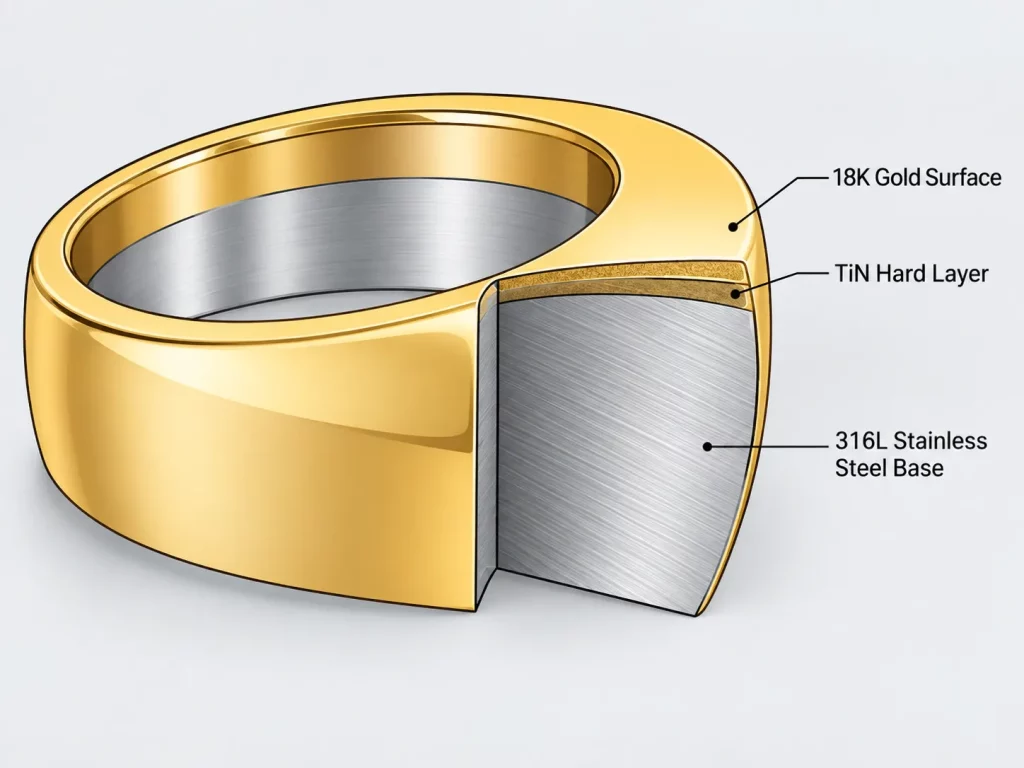
- These pure gold atoms are blasted onto the base metal surface (like 316L stainless steel), bonding at an atomic level.
The result is not a “painted” layer. It is a metallurgically bonded film that cannot flake off like traditional electroplating.
Technical Note
The bond strength of PVD gold on stainless steel typically exceeds 20 MPa in pull-off tests—far higher than electroplated gold, which relies on chemical adhesion and often fails below 5 MPa. This is why PVD jewelry doesn’t flake.
The "Dual-Layer" Secret of Premium Factories
PVD Gold vs. Traditional Fake Gold Plating
| Feature | 18K PVD Gold | Cheap Traditional Plating |
|---|---|---|
Material Sources |
Vaporized real 18K gold atoms |
Chemical yellow dyes or minimal gold liquid |
Bond Mechanism |
Atomic-level metallurgical bond |
Chemical adhesion |
Durability |
10x thicker, highly scratch-resistant |
Flakes off or fades within weeks |
Water Resistance |
100% waterproof, sweat-proof |
Turns fingers green when wet |
Skin Safety |
Hypoallergenic, lead/nickel free |
Often contains irritants like zinc/brass |
Thickness |
0.00μm - 0.1μm (custom), 0.03μm (standard) |
Typically <0.01μm, uneven |
Salt Spray Test |
Passes 72-hour ASTM B117 |
Fails within 12-24 hours |
An Honest Warning
If a supplier says “18K gold plated” but cannot provide a thickness measurement and a salt spray test report, treat it as marketing language, not a technical claim. At Haosen, every custom order ships with these two documents.
Why Not Just Buy Solid 18K Gold?
Metallurgical Fact
Pure gold (24K) has a Mohs hardness of ~2.5. 18K gold (75% gold + 25% alloys) reaches ~3.5-4.0. TiN coating reaches ~8-9. This is why a TiN-based PVD layer is more scratch-resistant than solid 18K gold itself.
How Haosen Verifies Every PVD Gold Batch
Thickness Measurement Report
Salt Spray Test Report (ASTM B117)
- Test conditions (5% NaCl solution, 35°C)
- Inspection intervals (24h, 48h, 72h)
- Pass/fail criteria (no tarnish, no color change, no corrosion)
Material Compliance Certificates
CIELAB Color Consistency Data
Source Authentic 18K PVD Gold with Haosen Jewelry
Why Choose Haosen
- 16+ years in jewelry and hardware manufacturing
- 200+ department stores, retailers, and global brand partners
- <1% defective rate, maintained by an independent 8-12 person QC team
- 30-120 flexible MOQ, approximately 25-day mass production lead time
- SEDEX/SMETA audit passed (2012 to present), compliant with EU REACH and California Prop 65
- US Showroom in San Diego, CA—for samples, meetings, and faster communication
Contact Us Now
- Visit our US Showroom:VISIONARE 1820 CAL INC., 3802 Main Street Suite 3, Chula Vista CA 91911, San Diego County
- Trade Shows: JCK Las Vegas 2026 (May 28-June 1, Booth 47099) | Magic Sourcing Las Vegas 2026 (Aug 10-12) | Magic Sourcing New York 2026 (Sep 9-11)
FAQ
Is PVD gold real gold?
Yes, high-quality PVD gold uses authentic gold (like 14K or 18K) that is vaporized in a vacuum chamber and atomically bonded to the jewelry’s surface. It is not a dye or a chemical imitation. At Haosen, we provide XRF thickness measurement reports to verify the gold layer.
Will 18K PVD gold tarnish or fade?
Unlike traditional electroplating, PVD gold is extremely durable. When applied over a stainless steel or titanium base with a 0.06μm-0.1μm thickened layer, it passes 72-hour salt spray tests (ASTM B117) and resists sweat, water, and daily wear. It will not tarnish or fade easily under normal conditions.
Can I wear PVD gold in the shower?
Yes. PVD coating over a rust-proof base metal (like 316L stainless steel) is 100% waterproof. You can confidently wear it in the shower, at the gym, or in the ocean. However, we recommend avoiding prolonged contact with harsh chemicals like chlorine or perfume.
How can I verify if a supplier's "18K PVD gold" claim is true?
Ask for three documents: (1) XRF thickness measurement report, (2) ASTM B117 salt spray test report, (3) material compliance certificate (SGS/REACH/Prop 65). If a supplier cannot provide these, the claim is not verifiable. Haosen provides all three with every custom order.
Is PVD gold safe for sensitive skin?
Yes. PVD gold over 316L stainless steel is hypoallergenic and free of lead, nickel, and cadmium. Haosen’s 316L stainless steel is SGS-certified (Feb 2026) and has passed 252 SVHC substance screenings for EU and US markets.
What is the difference between PVD gold and gold plating?
Traditional gold plating uses chemical liquids and relies on adhesion—it flakes off within weeks. PVD gold uses a vacuum process to atomically bond real gold to the base metal. It is up to 10x thicker, passes 72-hour salt spray tests, and does not flake.
