

Metal hair clips are made by forming a clip body through stamping or casting, building in or fitting the grip mechanism, then polishing, plating, assembling and inspecting each piece before packing. Each choice affects detail, grip and how long the color lasts. This guide walks through metal hair clip manufacturing step by step, so your brand can brief a factory with confidence and avoid costly sample rounds.
TL;DR
- Most metal hair clips are die cast in zinc alloy or stamped from iron sheet.
- Stamping suits flat shapes, while casting suits 3D detail.
- Some clips use a separate spring, while snap clips grip through their own curved spring steel body.
- Plating thickness and QC checks decide how well a clip holds up.
- Custom samples take a minimum of 7–10 days after CAD approval.
What Are the Main Steps in Metal Hair Clip Manufacturing?
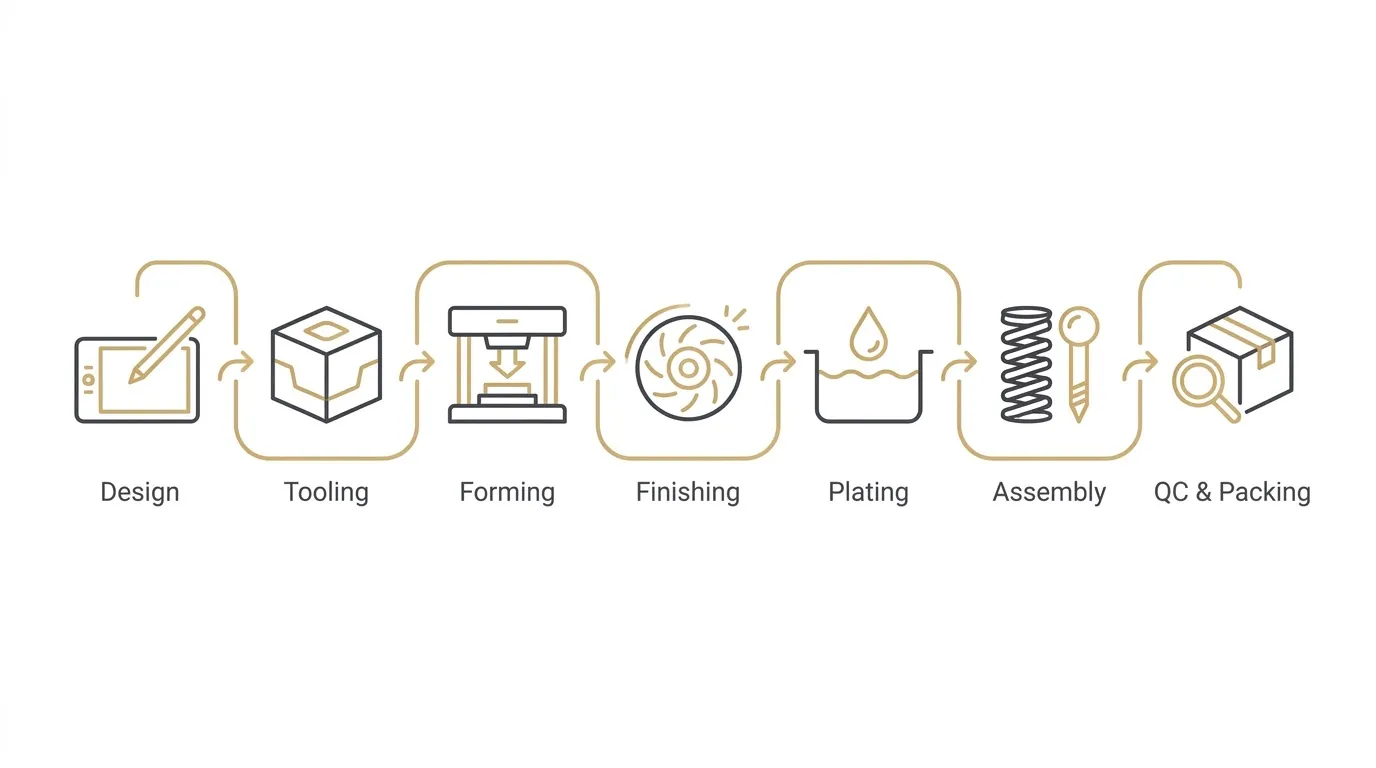
Metal hair clips are made in seven main steps: design and CAD, tooling, forming, finishing, plating, assembly, and QC and packing.
- Design and CAD: your sketch or reference image becomes a 3D file with exact sizes.
- Tooling: the factory makes a stamping die or a casting mold.
- Forming: the clip body is stamped or cast in the chosen metal.
- Finishing: edges are cleaned and the surface is polished or textured.
- Plating: the body gets its color, such as 18K gold or black.
- Assembly: separate springs, hinges, stones or logo parts are fitted where the design needs them.
- QC and packing: each batch is checked, then carded or bagged.
Which Metals Are Hair Clips Usually Made From?
Most metal hair clips are made from zinc alloy and iron, while brass is used for some designs and stainless steel for only a small share of products, mainly because of its higher cost.
- Zinc alloy is die cast into decorative tops, claw clips and logo clips.
- Iron sheet and wire are stamped or bent into snap clips, bobby pins and clip bases.
- Brass suits selected premium designs with fine detail.
- Stainless steel is used less often because it costs more to buy and process.
Iron and zinc alloy both need plating to protect the surface and give the clip its color. Stainless steel resists rust without plating, so brands sometimes choose it for specific designs despite the extra cost.
How Does Hair Clip Stamping Work?
Hair clip stamping uses steel dies in a press to cut, pierce, bend, form and emboss flat metal sheet into clip parts, usually through several separate operations. High-volume production often uses progressive dies, which move the metal strip through each operation in sequence. Iron sheet is the most common choice, with brass and stainless steel used for selected designs.
Where Stamping Works Best?
Stamping is ideal for snap clips, flat barrettes, bars and simple geometric shapes. Once the die is made, every piece comes out the same. This makes stamping fast and very consistent for larger runs.
Where It Falls Short?
Stamping cannot easily produce deep relief, undercuts or rounded 3D forms. If your design has florals, pearls in a raised setting or a sculpted shape, casting is usually the better path. Laser cutting is another option for flat clips with fine cut-out patterns.
When Is Casting the Better Choice?
Casting is the better choice when a hair clip has 3D detail, texture or an organic shape that a flat die cannot form. Liquid metal fills a mold, so it can capture curves and fine relief.
Lost-Wax Casting
Lost-wax casting suits brass and other alloys when a clip needs fine detail in smaller runs. A wax model is coated, the wax is melted out, and molten metal fills the cavity. It works well for detailed decorative clips and sample pieces.
Die Casting Hair Clips
Die casting hair clips means injecting molten zinc alloy into a steel mold under pressure. It is cost-effective for high volumes and holds sharp detail, which makes it popular for decorative claw clips and logo clips. Zinc alloy is one of the main materials for decorative hair clips, because die casting is cost-effective for high volumes and holds sharp detail. It is popular for decorative claw clips, barrette tops and logo clips.
How Do Hair Clips Get Their Grip?
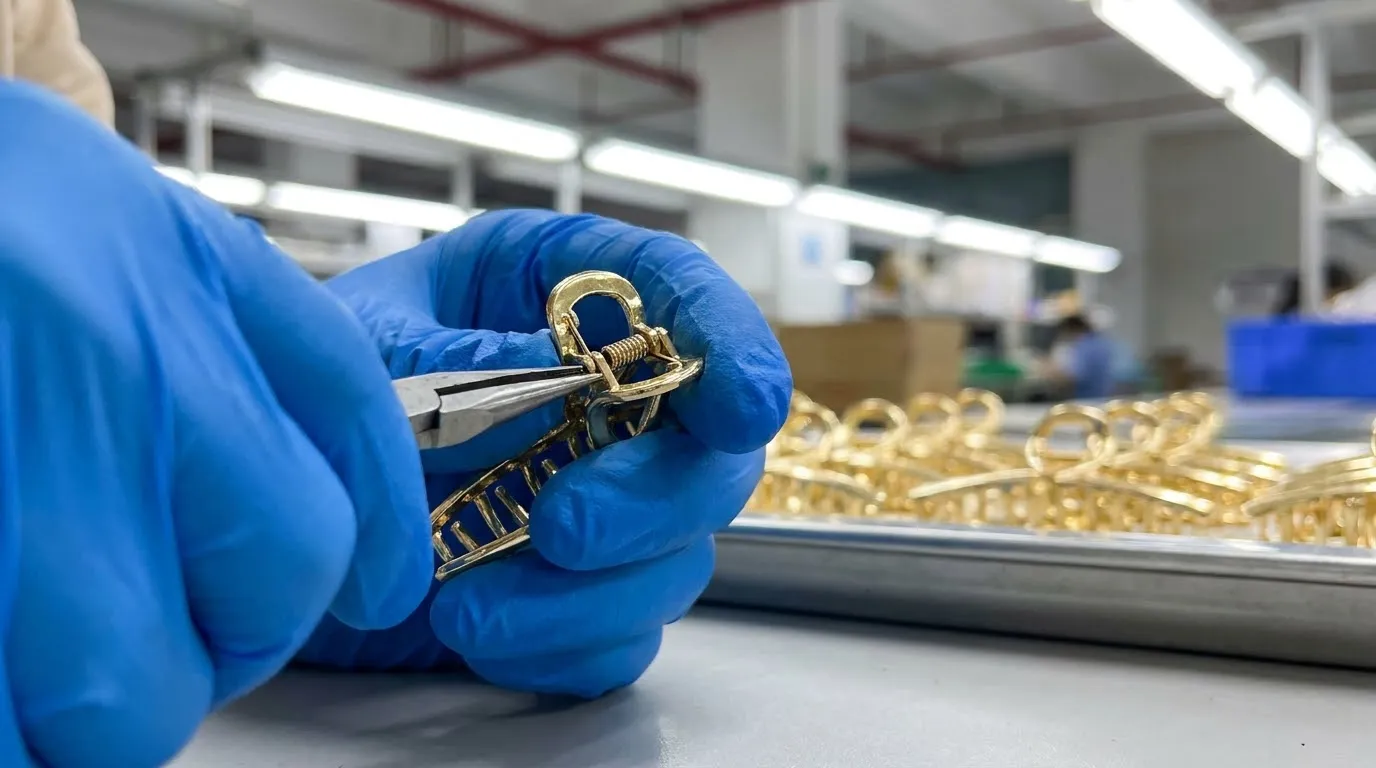
Hair clips get their grip either from a separate hair clip spring fitted during assembly, such as the coil spring in a claw clip, or from the springy metal body itself, as in a snap clip. Not every clip needs a separate spring.
- Claw clips use a coil spring and a hinge pin.
- Snap clips use a curved spring steel strip that flexes and snaps shut on its own.
- French barrettes use a hinged clasp with a spring catch.
- Bobby pins grip through the tension of the bent wire itself.
Where a separate spring is used, it is usually fitted after the decorative part is finished and plated. Cast zinc alloy parts are not designed to flex, so they are paired with a spring or clasp. You can customize spring tension and tooth spacing. Test this on real hair during sampling, not only on a desk.
Which Finishing and Plating Steps Follow?
Finishing and plating follow forming, and they give the clip its final look and color. First, the surface is polished, brushed, sandblasted or hammered. Then the clip is plated.
Plating Options
Zinc alloy, iron and brass clips are usually electroplated, with thickness options from 0.03 to 3 μm for brass and alloy. For stainless steel clips, PVD is a common choice, with a standard 0.03 μm coat and an upgraded 0.05 to 0.10 μm option. Electroplating and other surface treatments can also be used on stainless steel, depending on surface preparation, the look you want and the project requirements. An optional e-coating can add protection over electroplated finishes.
Color Choices
Popular colors include 14K gold, 18K gold, rose gold, silver, black and gunmetal. If you are choosing between gold tones, this guide to PVD gold colors shows how each shade is achieved.
How Are Metal Hair Clips Checked Before Shipping?
Metal hair clips are checked at five stages: incoming material, first piece, in-process, final and pre-shipment inspection. Pre-shipment checks follow AQL 2.5 or 4.0 sampling.
Typical checks cover size, finish, plating evenness, spring function and stone security. Lab tests can include plating thickness, salt spray, nickel release, and lead and cadmium content. You can see how this works on our quality control page.
What Should Brands Prepare Before Ordering Custom Hair Clips?
Brands should prepare a design file, target sizes, a material choice, a plating color and an order quantity before asking for a quote on custom hair clips. A sketch, reference photo, physical sample or CAD file all work as a starting point.
It also helps to know the basic numbers. Standard MOQ starts from 30 pieces per style per color. Custom samples take a minimum of 7–10 days after CAD approval. Bulk production takes a minimum of 25–45 days after sample approval. Explore our custom hair accessories service to see the full range of clips, pins and combs we make.
FAQs
What metal are hair clips usually made of?
Most metal hair clips are made of zinc alloy or iron. Brass is used for some designs, and stainless steel for a smaller share because it costs more. Some clips add a separate spring part, while snap clips get their grip from their curved spring steel body.
Are stamped or cast hair clips better?
Neither is better in every case. Stamped clips suit flat shapes and large runs, while cast clips suit 3D detail and decorative designs.
Why do some metal hair clips lose their grip?
Metal hair clips lose their grip when the spring or spring steel body loses tension, or the hinge wears loose. Testing spring tension on real hair during sampling helps prevent this.
Can I add my logo to custom hair clips?
You can add a logo by engraving, laser marking, stamping or embossing. The best method depends on the clip size and the metal.
How long does it take to make custom hair clips?
Custom hair clips take a minimum of 7–10 days to sample after CAD approval, then a minimum of 25–45 days for bulk production.
Final Thoughts on Metal Hair Clip Manufacturing
Good metal hair clips come from the right mix of forming method, spring, plating and inspection. Stamping keeps flat designs fast and uniform. Casting brings 3D detail to life. A well-tested grip, whether from a separate spring or a spring steel body, makes sure the clip actually works. Haosen Jewelry has 16+ years of experience making custom accessories in Dongguan, China, from a SEDEX/SMETA audited factory. Ready to develop your own hair clip line? Contact our team with your design, and we will help you choose the right process and materials.
