

When I started in this industry at age 26, I worked as a craftsman specializing in semi-precious stones—agate, mother of pearl, tiger’s eye—and manual inlaying. Back then, I saw the same problem again and again: beautifully designed jewelry that faded, tarnished, or turned skin green within months. Buyers were frustrated. Retailers lost trust.
That experience—learning how jewelry is made on the workshop floor and hearing directly from the market as a salesperson—led me to one conclusion: the finish is everything. A perfect design means nothing if the coating fails.
Today, Haosen Jewelry manufactures for global brands from our SEDEX-AUDITED FACILITY in Dongguan, China, with a U.S. showroom in Chula Vista, California. PVD (Physical Vapor Deposition) plating is at the core of what we do. For stainless steel jewelry, it’s the difference between a piece that lasts a lifetime and one that ends up in a drawer.
In this guide, I’ll share the technical details, real-world case studies, and quality control practices we’ve refined over 16 years of production. Whether you’re a brand owner, sourcing specialist, or designer, this guide will help you understand how PVD plating works, what it can (and cannot) do, and how to specify it correctly for your collections.
What is PVD Plating? Process Overview
PVD (Physical Vapor Deposition), also known as vacuum ion plating or IP plating (a term commonly used in Japan), is currently the industry-standard surface finishing technology for stainless steel jewelry. In the manufacturing sector, it is widely referred to as Vacuum Plating, representing a leap in durability over traditional methods.
The process takes place in a vacuum chamber at pressures below 10⁻² Pa. Metal target materials are vaporized—by resistance heating, electron beam, laser, or plasma—and then condense on the stainless steel surface, forming a dense, durable, and colorful coating at the atomic level.
As a specialized 316L stainless steel jewelry manufacturer, we utilize this technology to ensure our products achieve a surface hardness of PVD coating achieves a surface hardness of 1500-3000 HV, far exceeding traditional electroplating.
Explore research summaries on ScienceDirect for a deeper scientific explanation of deposition mechanisms.
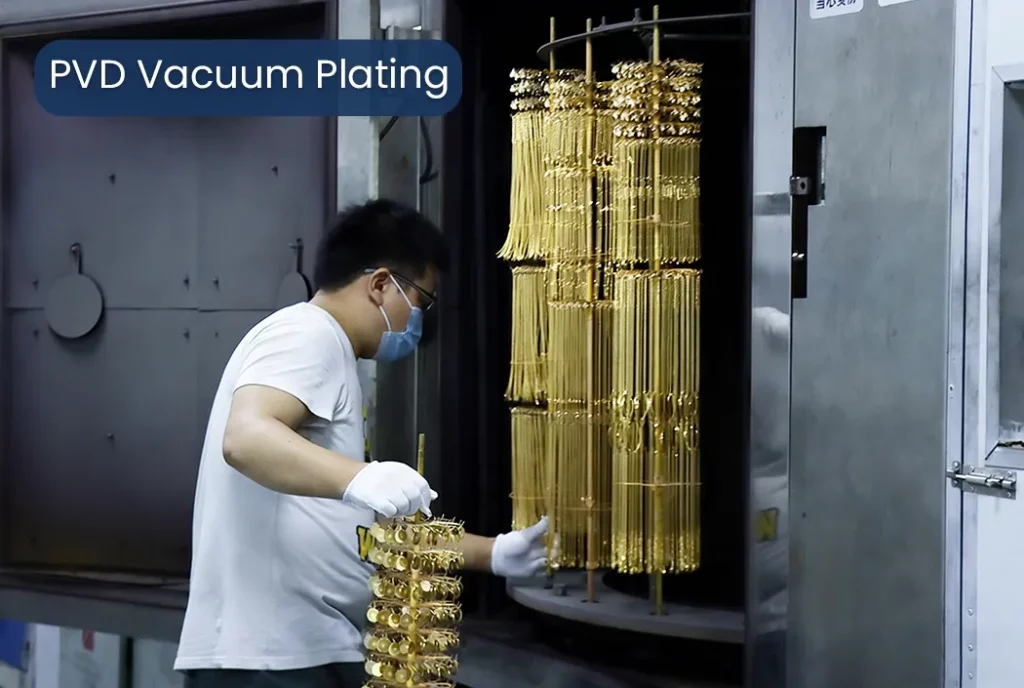
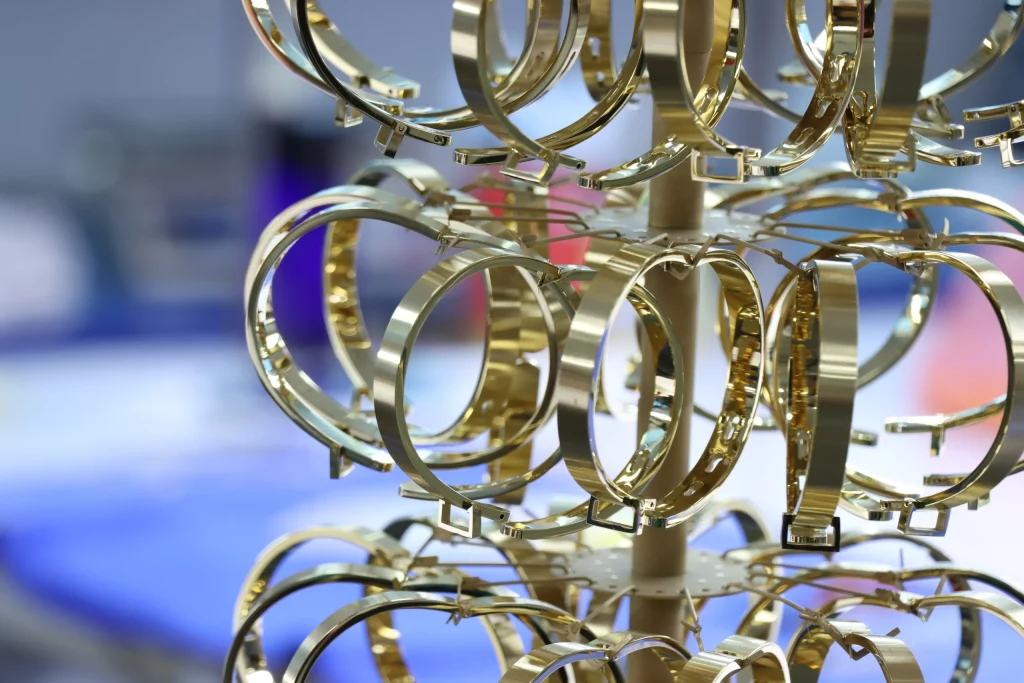
PVD vs Traditional Electroplating
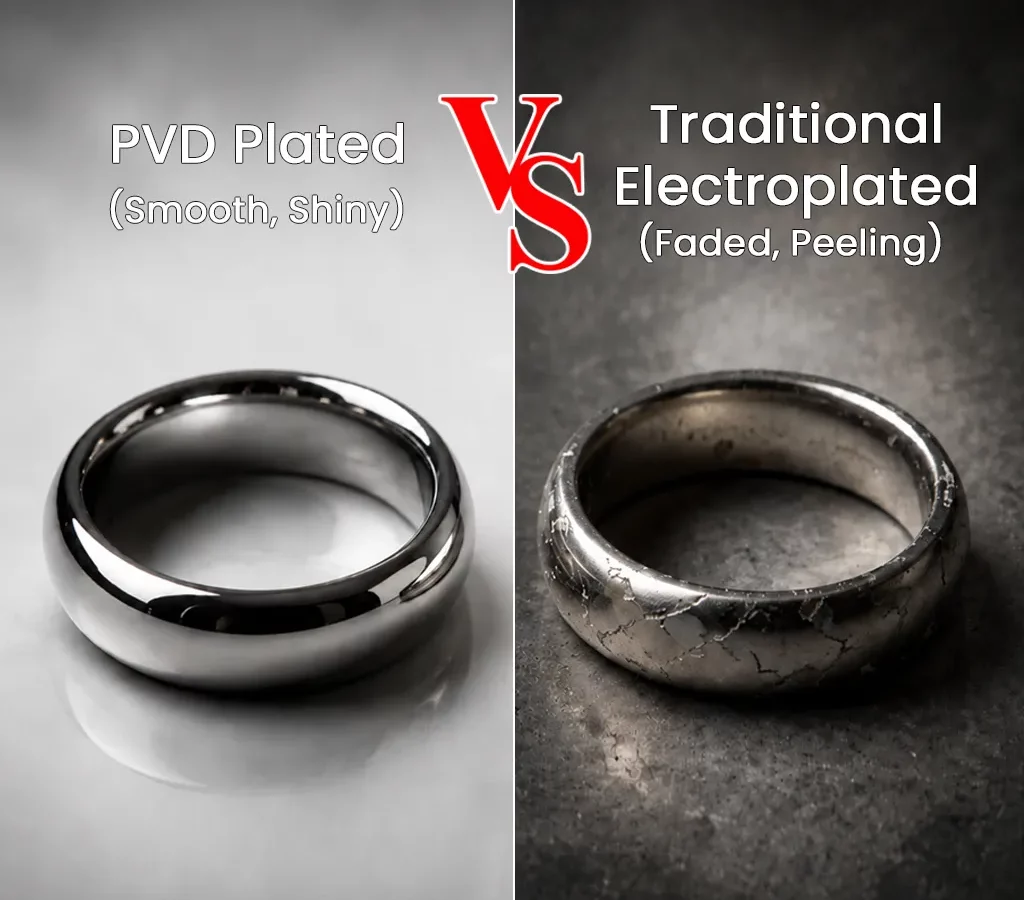
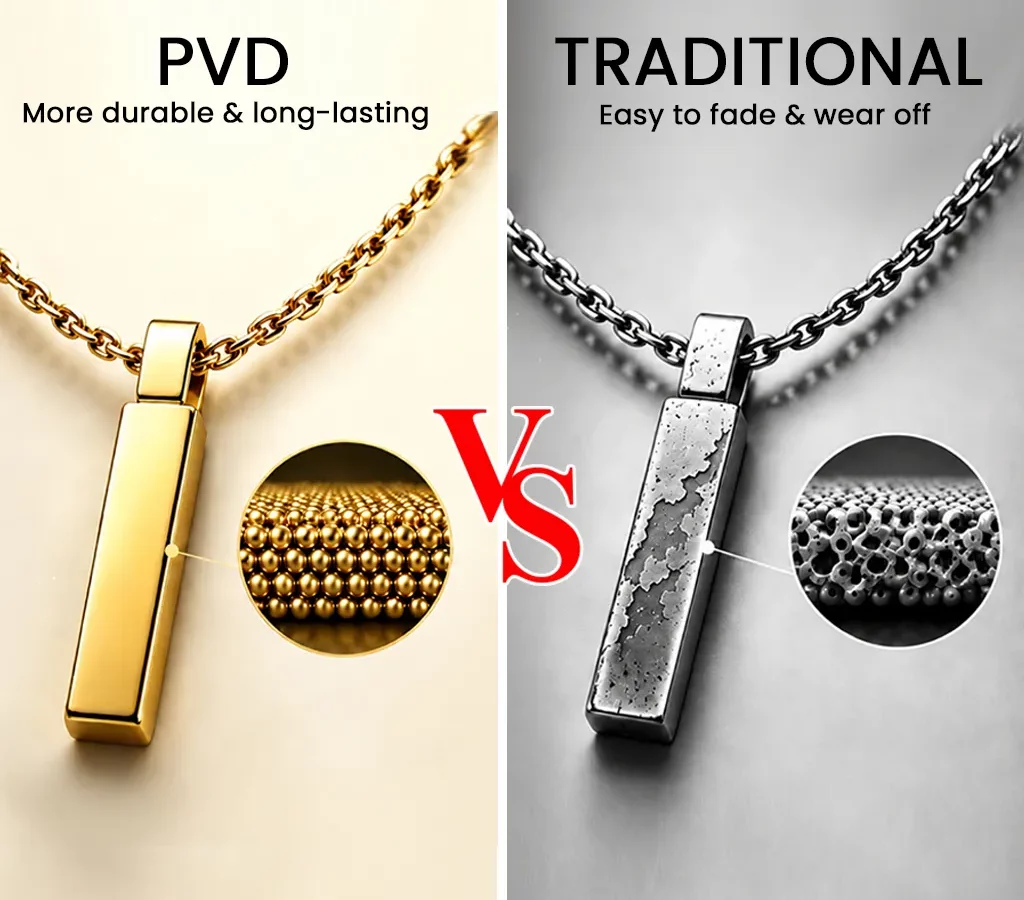
| Comparison | PVD Vacuum Plating | Traditional Electroplating |
|---|---|---|
Coating Density |
Extremely high, pore-free |
Low, prone to pinholes |
Adhesion Strength |
Atomic-level bond |
Mechanical bond, prone to peeling |
Environmental Impact |
Zero wastewater or emissions |
Contains heavy metal wastewater |
Wear Resistance |
Significantly increases surface hardness |
Limited improvement |
Color Range |
Wide, customizable |
Restricted |
Cost |
Higher |
Lower |
Why PVD Matters for Jewelry Brands
For B2B buyers, choosing PVD over traditional electroplating directly impacts your brand’s return rate and customer satisfaction. At Haosen, we’ve seen this across hundreds of client projects:
- PVD-coated stainless steel jewelry lasts 5–10 years in normal wear conditions
- It eliminates the risk of green stains on skin caused by copper oxidation
- It provides consistent color across large production batches—critical for brand consistency
- It meets EU REACH and California Proposition 65 compliance requirements without additional chemical treatment
Direct Jewelry Factory Source: Performance PVD Stainless Steel Jewelry (OEM/ODM Available)
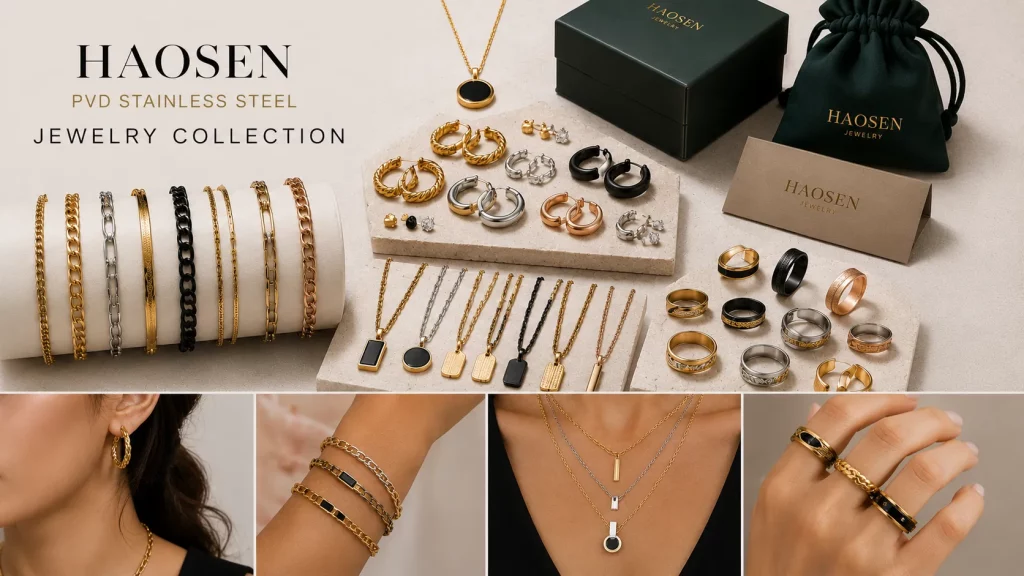
As a 316L stainless steel jewelry manufacturer, we don’t just provide technical expertise—we offer a stable, capacity supply chain for global brands. Our integrated production lines combine precision CNC machining with advanced Vacuum Plating to deliver market-ready collections across all major categories:
- PVD Rings & Earrings: From minimalist bands to hypoallergenic studs, ensuring 1500-2500 HV hardness and skin-safe durability.
- PVD Necklaces & Bracelets: Superior color consistency on high-surface area pieces like Cuban links, snake chains, and bangles.
- Garment Accessories: PVD-coated buttons, buckles, and metal accents engineered for apparel and leather goods.
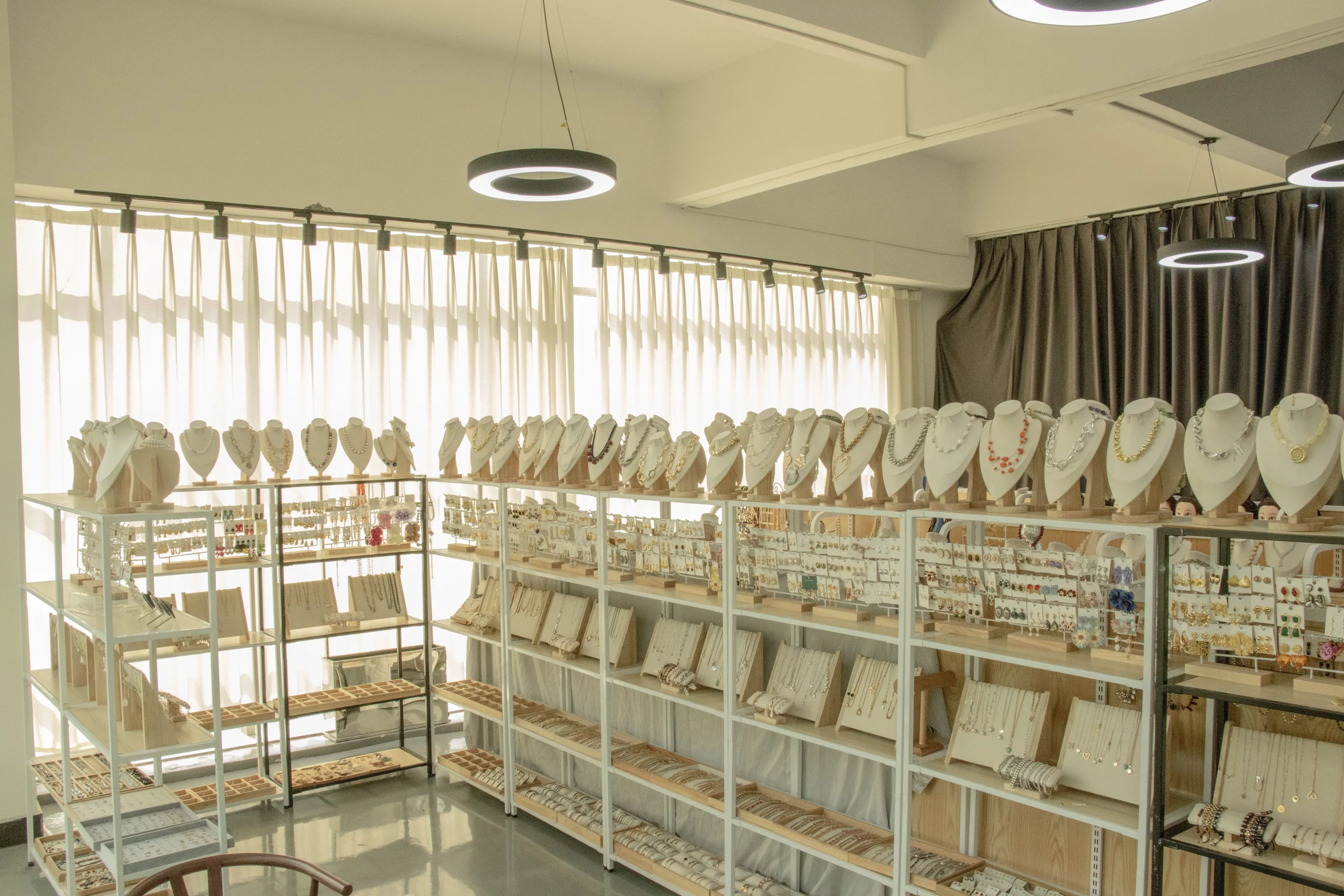
Our sample room features designs of PVD vacuum-plated jewelry, ready for OEM/ODM customization. Visit our US showroom in San Diego to see our PVD samples in person.
What Are the Technical Limits of PVD Coating Thickness?
Coating Thickness
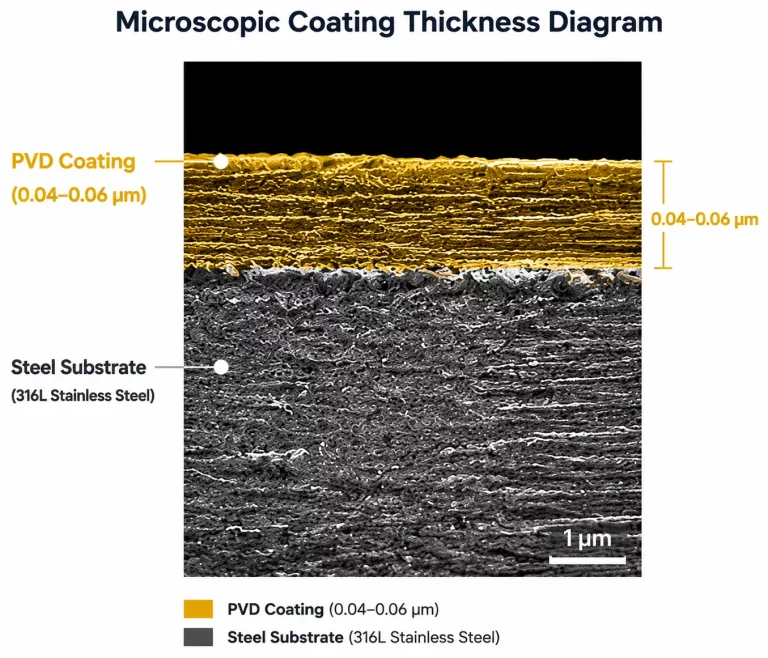
PVD coatings are measured in microns (μm) and typically do not alter the original.Dimensions of the workpiece:
| Coating Type | Thickness Range | Application |
|---|---|---|
Decorative Coating |
0.03 μm |
Standard fashion jewelry |
Standard PVD |
0.04-0.06 μm |
General wear resistance |
High-End PVD |
0.07-0.3 μm |
Luxury jewelry |
Thickness considerations:
- Too thin (<0.03 μm): Low reflectivity, dull color
- Too thick (>0.3 μm): Within the recommended range, greater thickness can improve wear life. Decorative jewelry coatings require tighter stress and adhesion control.
For high-wear items such as rings and bracelets, 0.07–0.3 μm is the recommended thickness range, which provides sufficient wear resistance without creating excessive coating stress or reducing adhesion.
Process Temperature
| Process Type | Temperature Range | Notes |
|---|---|---|
Typical PVD |
250–450°C |
Standard decorative coating |
20–200°C |
Low-temperature process, ideal for thin-walled designs | |
High-Temperature Vacuum |
~300°C |
Enhances wear resistance and color stability |
Why low-temperature PVD matters: The core advantage of this Vacuum Plating environment is that it operates under high vacuum pressure (typically 10-2 to 10–4 Pa), which effectively eliminates oxygen. By preventing metal oxidation during the heating process, we achieve a color purity and brightness that is 20-30% higher than traditional atmosphere-controlled plating, ensuring a consistent luster for every batch.
Surface Hardness
PVD coatings significantly increase the surface hardness of stainless steel jewelry:
| Jewelry Coating Materials | Surface Hardness (HV) | Performance Rating |
|---|---|---|
TiN (Titanium Nitride, Gold) |
1500–2500 |
Excellent |
ZrN (Zirconium Nitride, Gold) |
1500–2800 |
Excellent |
CrN (Chromium Nitride, Silver/Black) |
1500–2000 |
High |
TiCN (Titanium Carbonitride, Dark) |
2500–3000 |
Extremely high |
DLC (Diamond-Like Carbon, Black) |
2000–3000 |
Extremely high |
Untreated 304 Stainless Steel |
~220 |
— |
Process Time
| Phase | Duration | Description |
|---|---|---|
Pre-heating |
30+ minutes at 150°C |
Removes surface moisture |
Coating Process |
3–6 hours |
Vacuum, ion cleaning, deposition |
Cooling |
To below 100°C |
Controlled cooling |
Total Cycle |
4–8 hours |
Varies by coating complexity |
Color Range
| Color | Coating Material | Common Application |
|---|---|---|
IP Gold (18K/14K) |
TiN, ZrN |
Fashion jewelry, high-end accessories |
IP Rose Gold |
TiN-Cu Alloy |
Contemporary fashion |
IP Black |
TiCN, DLC, CrN |
Men’s jewelry, edgy designs |
IP Gunmetal |
CrN-Based |
Industrial/minimalist style |
IP Blue |
TiN/TiCN Multilayer |
Custom/niche designs |
IP Chrome |
Cr |
Mirror silver finish |
IP Coffee |
Composite |
Vintage/retro style |
Champagne Gold |
TiN (tuned) |
Light luxury aesthetic |
24K/18K Real Gold |
Au-Based |
Luxury segment |
Which Materials Are Best for PVD Coating?
PVD plating requires careful material selection. At Haosen, we specialize in multi-material hardware, and we’ve tested PVD performance across various substrates over 16 years of production.
Substrate Compatibility
| Base Material | Direct PVD Plating | Notes |
|---|---|---|
Stainless Steel (304/316/316L) |
✅ Yes |
Best adhesion, ideal for jewelry |
Titanium Alloy |
✅ Yes |
Suitable for high-end applications, hypoallergenic |
Tungsten Carbide |
✅ Yes |
For scratch-resistant products |
Zinc Alloy / Brass / Cast Iron |
⚠️ Requires chemical nickel underlayer |
Direct PVD may cause blistering |
ABS Plastic |
⚠️ Requires conductive coating (Ni/Cr) |
Limited applications |
Stainless Steel Grade Selection
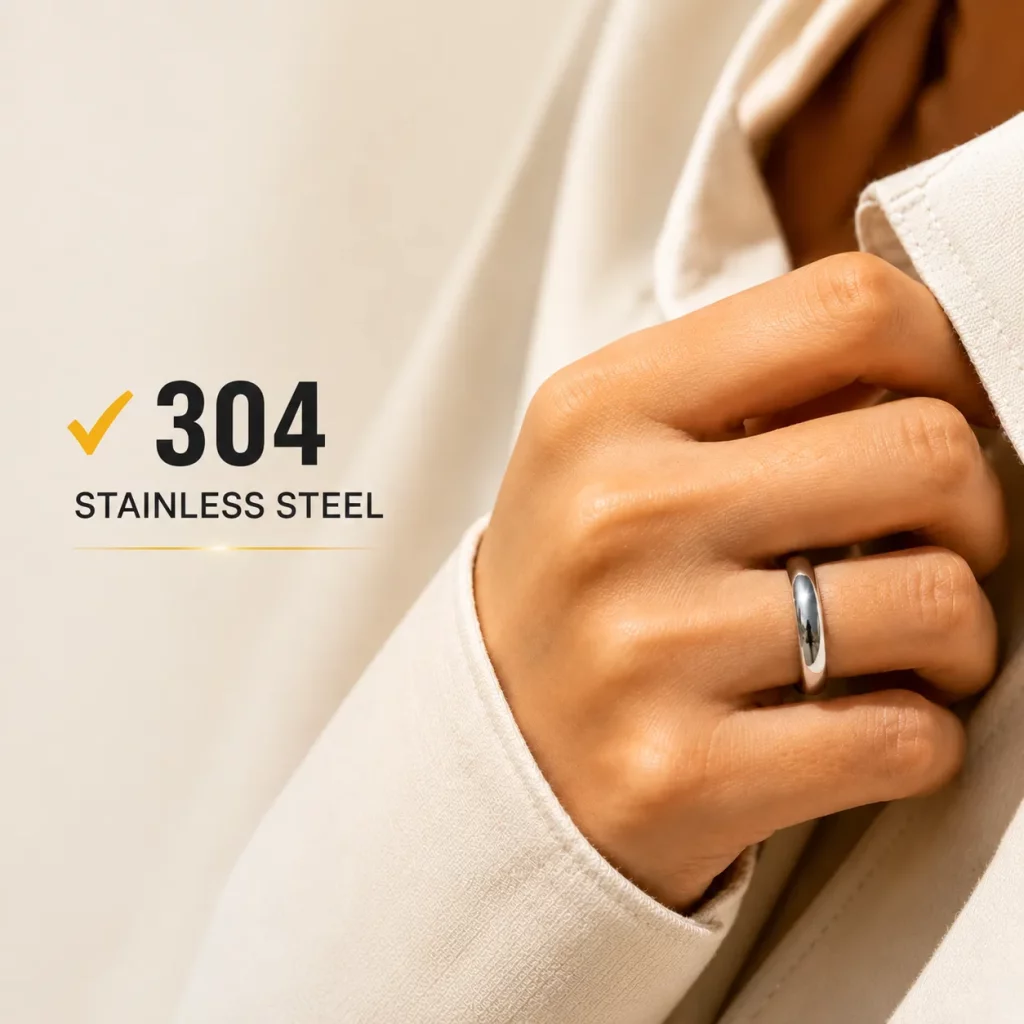
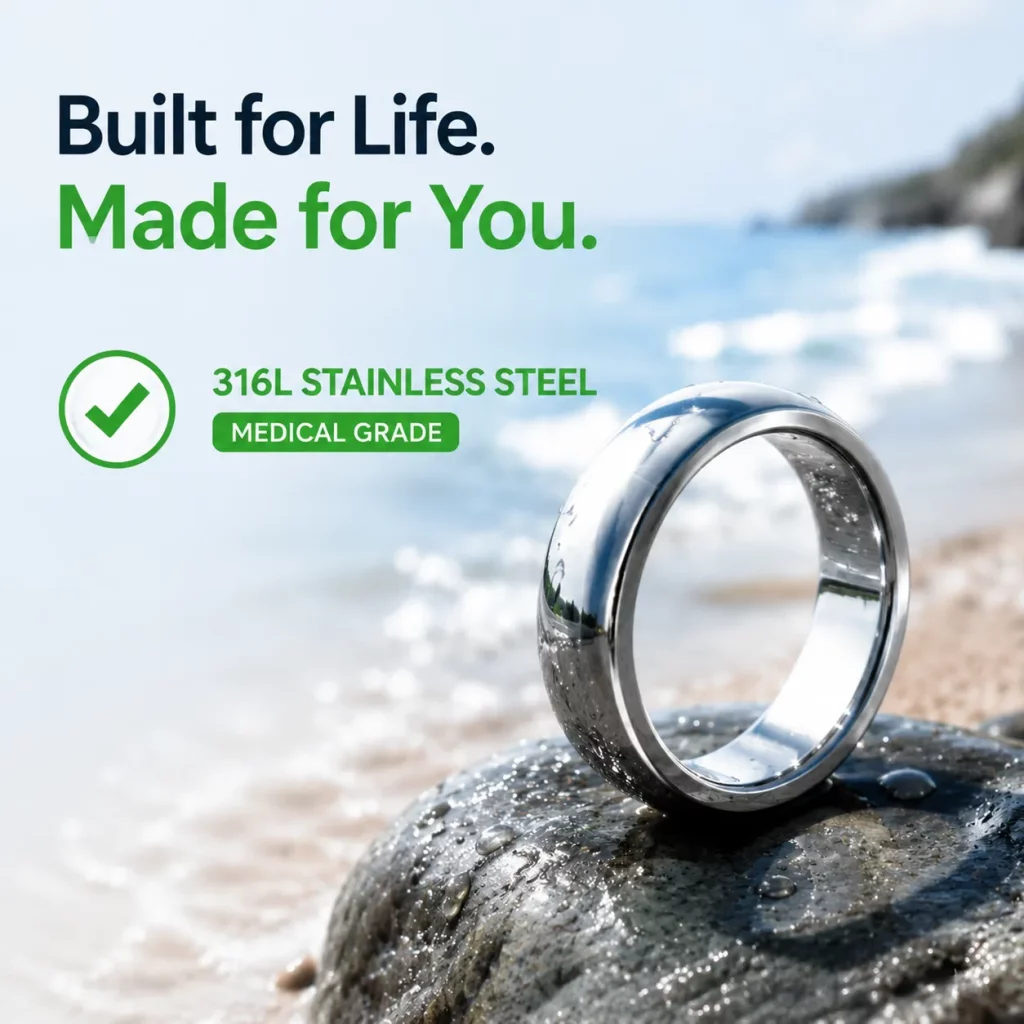
At Haosen, we primarily use 316L stainless steel for PVD-plated jewelry. Here’s how they compare:
| Grade | Corrosion Resistance | Adhesion Strength | Best Use |
|---|---|---|---|
304 |
Good |
Excellent |
Cost-effective for most jewelry |
316 / 316L |
Superior (marine grade) |
Excellent |
High-end jewelry, sensitive skin, coastal wear |
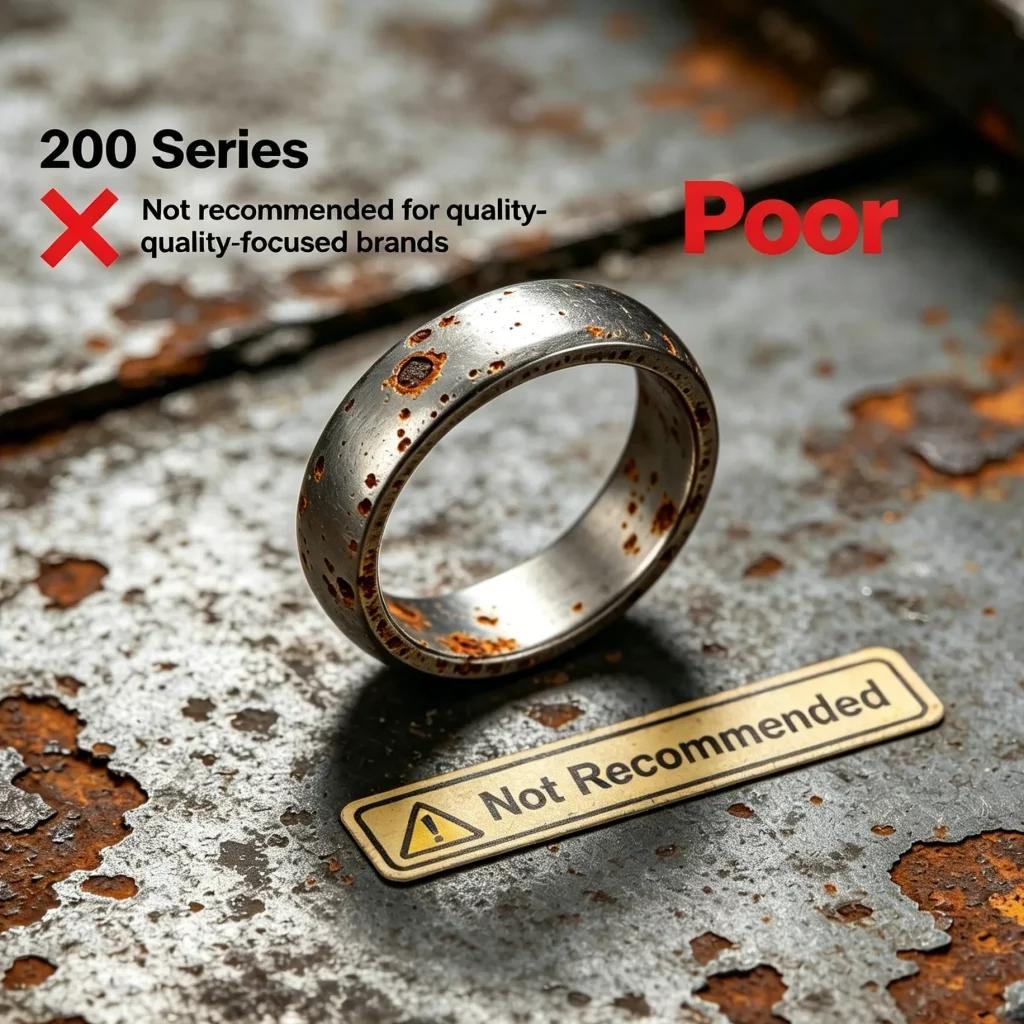
200 Series |
Poor |
Fair |
Not recommended for quality-focused brands |
Our recommendation: For most fashion jewelry applications, 304 stainless steel offers the best balance of cost and performance. For clients targeting the premium market or customers with nickel sensitivities, we recommend 316L.
How Does PVD Perform in Real-World Jewelry Applications?
Case 1: Hypoallergenic PVD for Sensitive Skin
Source: Haosen Jewelry client in the medical accessory space
Requirement: Zero nickel exposure for wearers with metal allergies
Solution: 316L stainless steel base with full-coverage PVD coating (TiN). The dense, pore-free PVD layer completely encapsulates the base metal, preventing nickel ion migration.
Verification: Passed nickel release testing per REACH standards (<0.2μg/cm²/week).
Case 2: PVD Gold-Plated Stainless Steel Ring (0.07–0.3 μm)
Source: Haosen Jewelry production for a European brand
| Parameter | Specification |
|---|---|
Base Material |
316L Stainless Steel |
Coating Type |
PVD Gold (TiN) |
Thickness |
0.07–0.3 μm μm |
Key Feature |
Nickel-free, hypoallergenic |
Result: The ring maintained its color after 18 months of daily wear. The client reported zero finish-related returns across a 5,000-piece order.
Case 3: Dual-Color PVD with Masking Technique
Source: Haosen Jewelry custom project for a U.S. brand
A pendant design required two distinct colors on a single piece—black on the outer frame, gold on the inner motif.
Process:
- First PVD cycle: Gold coating on entire piece
- Precision masking of the gold area
- Second PVD cycle: Black coating on exposed areas
- Masking removal
Result: Clean color separation with no bleed. The client achieved a premium look without assembly complexity.
Case 4: Brushed + Polished Surface with PVD
Source: Haosen Jewelry development for a fashion label
The design required a two-tone surface texture under a single PVD color:
- High-polish areas for brilliance
- Brushed areas for contrast
Process:
- Full polishing to mirror finish
- Selective brushing with precision abrasive tools
- PVD coating application
Result: The final piece showed rich visual depth under the same gold coating. The brushed areas appeared slightly darker due to light diffusion, creating a sophisticated dimensional effect.
How Does PVD Plating Process Work in Fashion Jewelry?
At Haosen, our PVD coating process follows a strict four-step workflow consisting of 12 detailed procedures:
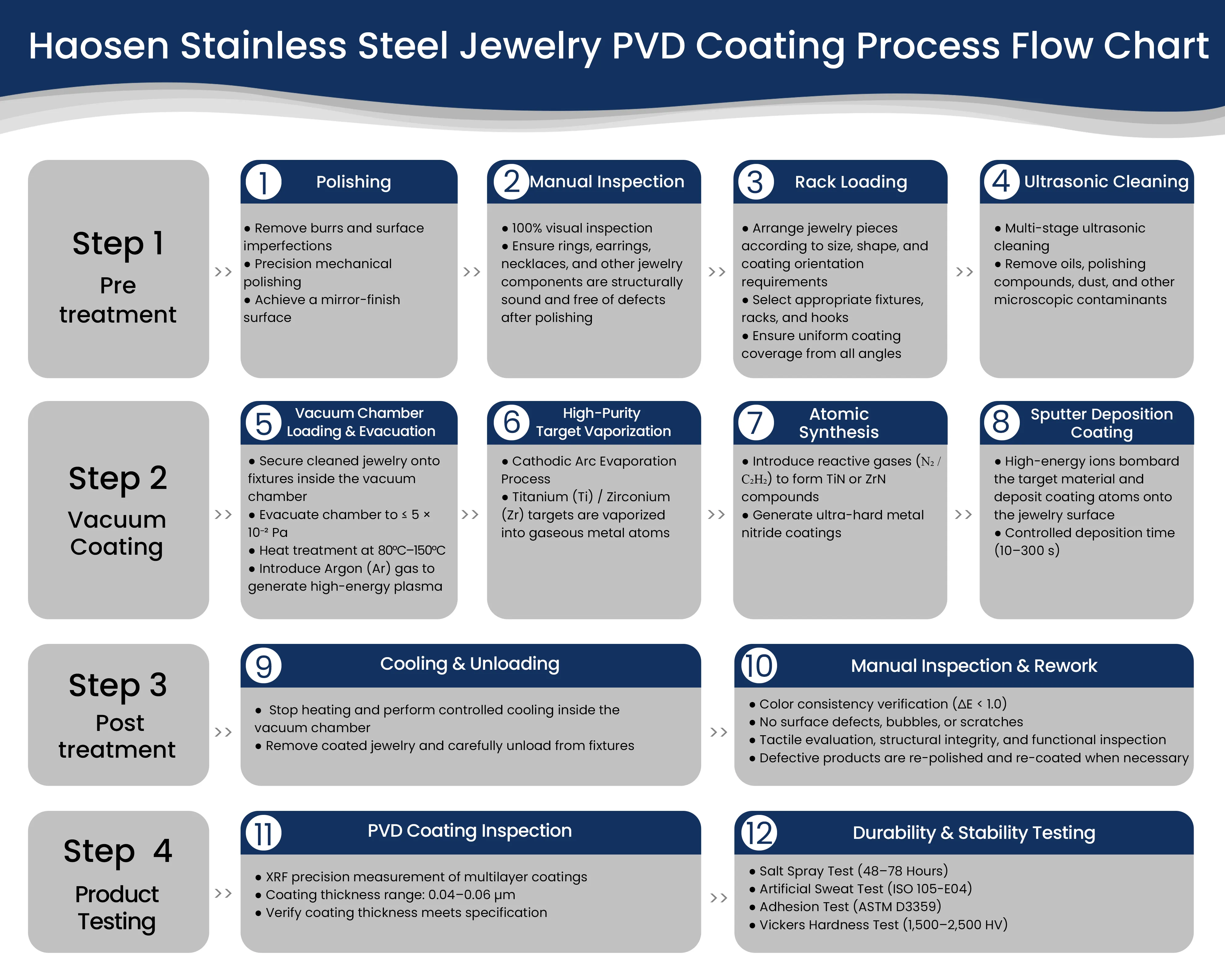
| Step | Process Link | Key Quality Control (QC) Points |
|---|---|---|
1 |
Polishing |
Ensure surface smoothness meets mirror or specified texture requirements and remove all scratches. |
2 |
Manual Inspection |
Inspect every piece for dents, burrs, or unpolished areas in corners. |
3 |
Rack Loading |
Ensure uniform spacing between jewelry pieces to avoid shadowing and ensure full exposure of the coating surface. |
4 |
Ultrasonic Cleaning |
Use multi-stage solvents to remove grease and polishing paste residues, ensuring a “hydrophilic” clean state. |
5 |
Vacuum Chamber
Loading & Evacuation |
Monitor vacuum levels to ensure the chamber reaches the required vacuum grade to eliminate air interference. |
6 |
High-Purity
Target Vaporization |
Strictly control target current and voltage to ensure purity and stability of the metal vapor source. |
7 |
Atomic Synthesis |
Precisely control the injection ratio of reactive gases (e.g., Nitrogen/Acetylene) for consistent color and hardness. |
8 |
Sputter Deposition
Coating |
Real-time monitoring of film thickness and deposition rate to ensure uniformity and adhesion. |
9 |
Cooling & Unracking |
Strictly monitor vacuum cooling and temperature reduction time to prevent coating stress cracks from sudden temperature changes. |
10 |
Manual Inspection & Rework |
Remove defective products and perform targeted repairs on pieces with minor color differences or surface contamination. |
11 |
PVD Coating Inspection |
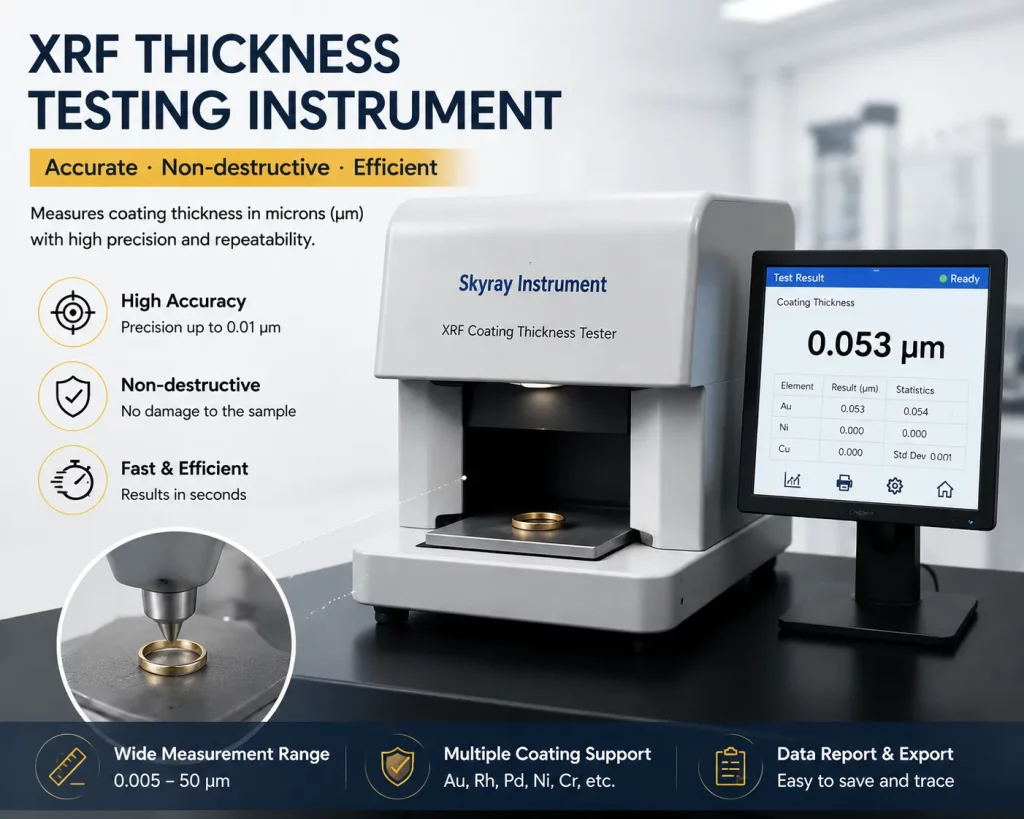
Verify film thickness using an XRF thickness gauge: typically 0.04–0.06 μm for standard PVD, and 0.07–0.3 μm for high-end or high-wear specifications. |
12 |
Durability & Stability Testing |
Conduct artificial sweat testing, adhesion testing (cross-hatch test), and corrosion resistance testing to ensure product longevity. |
Critical Pre-Treatment
In our experience, approximately 50% of PVD coating defects are caused by improper surface preparation before plating, not by the PVD process itself.
| Requirement | Why It Matters |
|---|---|
Complete Oil Removal |
Residual oil causes coating blistering and poor adhesion |
Proper Roughness |
Slightly textured surfaces (not mirror-polished) improve mechanical anchoring |
Absolute Dryness |
Moisture vaporizes under vacuum, causing coating defects |
Uniform Polishing |
PVD will magnify any surface imperfections |
What is Dual-Color & Multi-Color PVD Techniques
Dual-color PVD is one of the most requested capabilities from our brand clients. It allows a single piece to feature two or more distinct colors, creating signature design elements.
Masking PVD (Segmented Plating)
This technique applies multiple colors to a single, unified piece through sequential masking.
| Approach | Process | Best For |
|---|---|---|
Single-Furnace Masking |
Multiple colors in one furnace cycle |
Simple color separation |
Multi-Furnace Masking |
Separate cycles for each color |
Complex designs, tighter color control |
Critical Success Factors:
- Precision masking fixtures with tight seals
- High-temperature vacuum tape for clean boundaries
- Color matching across cycles
Component Assembly (Separate Coating)
For designs where color boundaries are extremely sharp or the geometry is complex, we coat components separately and then assemble.
| Assembly Type | Application |
|---|---|
Permanent Assembly (Welding) |
No visible connections |
Movable Assembly (Links, Pins) |
Articulating jewelry |
Advantages: Higher yield, perfect color separation, easier quality control
Consideration: Requires tight tolerance control to prevent coating damage during assembly
Design Cost Reality
“Dual-color PVD isn’t about whether it’s possible—it’s about whether the design justifies the added process cost.”
Cost drivers include:
- Masking fixture development
- Additional furnace cycles
- Yield considerations
- Assembly precision requirements
For emerging brands, we often recommend starting with single-color designs or exploring component assembly for dual-color effects to manage initial investment.
How Does Haosen Jewelry Manage PVD Quality Control?
Common PVD Defects and Solutions
| Problem | Root Cause | Solution |
|---|---|---|
Coating Peeling |
Incomplete cleaning, insufficient ion cleaning |
Enhanced pre-treatment, extended ion cleaning cycle |
Color Inconsistency |
Temperature variation, poor fixture design |
Optimized fixture layout, temperature monitoring |
Masking Bleed |
Fixture gap, tape lifting |
Precision fixtures, high-temperature vacuum tape |
Surface Particles |
Chamber contamination, target impurities |
Regular chamber cleaning, high-purity targets |
Poor Adhesion |
Surface oxide layer |
Extended ion bombardment prior to deposition |
Thin-Wall Distortion |
Excessive process temperature |
Switch to low-temperature PVD (20–200°C) |
Our Quality Control System
At Haosen, we maintain a dedicated 8–12 person QC team with end-to-end inspection at every production stage. Our key testing methods:
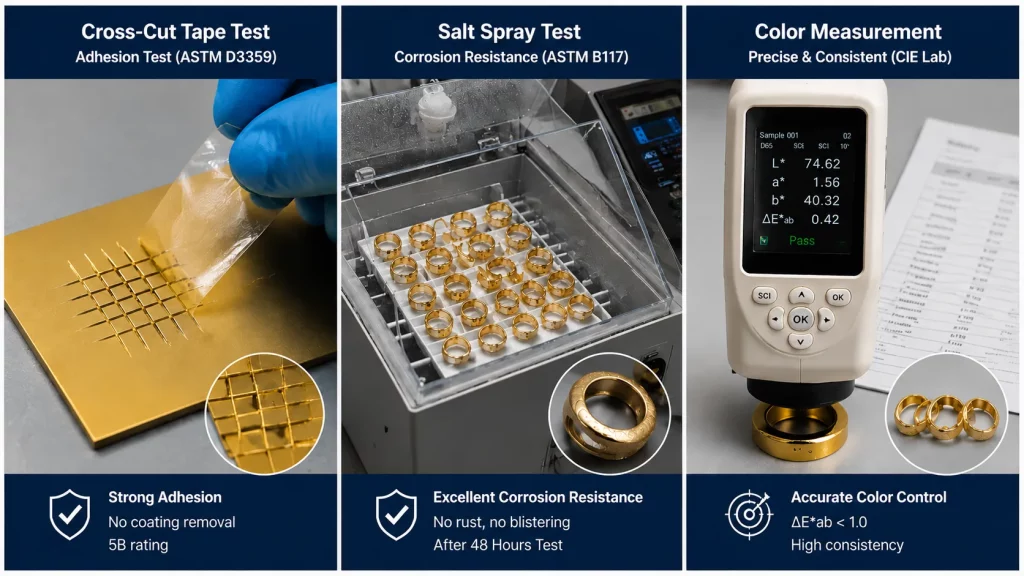
| Test | Method | Standard |
|---|---|---|
Adhesion |
Cross-cut tape test |
No peeling |
Thickness |
X-ray fluorescence (XRF) |
Within spec |
Color Accuracy |
Colorimeter |
ΔE < 1.0 |
Corrosion Resistance |
48–72 hours, no corrosion | |
Wear Resistance |
Rub test |
500 cycles, no base metal exposure |
PVD Coating Lifespan Factors
In our experience, PVD-coated stainless steel jewelry lasts 5–10 years under normal wear. Key factors influencing lifespan:
| Factor | Impact | Mitigation |
|---|---|---|
Coating Thickness |
Thicker = longer life |
Specify 0.07-0.3 μm for high-wear items |
Wear Environment |
Abrasives accelerate wear |
Educate end users on care |
UV Exposure |
Prolonged direct sunlight may fade |
Store away from direct light |
Cleaning Method |
Harsh chemicals damage coating |
Neutral cleaners, soft cloth |
Coating Material |
TiN, ZrN, DLC offer highest hardness |
Select appropriate coating for use case |
Why Is PVD More Valuable for Your Brand Than Electroplating?
Technical Comparison
| Dimension | PVD Vacuum Plating | Traditional Electroplating |
|---|---|---|
Process Environment |
Vacuum |
Aqueous solution |
Coating Thickness |
0.03–0.3 μm |
10–30 μm |
Adhesion |
Atomic-level, extremely strong |
Mechanical, moderate |
Hardness Increase |
1500–3000 HV |
Negligible |
Wear Resistance |
Excellent |
Moderate |
Environmental Impact |
Zero discharge |
Heavy metal wastewater |
Color Options |
Wide, customizable |
Limited |
Cost |
Higher |
Lower |
Typical Application |
Premium jewelry, watches |
Decorative hardware, fast fashion |
Why PVD Delivers Better Brand Value
- Longevity: PVD outlasts electroplating by years, reducing returns and warranty claims
- Color Stability: PVD colors remain consistent across production batches and over time
- Compliance: PVD meets REACH and Prop 65 requirements without chemical post-treatment
- Hypoallergenic: Full encapsulation of base metal prevents nickel exposure
- Premium Perception: The depth and richness of PVD finishes command higher retail prices
At Haosen, we utilize PVD vacuum plating for stainless steel (0.03–0.3 μm) and ensure every piece passes a rigorous
48–72-hour salt spray test—our standard for tarnish-free guarantees.
Summary & Selection Guide
Quick Selection Matrix
| Product Type | Recommended Coating | Thickness | Key Priority |
|---|---|---|---|
Fashion Jewelry (Bulk) |
IP Gold / Rose Gold |
0.03–0.06 μm |
Cost-effectiveness, color variety |
High-End / Luxury |
18K/24K Gold |
0.07–0.3 μm |
Wear resistance, color richness |
Men’s Jewelry |
Black / DLC |
0.07–0.3 μm |
High hardness, scratch resistance |
Dual-Color Designs |
Masking or Component Assembly |
Per color zone |
Clean color separation |
Sensitive Skin |
Any PVD (full coverage) |
0.04–0.3 μm |
Nickel-free, complete encapsulation |
Vintage / Retro |
Gunmetal / Coffee |
0.04–0.06 μm |
Color saturation |
Cost-Saving Strategies
- Single Color First: Dual-color PVD costs significantly more than single-color. Start with single-color designs when testing new collections.
- Simplify Masking: If dual-color is required, consider component assembly over masking for complex geometries.
- Surface Finish Pre-PVD: All polishing, brushing, and texturing should be completed before PVD—post-PVD surface work damages the coating.
- Batch Production: PVD is most cost-effective in larger batches. Our flexible MOQs typically range from 30–120 pieces, with some single-color designs starting at 30 pieces per design help emerging brands scale efficiently.
- Material Selection: 304 stainless steel offers the best value for most applications. Upgrade to 316L only when marine-grade corrosion resistance or medical-grade certification is required.
Technology Trends
- Low-Temperature PVD: 20–200°C processes now enable plating on thin-walled and complex designs without deformation.
- Antimicrobial PVD Coatings: Emerging technologies like Ionbond’s Barrion Beach series combine decorative finish with antimicrobial properties.
- Mature Multi-Color PVD: Masking techniques continue to improve, with higher yields and cleaner color boundaries.
- Sustainability-Driven Shift: As environmental regulations tighten, PVD is increasingly replacing traditional electroplating across the industry.
Frequently Asked Questions (FAQ)
Q1: What is PVD plating in custom jewelry
PVD (Physical Vapor Deposition) is a high-tech vacuum plating process that molecularly bonds metal to 316L stainless steel. For custom jewelry brands, it provides a surface 10x harder (1500-3000 HV) than electroplating, ensuring a tarnish-proof finish that justifies premium pricing and minimizes returns.
Q2: How long does PVD plating last on stainless steel jewelry?
Under normal wear conditions, PVD-coated stainless steel jewelry typically lasts 5–10 years. Factors like wear environment, coating thickness, and coating material affect actual lifespan.
Q3: Do you offer Flexible MOQ for PVD jewelry?
We support a Low MOQ of 30 pairs for your first order. We offer a rapid 7–14 day sampling window for new designs, followed by a reliable 25–45 day lead time for bulk production at Haosen.
Q4: Is PVD jewelry safe for people with nickel allergies?
Yes. A fully applied PVD coating completely encapsulates the stainless steel base, preventing nickel ions from reaching the skin. We verify this through Nickel Release Testing per REACH standards.
Q5: Does PVD plating turn skin green?
No. Green skin discoloration is caused by copper oxidation from copper-based alloys. PVD-coated stainless steel contains no copper and is fully encapsulated, eliminating this risk.
Q6: What is the difference between PVD and IP plating?
IP (Ion Plating) is the Japanese term for PVD. They refer to the same technology—physical vapor deposition in a vacuum environment.
Q7: What is your typical lead time for PVD-plated jewelry?
Our standard production lead time is 20–30 working days, including PVD processing. Sampling takes 2–4 weeks depending on design complexity.
Q8: Can PVD be applied to other metals besides stainless steel?
Yes. PVD works well on titanium, tungsten, and with pre-treatment on brass and zinc alloy. However, adhesion is strongest on stainless steel and titanium.
Q9: Do you provide compliance testing for PVD-plated jewelry?
Q10: Can you match a specific Pantone color with PVD?
PVD colors are created through specific coating materials rather than pigment mixing. While we can match standard colors like gold, rose gold, black, and gunmetal, custom color matching requires development time and is subject to the limitations of available target materials.
Q11: How should customers care for PVD-plated jewelry?
Recommend storing away from direct sunlight, cleaning with a soft cloth and mild soap, avoiding harsh chemicals, and removing before swimming or heavy exercise to maximize lifespan.
Q12: What is the minimum order quantity for custom PVD-plated jewelry at Haosen?
We offer flexible MOQs starting at 30 pieces per design, single color. This allows emerging brands to test collections without large inventory commitments.
Ready to Source PVD-Plated Stainless Steel Jewelry?
If you’re looking for a manufacturing partner who understands both the technical details and the market realities of PVD-plated jewelry, we’re here to help.
- 📧 Email: service@96jewelry.com
- 📞 Phone: +86 13825706718
- 🇺🇸 U.S. Showroom: 3802 Main Street Suite 3, Chula Vista, CA 91911 | Tel: +1 619-358-0328
Or visit our website to request samples, download compliance reports, or schedule a consultation with our engineering team.
Author

Ertian Jiang (Jasper) is the founder of Haosen Metal Jewelry. Since the age of 26, he has combined deep roots in traditional craftsmanship with a sharp vision for the market to build the foundation of the company’s excellence.
Ertian Jiang started on the ground floor as a craftsman, specializing in semi-precious stones (agate, mother of pearl, tiger’s eye) and manual inlaying—perfecting how to fit natural stones into metal bases without gaps or glue failure. He also worked on the front lines of sales, speaking face-to-face with buyers and listening to their frustrations about fallen stones and fading colors.