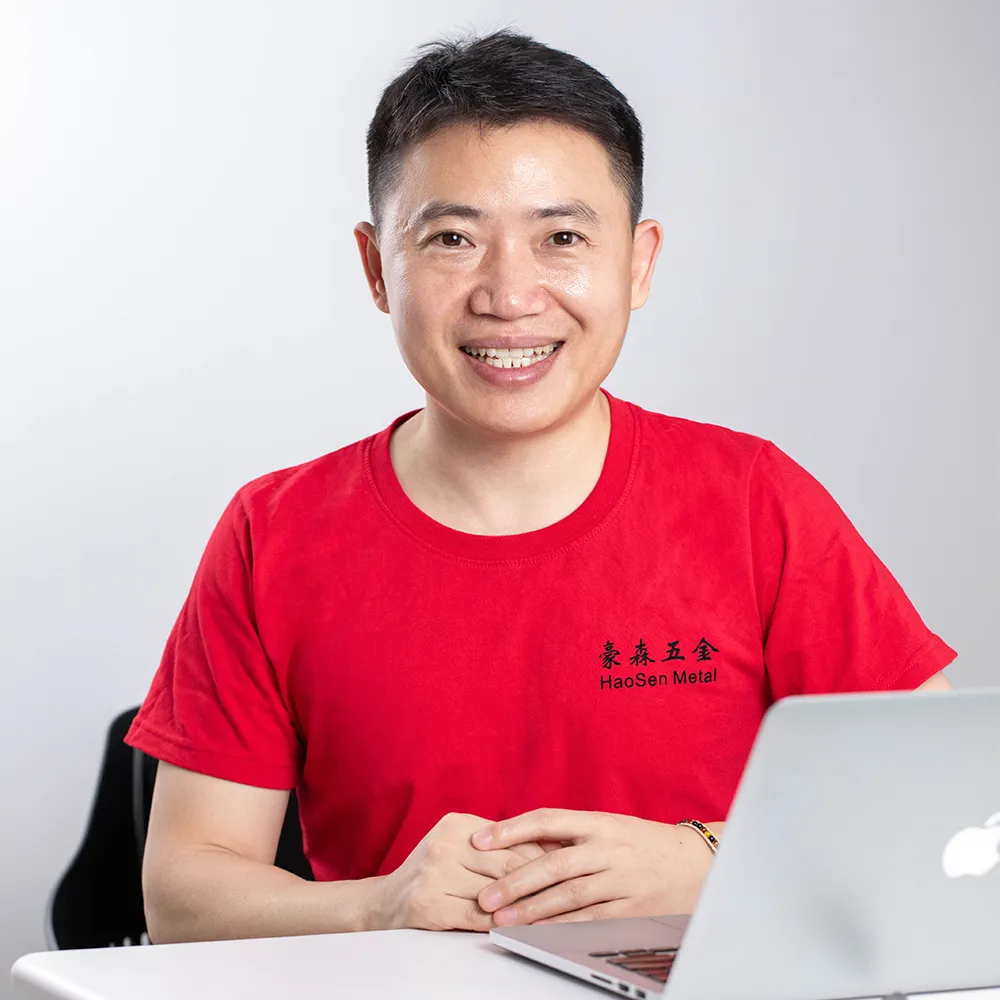

When you look for a fashion jewelry manufacturer in Guangdong, China, you aren’t just looking for a supplier—you’re looking for a partner who won’t let you down during the peak season.
After 16 years of managing production and quality control in the heart of China’s B2B jewelry industry, I’ve seen countless international brands struggle. They often fail not because the factories are “bad,” but because they chose a factory that didn’t match their specific scale or OEM material needs. For instance, a factory built for silver casting may struggle to meet the precision required of a dedicated 316l stainless steel jewelry manufacturer. In this guide, I will break down the “Industry Map” of Guangdong and show you exactly how to find the factory that fits your brand like a glove.
Where Are the Best Jewelry Manufacturing Clusters Located in Guangdong?
Guangdong is the world’s jewelry powerhouse, but it is highly segmented. In supply chain economics, this is known as Industrial Agglomeration.The province accounts for over 70% of China’s total jewelry production value.
Each town has its own “DNA.” If you go to the wrong town, you will pay more for lower quality because the local supply chain (platers, mold makers, stone setters) isn’t optimized for your specific material.
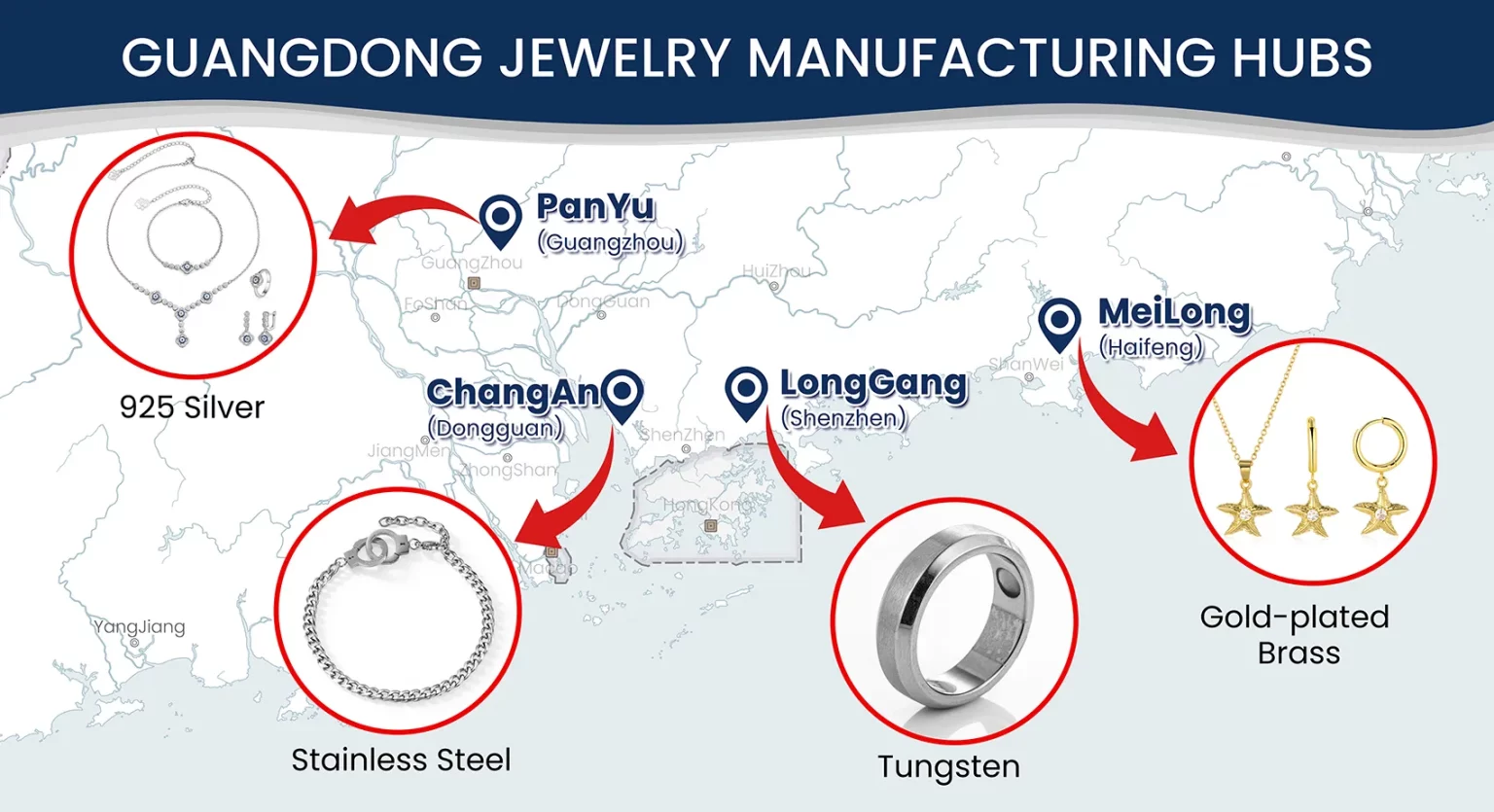
| Location | Core Materials | Best For | Industry Characteristic |
|---|---|---|---|
Panyu (Guangzhou) |
925 Silver / Fine Gold |
Luxury-grade finish |
High-end export “Gold Standard” |
Changan (Dongguan) |
Stainless Steel / Zinc Alloy |
Durable fashion jewelry |
Global hub for massive volume |
Longgang (Shenzhen) |
Tungsten / Titanium |
High-precision CNC |
Industrial-grade innovation |
Meilong (Haifeng) |
Gold-plated Copper |
Cost-efficiency |
“The Speed King” for mass market |
Why is Panyu the Hub for 925 Silver & Fine Gold?
Panyu’s dominance began in the 1980s when Hong Kong jewelers moved production across the border. Today, it remains the specialized hub for Micro-Pave Setting and lost-wax casting. If your design requires stones that don’t fall out after 3 months, you need Panyu’s skilled labor pool.
Why Choose Changan for Stainless Steel & Zinc Alloy Production?
Changan’s jewelry industry evolved from its mold and hardware background. This means their tolerance control in CNC machining is superior, often reaching precision levels of ±0.02mm (the standard execution precision for Dongguan’s stainless steel jewelry industry). Learn more about Dongguan Haosen Stainless Steel Jewelry Factory
What Makes Meilong the Efficiency Beast for Mass Market?
Meilong processes a staggering volume of silver and copper. However, be aware that their water treatment and environmental compliance levels vary; ensure your supplier there uses a licensed centralized plating park.
How Do You Ensure Plating Quality and Material Compliance in Guangdong, China?
One of the biggest reasons OEM brands fail is a lack of technical communication. You cannot simply ask for “gold plating.” You must specify the parameters in accordance with international jewelry standards such as ISO 10713:2025 (Gold alloy coatings).
In Guangdong, you must specify the micron thickness and the undercoat:
- Flash Plating (<0.1 microns): Only suitable for short-term fashion jewelry.
- Boutique Quality (0.5 – 1.0 microns): The standard for most mid-tier “Gold Vermeil” brands.
- High-End/Vermeil (2.5 microns+): Required by US and EU standards to officially use the term “Vermeil.”
- PVD vs. Electroplating: For Stainless Steel (Changan hub), the standard is PVD (Physical Vapor Deposition). Unlike traditional electroplating, PVD is performed in a vacuum chamber and results in a coating that is highly resistant to sweat and seawater. For Silver (Panyu hub), factories use Electroplating, usually with a Palladium or Rhodium barrier layer to prevent the base silver from oxidizing the gold top layer.
Are Your Suppliers Truly REACH and Prop 65 Compliant?
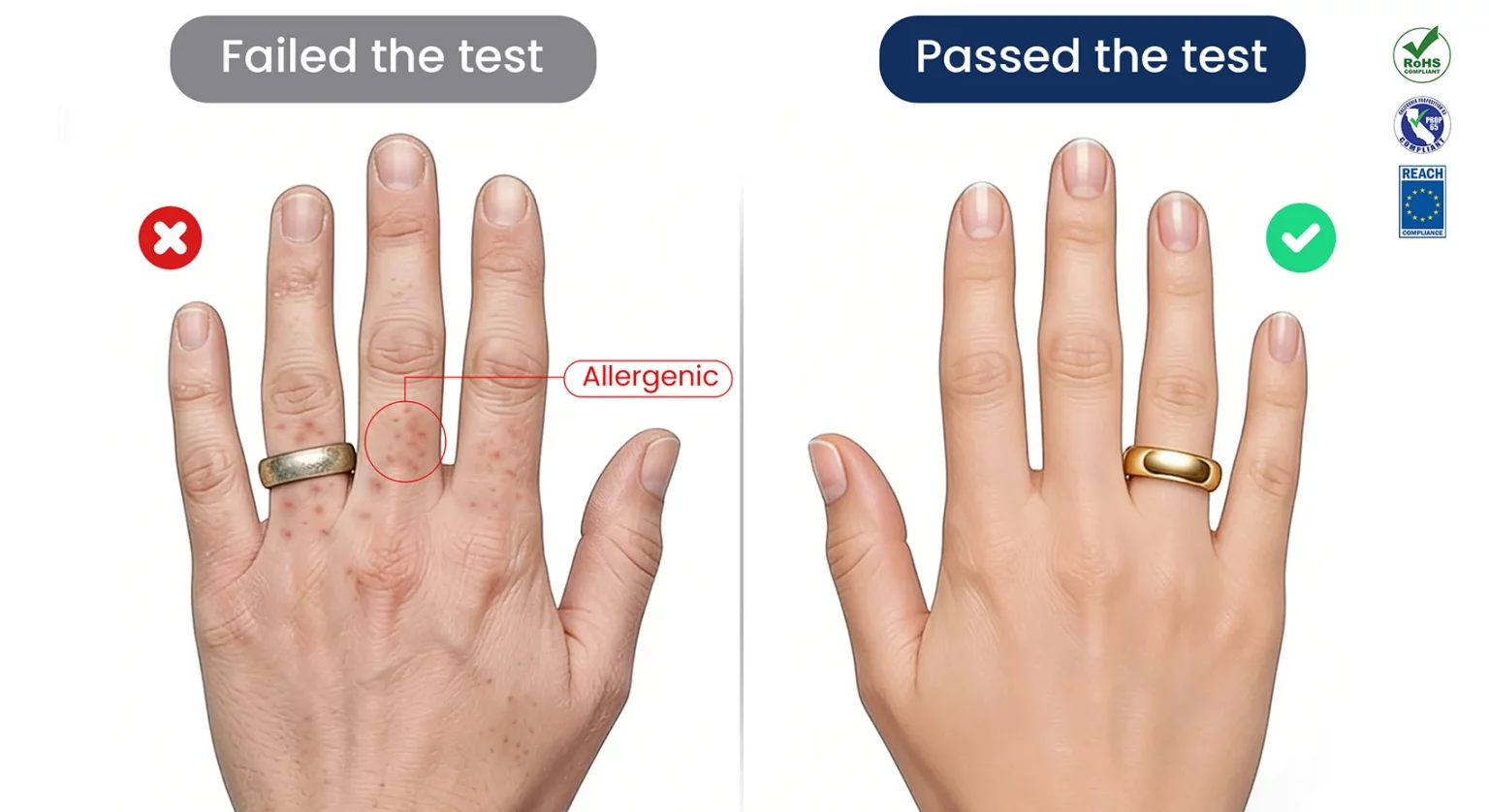
China’s GB/T 28480-2012 aligns closely with EU REACH standards, as defined by the European Chemicals Agency (ECHA) and the California EPA. However, you must verify:
- Lead Content: Must be <100 ppm (parts per million).
- Cadmium Content: Must be <100 ppm.
- Nickel Release: Essential for “hypoallergenic” claims. Nickel is the top cause of contact dermatitis in jewelry. A reliable B2B factory will provide Nickel Release Testing reports via a third-party lab like SGS or ITS. Click here to view our test report
Which Type of OEM Jewelry Factory Best Matches Your Brand's Scale?
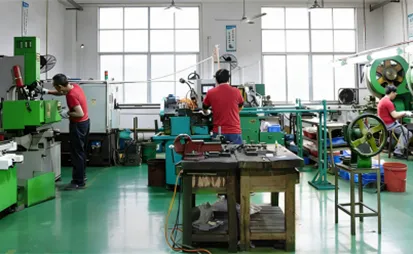
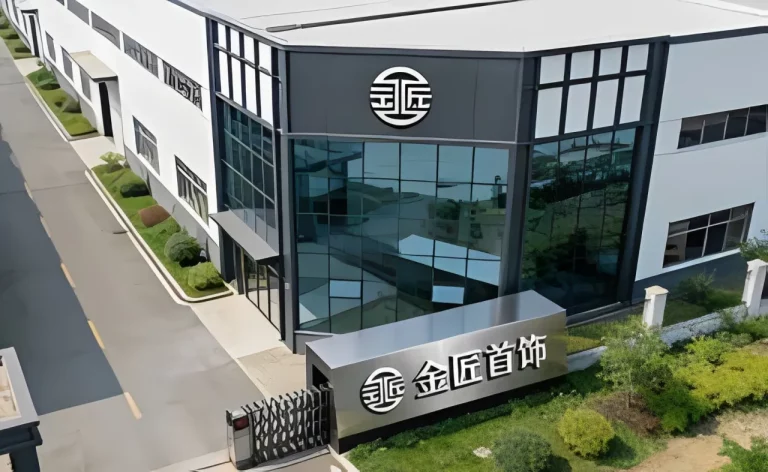
A common mistake is a startup trying to work with a factory that produces for giant retailers. You won’t get the attention you need.
- The Emerging Brand (MOQ 50 pcs/style): Work with a Professional Sourcing Agency. A factory with 500 people will deprioritize your small order. An agency pools multiple small brands together to gain collective bargaining power and acts as your on-site Quality Assurance (QA).
- The Established Brand (MOQ 300+ pcs/style): Work with Medium-Sized Factories (100-300 employees). They have BSCI or Sedex audits, in-house CAD designers, and can turn a sketch into a sample in 7-10 days.
- The Enterprise Retailer (MOQ 10,000+ pcs/style): Work with Manufacturing Giants. You are buying a Risk Management System. These factories have in-house laboratories to test Tension/Pull strength, Salt Spray resistance, and Color Consistency using spectrophotometers.
How Can You Spot a Reliable B2B Jewelry Supplier in Just 5 Minutes?
Beyond the flashy showroom, look for these three hard indicators:
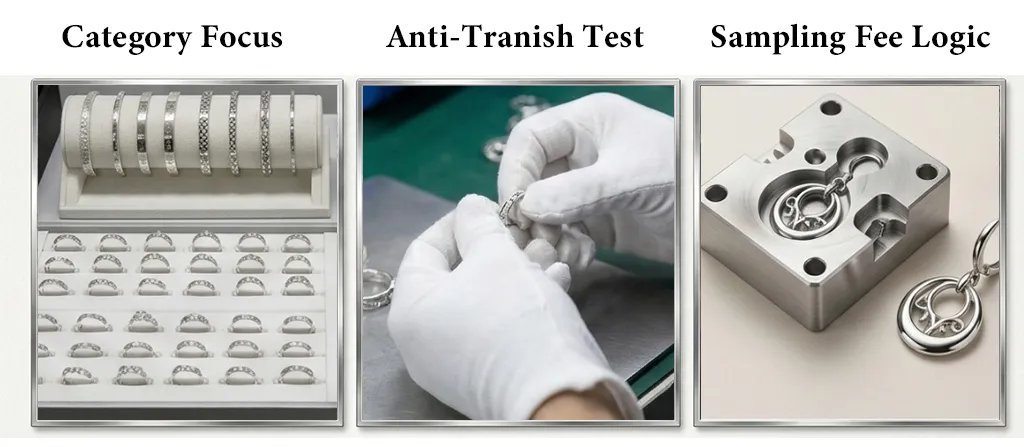
- The Specialization Test: If a factory’s catalog includes 925 silver, 316L steel, leather bracelets, and sunglasses, they are a trading company, not a factory. Specialization equals quality.
- The “Scuff Mark” & Oxidation Test: Ask: “What is your protocol for anti-tarnish storage?” A professional factory will mention Intercept Technology or 3M Anti-tarnish strips. They handle items with gloves to avoid finger oils, which cause early tarnishing.
- The Sampling Fee Logic: In Panyu, a silver mold typically costs $30 – $60 USD. In Changan, a steel mold can cost $300 – $800 USD because it requires harder steel for stamping. If a supplier offers “Free Molds” for steel jewelry at low volumes, they are likely using Zinc Alloy as a substitute—a major red flag.
What Are the Hidden Sourcing and Logistics Costs You Must Avoid?
Don’t be blinded by the Unit Price (EXW). You must calculate the Landed Cost.
- Defect Rate: In the jewelry industry, an AQL (Acceptable Quality Level) of 1.5 or 2.5 is standard. If your factory has a 5% defect rate, your “cheap” unit price just increased by 5%.
- Logistics : While some use informal channels to save on taxes, always use Official Customs Clearance (General Trade) for large orders to ensure you have a legal Certificate of Origin. This can reduce import duties in certain “Most Favored Nation” (MFN) countries.
Summary: Building a "Resilient" Supply Chain
Sourcing fashion jewelry in China is no longer about finding the lowest price—it’s about finding the correct cluster and the right technical fit. Choose Panyu for luxury silver, Changan for durable 316L stainless steel jewelry, and Meilong for mass-market pricing. When you align your brand’s scale with the right factory’s DNA, you get a supply chain that grows with you.
FAQs
Basic Questions About Customizing Jewelry
Q1: What Is the Minimum Order Quantity (MOQ) for Custom Jewelry
To support emerging brands, e-commerce sellers, and designer jewelry labels, we offer a low MOQ policy to help you start with small-batch production:
Jewelry: MOQ is 30 pairs per design, single color
This flexible MOQ is ideal for brands testing new collections, launching products, or creating limited editions.
For large wholesale buyers and established brands, we also provide bulk order discounts—the higher the quantity, the lower the unit cost, maximizing your profit margin.
Q2: What Customization Options Do You Offer for Jewelry?
Jewelry offers a wide range of customization options. Our common OEM/ODM services include:
- Design & Structure Customization– New development or style modification based on sketches or 3D files.
- Material Selection– Stainless steel, brass, zinc alloy, titanium, tungsten, and more.
- Surface Finishing– Polishing, brushed texture, sandblasting, matte effects, etc.
- Color & Plating Options– (PVD/Electroplating) gold, rose gold, black finishes, plus enamel/epoxy Resin filling for enhanced visual depth.
- Logo Engraving & Branding– Laser engraving, stamping, etching, color-filled, or plated logos.
- Stones & Decorations– CZ stones, natural gemstones, crystals, pearls, and other embellishments.
- Size & Specifications– Custom length, width, thickness, and detailed measurements.
- Packaging Customization– Jewelry cards, gift boxes, and fully branded packaging solutions.
Customization helps strengthen brand identity and is especially suitable for designer brands, cross-border e-commerce sellers, and bulk jewelry production.
Q3: Can I Order Samples Before Placing a Bulk Order?
Yes, we highly recommend ordering samples before mass production to verify product quality and avoid risks.
Sample Ordering Process:
Design submission → Material & finish confirmation → Quotation (sample fee + mold fee if needed + shipping) → Payment → CAD/3D design (1–3 days, 2 free revisions) → Sample production (5–15 days) → Polishing & plating → Quality inspection → Shipping (3–7 days)
Sample Cost & Lead Time:
- Sample fee: USD 50–200 per style
- Mold fee (if required): USD 100–500
- Shipping fee:USD 30–80
Total sample delivery time: 2–4 weeks
Q4: What is the Production Lead Time for Bulk Jewelry?
Our standard bulk production lead time is 20–30 days, depending on the design complexity and order quantity. In general, mass production for jewelry orders takes around 15–45 days, based on the factors below:
- Jewelry type & craftsmanship:Simple designs usually take 15–25 days, while stone-set or highly customized styles may require 30–45 days.
- Order quantity:Larger wholesale orders need more time for scheduling and quality inspection.
- Mold or sampling requirement:New styles may need an additional 7–15 days for mold development and sample approval.
- Material & stone availability:Lead time may vary based on raw material and gemstone supply.
- Factory capacity & peak seasons:Production schedules can be affected during busy periods.
To shorten lead time and improve on-time delivery, we recommend confirming designs early, placing consolidated orders, and working with a reliable stainless steel jewelry manufacturer like Haosen with a stable supply chain and efficient production management.
Q5: Are Your Jewelry Tested and Compliant with International Standards?
Yes. All of our jewelry undergo strict quality testing and meet international compliance standards for global export.
Common certifications and tests include:
- REACH / RoHS compliance
- Heavy metal testing (Nickel, Lead, Cadmium)
- Physical durability tests: corrosion resistance, oxidation protection, and abrasion tests
- Third-party inspection support: SGS, TÜV, BV, etc.
We can provide customized testing solutions and reports based on your target market (EU, USA, Middle East, etc.).
Q6: What Are Your Payment Terms?
We offer flexible payment terms depending on the cooperation model:
- Bulk orders:30% deposit + 70% before shipment
- Custom or mold orders:50% deposit + balance after sample approval
- Long-term partners:Monthly settlement or staged payment options available
Supported payment methods: T/T bank transfer, Alipay, PayPal (for small sample orders)
Q7: Do You Provide Worldwide Shipping? What Shipping Methods Are Available?
Yes, we ship globally to North America, Europe, Australia, the Middle East, and Asia.
Available shipping options include:
- Express courier (DHL/UPS/FedEx):best for samples or small orders
- Air freight:balanced speed and cost for medium replenishment
- Sea freight:lowest cost for large wholesale shipments
- Amazon FBA direct shipping:labeling, carton splitting, packing list support
We also assist with customs clearance documents, HS codes, and Incoterms (EXW/FOB/CIF/DDP).
Q8: What if there are quality issues after receiving the goods?
If you discover quality issues after receiving the goods, we provide comprehensive after-sales service and quality assurance solutions. The common process is as follows:
Problem confirmation: Please provide pictures or videos explaining the problem within the specified time after receiving the goods.
- Cause determination:Distinguish between manufacturing defects, transportation damage, or usage factors.
- Solution:Provide replacement, repair, or refund depending on the situation.
- Responsibility:We will be responsible for the costs incurred due to manufacturing quality problems.
Our quality assurance measures include pre-shipment inspection, a sample retention system, and traceable production records to minimize after-sales risks.
Hasoen’s comprehensive after-sales mechanism aims to enhance cooperation security, making it particularly suitable for bulk purchases of stainless steel jewelry, cross-border e-commerce, and brand collaborations.
Frequently Asked Questions about the Article
Q1. Who owns the mold after I pay the sampling/mold fee?
In a standard professional B2B agreement in Guangdong, the client (you) owns the intellectual property and the physical mold. At Haosen Jewelry, we store your exclusive molds in a temperature-controlled library for repeat orders, but they will never be used for other clients without your authorization.
Q2. How do you handle production delays during the Chinese New Year or peak seasons?
Guangdong’s clusters are highly efficient, but the “Golden Month” around Chinese New Year can halt production. We recommend placing “Peak Season” orders (for Q4) at least 90 days in advance. A resilient supply chain partner should provide a production schedule that accounts for these national holidays.
Q3. Can I mix different materials (e.g., Stainless Steel and 925 Silver) in one order?
While clusters are specialized (Changan for steel, Panyu for silver), a professional OEM partner can coordinate cross-material collections. However, be aware that the plating processes differ: stainless steel uses PVD, while silver uses Electroplating. Mixing them requires strict QC to ensure color consistency across the entire collection.
Q4. What is the standard "Defect Rate" for handmade versus CNC jewelry?
Handmade processes like micro-pave setting in Panyu naturally have a slightly higher variance than CNC-machined steel from Changan. While the industry standard AQL is 1.5 to 2.5, CNC-produced items often achieve higher precision with a lower defect rate. Always clarify if “Defect Rate” refers to functional or purely aesthetic minor flaws.
Q5. How do you protect my original designs from being leaked to competitors?
This is the biggest concern for OEM brands. Beyond signing an NNN (Non-Disclosure, Non-Use, and Non-Circumvention) agreement, a reliable factory limits access to CAD files and restricts photography in the production area. We treat your designs as trade secrets from the initial sketch to the final delivery.
Not Sure Which Factory Fits Your Scale?
Don't let a "mismatched" supply chain drain your budget or delay your launch. With 16 years of hands-on production management in Guangdong’s jewelry hubs, I help B2B brands identify the exact factory—from Panyu’s luxury silver masters to Changan’s high-precision steel experts—that aligns with your specific volume and technical needs. Let’s bridge the gap between your design and a flawless delivery.
Get a Free Sourcing ConsultationAuthor

Ertian Jiang (Jasper) is the founder of Haosen Metal Jewelry. Since the age of 26, he has combined deep roots in traditional craftsmanship with a sharp vision for the market to build the foundation of the company’s excellence.
Ertian Jiang started on the ground floor as a craftsman, specializing in semi-precious stones (agate, mother of pearl, tiger’s eye) and manual inlaying—perfecting how to fit natural stones into metal bases without gaps or glue failure. He also worked on the front lines of sales, speaking face-to-face with buyers and listening to their frustrations about fallen stones and fading colors.