
Using the same plain ring design, 96Jewelry explains how raw materials, turning, polishing, and coatings work together to shape a quote.
If you make the same ring from stainless steel, which costs less as a raw material, will the manufacturing cost necessarily be lower?
Not necessarily. For a simple plain ring that can be turned from tubing in either material, the higher raw material cost of brass may be offset by lower machining and polishing costs. The final costs may be similar, or they may diverge because of different coating requirements.
For brand buyers, the comparison that matters is how each material must be processed to meet the same design, appearance, and acceptance requirements, and what the final delivered cost will be.
This article explains that assessment using production experience and examples of process costs supplied by 96Jewelry. The amounts illustrate the cost structure and do not constitute a quote for a specific project.
Define the Same Ring Before Comparing Costs
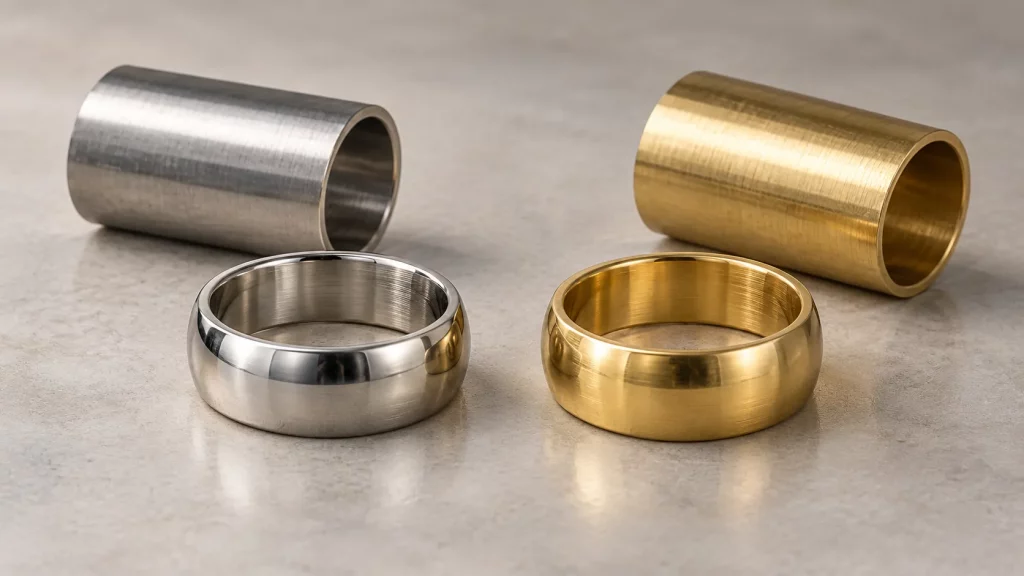
This discussion concerns a simple, plain, all-metal ring with the following specifications:
- No stones, complex openwork, or soldered structures;
- Both stainless steel and brass can be formed by turning metal tubing;
- The same ring size, width, thickness, and edge profile requirements;
- A surface that meets the agreed mirror finish;
- A gold-colored final appearance.
The forming route is the same for both options, but the surface treatment may differ. This example considers PVD for stainless steel and electroplating for brass.
The same gold-colored appearance does not imply the same coating structure, actual gold-layer thickness, or durability. These conditions still need to be confirmed separately.
Rings of the same dimensions made from these two materials will also generally have different weights. The calculations below use 6 grams for both solely to demonstrate the value of the raw metal. Actual costing should use each material’s real finished weight and material input.
Why More Expensive Brass Does Not Always Mean a More Expensive Ring
| Matériau | Example price | Price per gram | Net metal value at 6 g |
|---|---|---|---|
Stainless steel |
CNY 40,000 per metric ton |
CNY 0.04 |
CNY 0.24 |
Brass |
CNY 70,000 per metric ton |
CNY 0.07 |
CNY 0.42 |
These prices are for illustration only. They do not represent current market quotes and do not specify particular material grades or tubing dimensions.
Brass costs 1.75 times as much per metric ton as stainless steel in this example, but at 6 grams the difference in net metal value is only about CNY 0.18.
This does not mean that actual material purchasing costs differ by only CNY 0.18. In addition to the finished net weight, costing must account for tubing dimensions, machining allowance, cut-off losses, purchasing costs, and scrap recovery value.
The point is that, for a lightweight ring, the percentage difference in raw material prices per metric ton cannot be applied directly to the finished product quote.
A change in machining, polishing, or coating costs alone may offset that raw material difference.
Turning Efficiency Can Change the Raw Material Cost Advantage
Using turning for both materials does not mean that their machining costs are the same.
For the type of product discussed here, stainless steel requires more machining time. Although brass has a higher raw material price, it can be machined faster. As a result, the cost of producing an acceptable ring blank in each material may be closer than the raw material prices alone suggest.
Actual costing should also examine:
| Costing factor | Why it affects cost |
|---|---|
Material grade |
Different grades may have different machining characteristics |
Tubing inner and outer diameters |
The closer they are to the finished dimensions, the less material generally needs to be removed |
Machining time |
Determines equipment and labor cost allocation per piece |
Tool consumption |
Affects ongoing production costs and time spent changing tools |
Order quantity and ring size allocation |
Affects setup, size changes, and production batches |
Dimensional and appearance requirements |
Affects process control and the proportion of acceptable pieces |
When comparing quotes, buyers can therefore move beyond asking how much the material costs per kilogram and ask:
How much does it cost to turn each material into a ring blank that meets the requirements?
Materials and machining may be quoted together or shown separately. Either way, the total must use a consistent basis and avoid double counting.
Mirror Polishing Can Take Significant Time Even for a Plain Ring
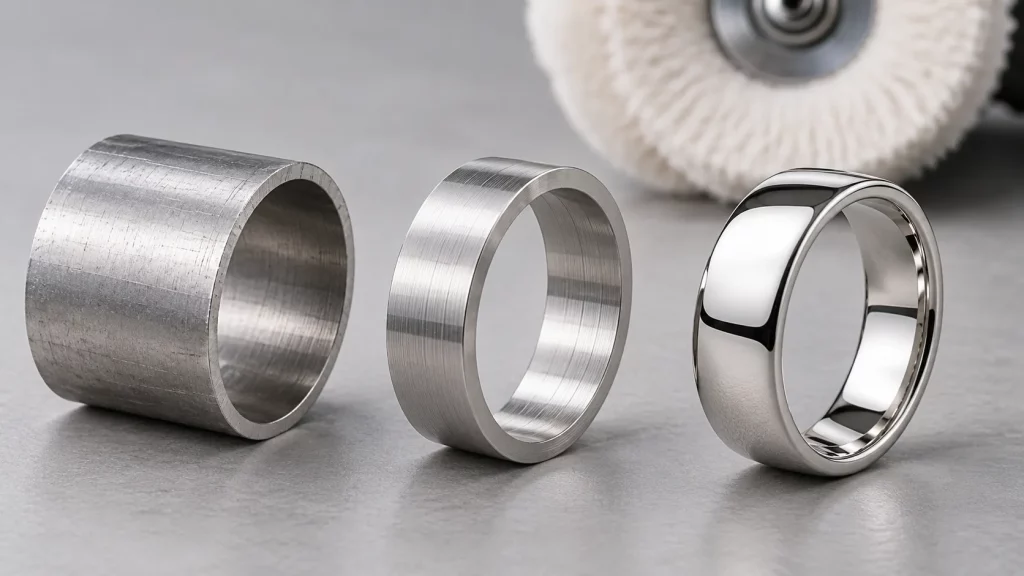
A plain ring may look simple, but there are no textures or stones to conceal surface imperfections. Tool marks, fine scratches, waviness, and edge finishing all affect the final appearance.
The process estimates supplied for this example are:
| Processus | Stainless steel ring | Brass ring |
|---|---|---|
Labor for mirror polishing |
About CNY 2 per piece |
About CNY 1 per piece |
In this example, achieving the target mirror finish on stainless steel takes more labor time, resulting in a higher polishing cost.
This ratio cannot be applied to every ring. Costs can change with the treatment required for wide flat surfaces, curved surfaces, the inner band, and the edges.
When comparing supplier quotes, provide the same approved appearance sample and specify which areas must have a mirror finish and what surface condition is acceptable. Otherwise, two factories may both quote ‘mirror polishing’ while allowing for different amounts of work.
Confirm the Coating Before Comparing Surface Treatment Prices
The surface treatment cost examples supplied are:
| Option | Example cost |
|---|---|
Stainless steel with a gold-colored PVD finish |
About CNY 2 per piece |
Brass with a gold-colored electroplated finish |
About CNY 3 per piece |
| Finishing item | Stainless steel ring | Brass ring |
|---|---|---|
Mirror polishing |
About CNY 2 |
About CNY 1 |
Surface treatment |
About CNY 2 |
About CNY 3 |
Subtotal for these two items |
About CNY 4 |
About CNY 4 |
In this example, the finishing costs happen to be equal. This is only an arithmetic comparison of the listed costs; it does not establish that the coating specifications or finished product performance are equivalent.
A formal inquiry should specify:
- Whether the target is a gold-colored appearance or an actual gold layer of a specified fineness;
- Whether thickness is expressed in micrometers (μm);
- Whether that thickness refers to the actual gold layer, a particular functional layer, or the entire coating system;
- Whether base layers, barrier layers, and protective layers are included;
- Which sample or testing requirements will determine final acceptance.
Without these details, ‘gold plating at CNY 2’ and ‘gold plating at CNY 3’ may refer to different product requirements. It is then impossible to judge directly which offers better value.
Why This Example Does Not Give One Finished Product Price
The material and turning costs, production quantities, and coating specifications have not yet been defined on a complete and consistent costing basis.
Presenting a fixed total as the conclusion could lead buyers to assume that it applies to all similar custom rings.
For a specific project, complete costing should confirm at least the following:
| Cost item | Details to confirm |
|---|---|
Materials and turning |
Material grade, tubing dimensions, material input, machining time, and quantity |
Polissage |
Surface condition and acceptance sample |
Surface treatment |
Color, coating structure, thickness, and testing requirements |
Quality and losses |
How inspection, rework, and rejected pieces are accounted for |
Packaging and other costs |
Packaging method, tax inclusion, shipping, and quotation terms |
The conclusion supported by this example is therefore:
Finished costs for the two materials may be similar, but they must be calculated against the same product requirements. Material selection cannot be based on raw material prices per metric ton alone.
If you already have a ring design, send images or drawings, the expected quantity, and your target color to 96Jewelry. We can assess whether both materials are suitable and identify the main cost drivers for each.
Compare Material Options for My Ring
Changes That Can Widen the Cost Gap Again
Changing to a Silver Appearance
Specifying a Thicker Actual Gold Layer
Adding Stones Openwork or Deep Relief
Reducing Order Quantities or Adding Ring Sizes
Tightening Mirror Finish and Dimensional Acceptance Requirements
How Brands Can Choose When Costs Are Similar
First, which option better meets your product specifications?
Second, which option can more consistently match the approved sample?
Third, will future pieces in the collection use the same design approach?
If the collection also includes stone-set rings, complex shapes, or different surface finishes, confirm the process for each design. Avoid extending the conclusion for a simple plain ring to the entire collection.
The aim of material selection is to find an option that consistently meets the product requirements within budget.
Ask 96Jewelry to Assess Your Ring Design
If you are unsure whether to use stainless steel or brass, start by providing:
- Product images, design drawings, or a reference sample;
- Expected order quantity;
- Target color;
- Target purchasing price, if established.
Include dimensions, the ring size breakdown, and coating requirements if available. If the material grade or coating thickness is undecided, describe the desired appearance and product positioning first.
We can assess the following for your design:
- Whether both materials are suitable;
- Which forming and finishing routes each requires;
- Which processes have the greatest effect on price;
- Which changes in requirements would warrant a revised costing.
Submit your ring design to compare stainless steel and brass manufacturing options.
Auteur

Ertian Jiang (Jasper) est le fondateur de Haosen Metal Jewelry. Depuis ses débuts à 26 ans, il associe un solide savoir-faire artisanal à une compréhension fine du marché, deux piliers sur lesquels repose l’excellence de l’entreprise.
Ertian Jiang a commencé comme artisan, spécialisé dans les pierres semi-précieuses (agate, nacre et œil-de-tigre) et l’incrustation manuelle. Il a perfectionné la pose de pierres naturelles sur des supports métalliques, sans jeu ni défaillance de la colle. Son expérience directe de la vente lui a également permis d’échanger avec les acheteurs et de comprendre leurs difficultés face aux pierres qui se détachent et aux couleurs qui s’altèrent.