

Factory Address
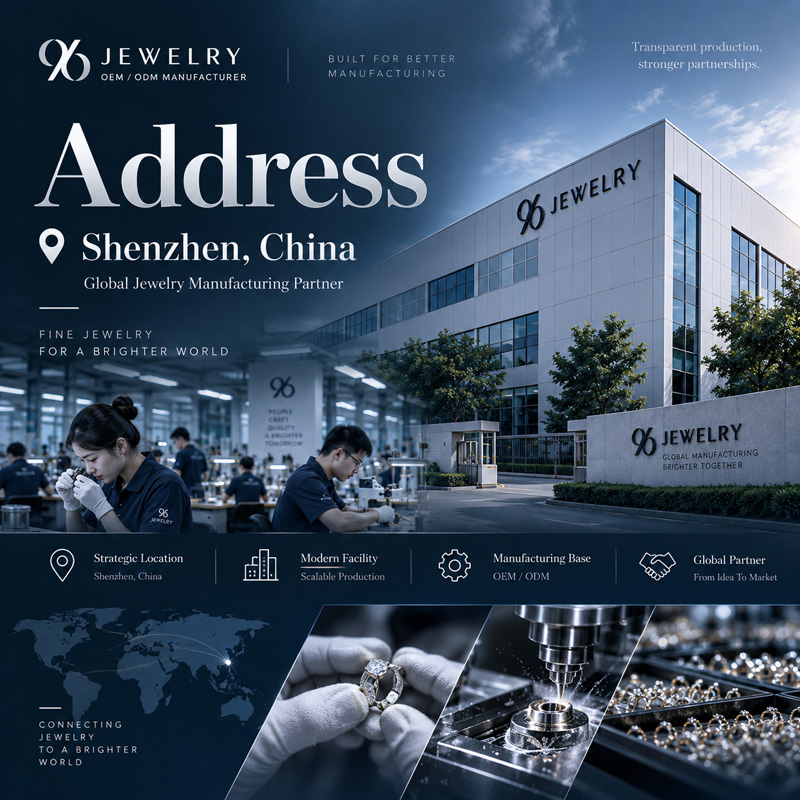
Where Our Jewelry Manufacturing Takes Place
China Manufacturing Base
Our manufacturing facility is located in Chang’an Town, Dongguan, Guangdong Province, China, one of the major manufacturing regions in the Pearl River Delta.
Factory Address
Room 101, No. 2 Zhen Rong Road
Wu Sha, Chang An Town
Dong Guan City, Guang Dong Province
China 523859
The facility supports product development, production coordination, polishing, quality inspection, packaging and showroom review. Buyers can also arrange a live factory video walkthrough to review the production floor, polishing workshop, packaging department and showroom remotely.
Supporting Global Communication
In addition to the China manufacturing base, 96 Jewelry also provides U.S.-based communication and showroom support in Chula Vista, San Diego County, California.
People
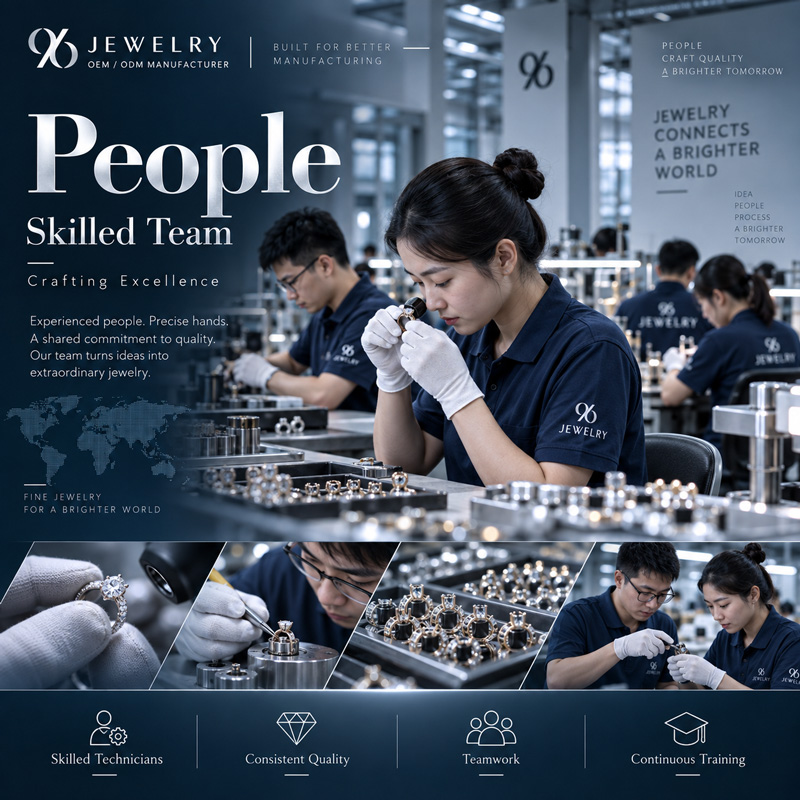
The People Behind Every Production Order
Experienced Teams Across Design, Production and Quality Control
Jewelry manufacturing combines machinery with skilled manual work.
Our operations bring together design, production, customer service and quality-control teams to support projects from initial development through final delivery.
According to our current factory information, department heads typically bring 5 à 10 ans d’expérience dans le secteur, while around 70% of frontline artisans have worked with the company for more than one year.
Quality control is handled throughout production, with an independent 8–12 person QC team supporting stage-by-stage inspection. The factory reports maintaining a defective rate below 1%.
Our Team Supports
| Function | Responsibility |
|---|---|
Conception |
Design feasibility, CAD and 3D development |
Production |
Manufacturing and process execution |
QC |
Incoming, in-process and finished inspection |
Service clients |
Project coordination and after-sales support |
Management |
Production planning and delivery coordination |
Equipment
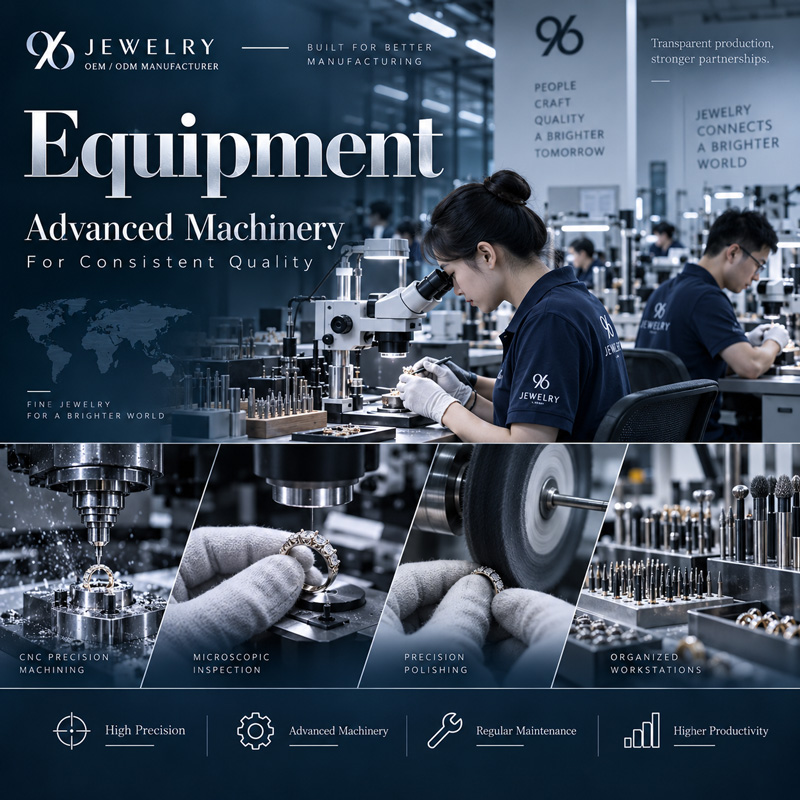
Equipment That Supports Consistent Manufacturing
Production and Testing Tools for Different Jewelry Requirements
Different structures require different manufacturing routes.
96 Jewelry uses multiple manufacturing and inspection technologies to support stainless steel, brass, titanium and other jewelry projects.
Our documented production capabilities include stamping, laser cutting, lathe machining and casting-related production, allowing the manufacturing route to be selected according to structure, tolerance and order requirements.
Quality and testing equipment also includes an EDXRF spectrometer (Thick800A) for non-destructive material and plating analysis, as well as salt-spray, temperature/humidity and transportation-vibration testing equipment.
Our Equipment List
| Equipment Name | Model & Specifications | Quantity | Demande |
|---|---|---|---|
| Material Cutting Machine | LX267 / Straight cutting range: 2–13 mm | 2 units | Material Cutting |
| Lathe (3 units total) | A-2025 | 2 units | |
| M-CK0625BC | 1 unit | ||
| Punch Press (6 units total) | 8T | 2 units | Hot Pressing / Stamping Forming |
| 14T | 1 unit | ||
| 16T | 1 unit | ||
| 30T | 1 unit | ||
| 60T | 1 unit | ||
| Cutting Machine | Y90L-4 / 1400 rpm / 1.5 kW | 1 unit | Cutting |
| Shaping Machine | Y90S-4 / 1.1 kW | 1 unit | Shaping |
| Wet Grinding Machine (2 units total) | 1 station | 1 unit | |
| Dry Grinding Machine | VB-70 / 70 L | 3 units | Grinding |
| Manual Welding Machine | 2X7--200D / High current: 200 A | 1 unit | Welding |
| Grinding Machine | 4 stations | 1 unit | Grinding |
| Ultrasonic Cleaning Machine | Each unit is equipped with a water tank; dimensions (L × W × H): 0.5 × 0.45 × 0.7 m | 2 units | Nettoyage par ultrasons |
| Assembly Workbench | / | 2 benches | Assemblage |
| Manual Punch Press | JG100 / 1T | 1 unit | |
| Electric Oven | / | 1 unit | Drying |
| Precision Engraving Machine | Beijing Jingdiao JDPMS-V08A / 3 axes + 2 travel axes / X400 × Y400 × Z160 mm | 1 unit | Machining |
| Wire EDM Machine | DK7720 / Travel specification: directional travel 200 mm | 1 unit | |
| Grinding Machine | Yuqing 214 / Worktable size: 6 × 14 in | 1 unit | |
| Benchtop Milling Machine | YB-25 / Max. machining diameter: 25 mm | 1 unit | |
| EDM Machine | DF-250 / Travel specification: 250 mm | 1 unit | |
| Drilling Machine | 2Q4116 / Max. diameter: 16 mm | 2 units | |
| Sandblasting Machine | 9060 / 0.75 kW | 1 unit | Sandblasting |
| Tool Grinder | G480 / Grinding wheel diameter: 100 × 50 × 20 mm | 2 units | Maintenance Equipment |
| Bench Grinder | / | 1 unit | |
| Electric Welding Machine | / | 1 unit | |
| LPG Torch Machine | / | 1 unit | Heating |
| Air Compressor | J-08AP / Power: 7.5 kW | 1 unit | / |
| Laser Marking Machine | QN-F20 / 3 kW / Marking area: 110 × 110 mm | 2 units | Marking |
| Laser Welding Machine | Jincheng Laser TL-27 | 2 units | Welding |
| Benchtop Dual-Station Polishing Machine | KXC712-Z / 550 W / 2800 rpm | 8 units | Manual Grinding & Polishing |
| Jewelry Setting Workbench | / | 4 units | Gemstone Setting |
| Wax Injection Machine | Fengshenghang SDVW1-1 / 800 W | 2 units | Jewelry Wax Injection |
| Chain-Making Machine | / | 4 units | Chain Weaving |
Procédé de fabrication
From Material to Finished Jewelry
A Structured Production Workflow
A consistent finished product depends on controlling more than the final inspection.
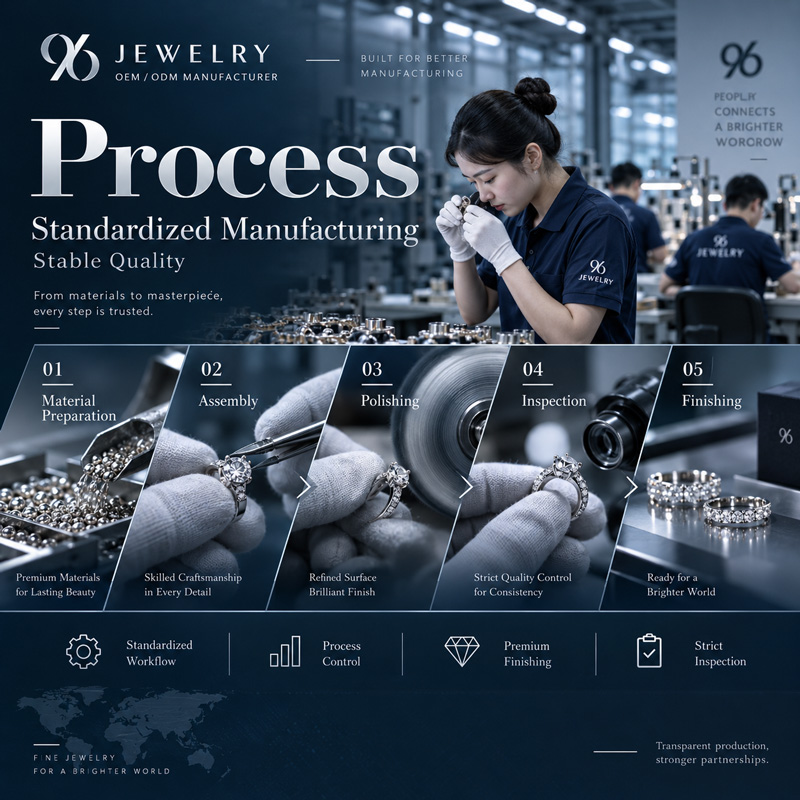
Production routes vary according to product design, material and surface requirements, but a typical project moves through:
Material Preparation → Forming / Machining / Casting → Assembly → Polishing → Surface Finishing → Inspection → Packaging
96 Jewelry combines several forming methods, including stamping, laser cutting, lathe machining and lost-wax casting support, allowing different structures to use an appropriate manufacturing route.
Surface-finishing options include processes such as polishing, brushed finishes, matte treatments, enamel, PVD and electroplating depending on the project specification.
Process Control
At key production stages, quality checks may cover dimensions, assembly, surface finish, plating, stone setting, functionality and final appearance.
This process connects directly with the Quality Control system rather than treating inspection as a separate final step.
Production Capacity
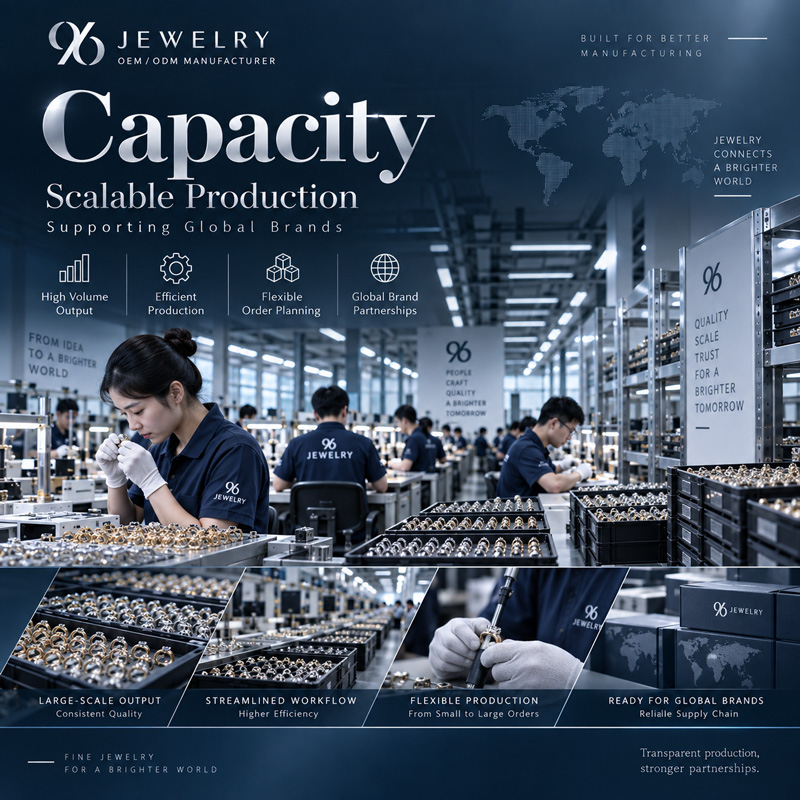
Production Capacity Built for Development and Scale-Up
From Samples to Repeat Production
Capacity for a B2B jewelry factory is not only about how many pieces can be made.
It also depends on whether the factory can move a project from:
Prototype → Small Order → Volume Production → Repeat Order
without losing control over specifications and quality.
96 Jewelry currently supports flexible MOQ structures, with many standard projects starting around 30 pieces per style/color, while more complex custom-mold projects may require higher quantities depending on craftsmanship and tooling requirements.
For most mass-production projects, current published lead times are approximately 25–45 working days after final design approval and deposit, depending on technical complexity and order volume.
Rather than publishing a single theoretical “pieces per month” number, we recommend presenting capacity on this page around four measurable production abilities:
| Capacity Dimension | What Buyers Can Evaluate |
|---|---|
Sample Development |
Ability to turn concepts into production-ready samples |
Flexible MOQ |
Support for market testing and smaller initial orders |
Scale-Up |
Transition from approved sample to volume production |
Repeat Orders |
Reuse of confirmed specifications and production experience |
Outsourcing Scope
What We Produce and What We Coordinate With Partners
Clearer Supply-Chain Boundaries
For B2B buyers, understanding outsourcing scope is important.
Not every manufacturing process needs to be physically located under the same roof. What matters is knowing which processes are controlled internally, which require specialized partners, and how quality is managed between them.
96 Jewelry integrates multiple manufacturing processes directly into its production workflow. One specifically disclosed partner-supported process is le moulage à la cire perdue, which is carried out through a long-term partner foundry in which the company states it holds an equity stake.
This structure is intended to expand manufacturing capability while keeping production coordination and quality requirements connected to the main project workflow.
Scope Transparency
| Area | Manufacturing Approach |
|---|---|
Design & Development |
Managed as part of the OEM/ODM project |
Sampling |
Factory-coordinated |
Lathe / Precision Machining |
Integrated production capability |
Stamping |
Integrated production capability |
Laser Cutting |
Integrated production capability |
Lost-Wax Casting |
Long-term partner foundry |
Polissage |
Factory workshop |
QC |
Factory-controlled throughout production |
Packaging |
Factory packaging department |
Third-Party Compliance Testing |
Qualified external testing organizations when required |
For individual projects, the exact production route can be confirmed before sampling so buyers know which manufacturing steps are handled directly and which use specialized external resources.
Factory Transparency
See the Factory Before You Place a Volume Order
Product photos alone cannot show how a factory operates.
For buyers evaluating a new manufacturing partner, we can support a live video factory tour covering relevant production areas, polishing, packaging and showroom samples.
This can help your sourcing team review:
Facility → People → Equipment → Workflow → QC → Finished Samples
before proceeding to a larger production commitment.
Why Factory Transparency Matters
Better Information Leads to Better Supplier Decisions
A manufacturing partner should make it possible for buyers to understand more than the quotation.
Factory transparency helps answer practical sourcing questions:
Where will my order be produced?
Who manages production and QC?
Which equipment supports my design?
Which processes are controlled directly?
Can production scale after market validation?
Which processes involve external partners?
Providing clear answers to these questions helps reduce uncertainty before sampling and volume production.
Start Your Project With a Clear Manufacturing Plan
Share your product design, material, finish, quantity and target market with our team.
We can help evaluate the manufacturing route, sampling requirements, production process and testing needs before your project enters production.