

Use material, design, order volume, and target purchase price to decide what can stay and what may need to change.
Our sales representative, Ana, often hears a similar request from clients: they have a product originally designed for 925 sterling silver or fine jewelry, and they want to keep its shape and details while switching to stainless steel for mass production.
The first question is whether the original design can be manufactured in the new material using a practical production process.
Fine prongs, deep recesses, openwork connections, and the space beneath gemstones may all need to be reviewed. The front-facing design can remain the visual target, but the back construction, local thicknesses, and joining methods may not translate directly.
A design that works in silver cannot simply be relabeled “stainless steel” and sent straight into mass production.
Designers should therefore identify the intended metals and nonmetal materials early, together with suitable methods for producing them at scale. Before finalizing the construction, order quantity and target purchase price should be part of the evaluation.
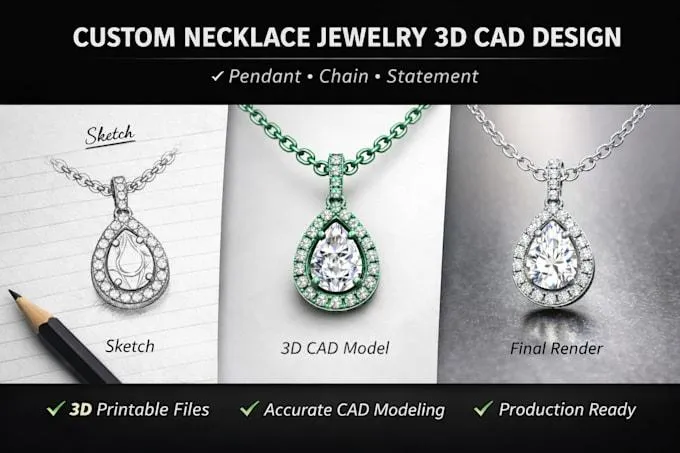
Start with Four Factors to Evaluate Your Design
A practical way to select jewelry-forming methods is to work through four factors—material → design → order quantity → target purchase price—and revisit earlier decisions as needed.
| Factor | Question to ask | How it affects the decision |
|---|---|---|
Matériau |
Which metal and nonmetal materials will be used? Are substitutions allowed? |
Rules out unsuitable processes and identifies manufacturing options worth assessing. |
Conception |
Which structural features, stone settings, and surface effects must be retained? |
Checks whether the item can be formed and subsequently finished, set, and assembled. |
Order quantity |
How many units are needed per design? Is the design finalized? |
Helps compare tooling investment, production efficiency, and modification costs. |
Target purchase price |
What is the budget, and what does it include? |
Determines whether the complete production approach meets the sourcing target. |
Material determines which processes are available. Design determines which of those processes are suitable. Quantity and target purchase price determine whether a workable route is economically viable.
If the material and budget are fixed, the construction may need to change. If the design effect cannot change, the material, order quantity, or budget may need to be reconsidered.
What Are Jewelry-Forming Processes?
Jewelry forming refers to manufacturing methods that turn raw materials into blanks or components with defined shapes, structures, and dimensions. It is a core step in bringing a design into physical form.
In this article, we use the term broadly to include shape-making processes such as laser cutting, turning, and CNC machining.
| Comparaison | Forming and shape-making | Surface finishing and treatment |
|---|---|---|
Primary purpose |
Create the outline, structure, and dimensions. |
Achieve the required luster, texture, color, and surface performance. |
Common methods |
Casting, forging, stamping, hydraulic pressing, cutting, and machining. |
Polishing, diamond-cut detailing, engraving, sandblasting, electroplating, and PVD coating. |
Main considerations |
Thickness, three-dimensional geometry, dimensions, and weight. |
Surface texture, decorative appearance, and protective effect. |
These stages need to be considered together. A deep recess may be formable but difficult to polish to a mirror finish; a narrow edge may need extra thickness to allow for finishing.
The selection of a forming method should therefore work backward from the finished product—not stop at whether a blank can be made.
1. Different Materials Require Different Manufacturing Approaches
Choose the material early in development, or at least narrow it down to a clearly defined shortlist.
Brass, 925 sterling silver, stainless steel, and zinc alloys behave differently during forming, melting and casting, cutting, joining, and subsequent processing. Nonmetals such as resin, acrylic, and glass also have their own processing requirements.
What Needs to Be Rechecked When Switching from Silver to Stainless Steel?
For the type of inquiry Ana receives, the first step is to establish whether the client wants to preserve the overall appearance or every feature of the existing construction—including thickness, weight, stone positions, and the back of the piece.
| Feature in the original design | What to review after changing the material |
|---|---|
Fine prongs, thin bezels, and closely spaced settings |
Whether the retention structure, setting method, and tool access remain suitable. |
Deep recesses or interlocking forms |
Whether the part can be trimmed and polished where required after forming. |
Original dimensions, thickness, and weight |
Whether all three can still be achieved with the new material. |
Moving connections and concealed joints |
Whether the joining method, fit, and assembly sequence need to change. |
A consistent gloss across every surface |
Whether each area can meet the requirement and how much finishing it will take. |
The outcome may be to keep the main visual design while adjusting the back or certain thicknesses. Another option is to make selected components separately and join them later.
These changes should be discussed before the construction is approved and tooling begins. Discovering insufficient stone-setting or polishing access after sampling will usually add rework.
For stainless steel casting projects, our related article on the differences in production lead times between 316L stainless steel casting and silver jewelry provides further context on how a material change can also affect production scheduling.
Confirm the Alloy Specification and Raw Material Form
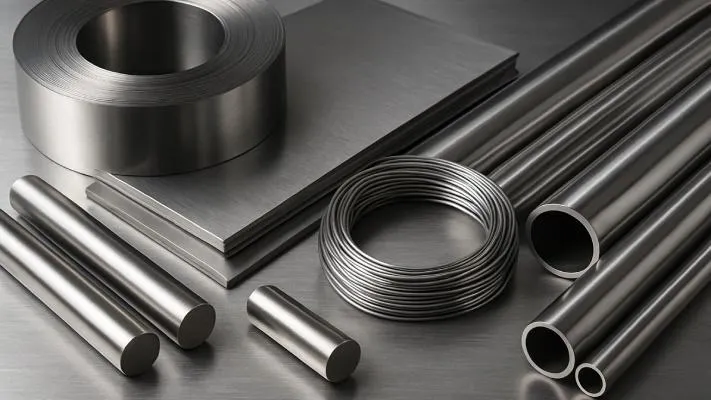
“Brass” or “stainless steel” is only the starting point. The alloy grade, material temper, and supply form—such as sheet, wire, bar, or casting feedstock—may also need to be specified.
Sheet can be evaluated for cutting, stamping, and bending; wire for coiling and joining; bar stock for turning and other machining; and casting feedstock for processes that match the alloy and casting conditions.
Material form and process can be selected together. Buyers do not need to preselect every stock form, but they should state whether the finished-product material may be changed.
Nonmetal Materials Also Affect the Overall Construction
When metals are combined with resin, shell, glass, or other nonmetals, the attachment points, dimensional fit, and processing sequence also need to be confirmed.
Showing that each component can be manufactured separately does not prove that the finished assembly can be produced consistently. The joints and each material’s ability to withstand later operations matter too.
For a related manufacturing example, see our article on the production process for resin jewelry with a metal base.
2. Evaluate the Design: Structure, Stone Setting, and Surface Detail
Once the material is established, narrow the manufacturing choices to processes that suit the design.
A simple-looking design is not necessarily simple to manufacture. Even a plain piece may require several operations if it calls for large mirror-polished surfaces, crisp corners, and precise fits.
Use the Basic Geometry to Narrow Down Manufacturing Options
| Design characteristic | Processes to consider | Key checks |
|---|---|---|
Flat letters, geometric outlines, and openwork sheet parts |
Laser cutting or stamping |
Sheet thickness, narrow connections, holes, and edges. |
Curved petals, relief patterns, and shell-shaped parts |
Stamping or hydraulic forming |
Forming depth, localized thinning, release from tooling, and edge trimming. |
Three-dimensional animals, intertwined branches, and complex curves |
A casting process suited to the material |
Thin walls, fine details, and access for post-processing. |
Zinc-alloy decorative components |
Die casting or suitable rubber-mold centrifugal casting |
Alloy selection, parting lines, mold release, and in-use strength. |
Round beads, tubular parts, and certain plain bands |
Turning and subsequent machining |
Inner/outer diameters, hole placement, and assembly. |
Faceted geometries and precise slots or holes |
usinage CNC de précision |
Tool access, workholding, and machining time. |
Hoops, jump rings, and linear designs |
Wire bending, coiling, and joining |
Springback, welded or soldered joints, and shape consistency. |
Large, lightweight hollow forms |
Electroforming or fabrication from formed and joined sheet |
Wall thickness, support, seams, and dent resistance. |
This table is a starting point, not a substitute for assessing the exact material and dimensions of the design.
For complex three-dimensional structures, our guide to the full lost-wax jewelry casting process provides further detail. 3D printing can also be used to make models, but printing a wax or castable-resin pattern is not the same as directly metal-printing the finished product; the two routes must be assessed separately.
Specify the Required Surface Detail by Location
“High-quality polishing” is too broad to serve as a useful production instruction. A more effective approach is to mark up the design images to show:
- Which areas need a mirror finish and which should retain texture.
- Whether deep recesses need the same finish as exposed surfaces.
- How rounded the corners may become and which lettering or patterns must remain sharp.
- Where seams, parting lines, or machining marks are acceptable, if anywhere.
If a particular area can meet its finish requirement only through extensive manual work, compare the cost of retaining the original process with the option of changing the construction to achieve the result more directly.
Surface-finishing difficulty is often built into the design long before polishing begins.
Stone Setting Requires More Than a Front-View Layout
Just because gemstones fit in the design drawing does not mean the blank has a workable setting structure.
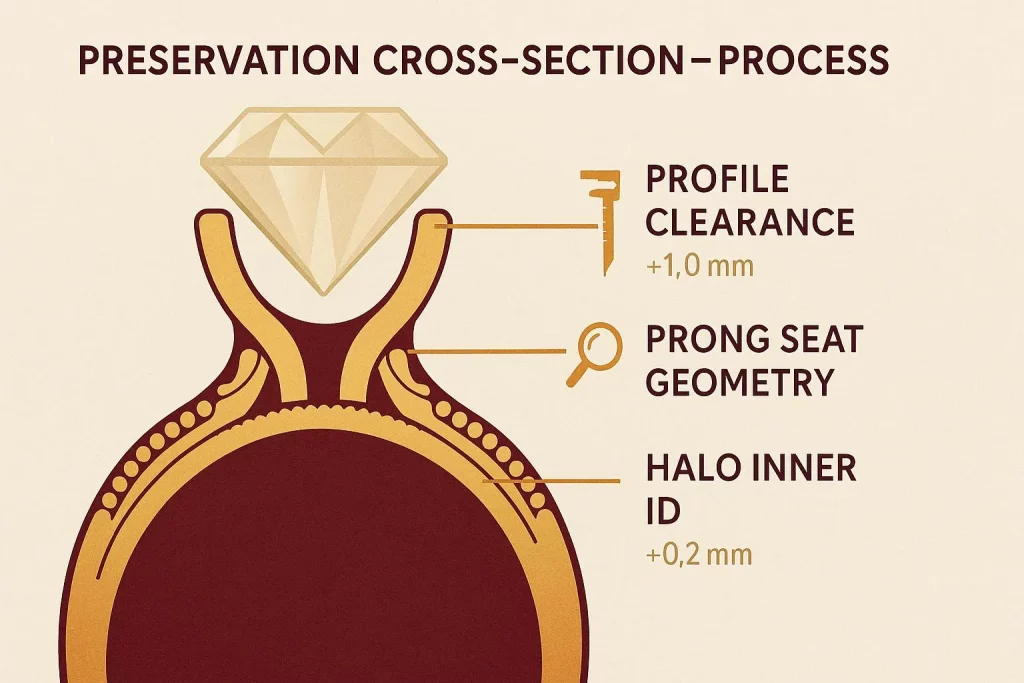
Stone dimensions, height, count, arrangement, and retention method all need to be checked together—especially the depth of each seat, the metal left between settings, and whether tools can reach the required areas.
For example, if a shallow pressed component needs to accommodate a relatively tall stone, the options may include making the main body deeper, adding a separate setting, or changing the construction.
A multi-stone design does not necessarily require one-piece casting. The main body and settings can be produced separately, then assessed for joint strength, appearance, and total cost.
Assess One-Piece Construction and Multi-Part Assembly as Complete Products
Petals, stone settings, jump rings, and functional fittings may be better suited to different manufacturing methods.
Making components separately can improve access for certain operations but adds joining and assembly requirements. Forming a component as one piece may reduce some seams, yet can make other areas harder to finish.
For an example involving functional hardware, our stainless steel lobster clasp manufacturing guide shows how forming and assembly contribute together to the final product’s operation.
3. Use Order Quantity to Assess Whether Tooling Is Justified
Even after a material and design pass the initial evaluation, more than one manufacturing route may remain viable. Order quantity affects the cost and efficiency of those alternatives.
Ten styles at 100 pieces each and one style at 1,000 pieces have the same total volume, but may require very different tooling and setup. If the outlines, sizes, or stone placements vary, separate development may be necessary.
An inquiry should therefore specify the quantity per design and color, and identify which styles could share components or tooling.
One process may require more up-front tooling but offer greater efficiency at volume. Another may cost less to set up but take more time per unit. If the design is still changing, the expense of revising models or tooling also matters.
Reorder plans are relevant, but confirmed orders should be distinguished from sales forecasts. Uncommitted future quantities should not be treated as a guaranteed basis for allocating present tooling costs.
No universal order threshold determines that jewelry “must be stamped” or “must be cast.” Quantity helps compare the economics of feasible approaches; it cannot remove restrictions imposed by the material or design.
4. Check the Manufacturing Plan Against the Target Purchase Price
The target purchase price should be discussed early in the project.
This helps the manufacturer determine which requirements can be met together for the specified material, design effect, and quantity—and where compromises may be necessary.
Agree on What the Quoted Price Includes
The target price should be tied to defined material, dimensions, weight, stones, finish, findings, and packaging requirements. Clarify whether testing, shipping, and other charges are included.
Otherwise, two apparently similar unit prices may refer to different products and different scopes of supply.
Compare the Cost of the Complete Finished Piece
A cheaper blank does not necessarily mean a cheaper finished product.
Trimming, soldering or welding, polishing, stone setting, and surface treatment can change the final cost. Compare the full route—including development, tooling, forming, and subsequent operations—not just the price of a single process.
If the Design Exceeds the Budget, Revisit Its Priorities
When adapting a silver jewelry design to stainless steel, it may not be possible to hold the material, every design detail, order quantity, and a low target price constant at the same time. Those requirements need to be reviewed together.
If changes are permitted, the options may include revising the back construction, local thicknesses, individual stone settings, gemstone layout, surface requirements in less visible areas, or shared components.
Any adjustment should serve the client’s product goals and be approved by the client. Essential strength and stone-retention requirements must still be maintained.
A Design Scenario: Bringing All Four Factors Together
The following is an illustrative design scenario, not a completed customer project.
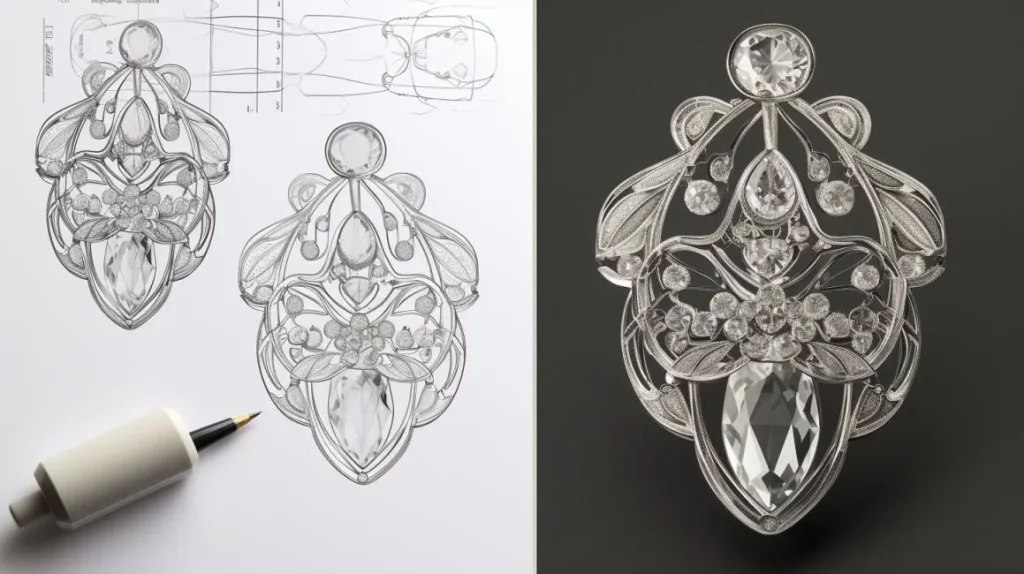
Suppose a buyer sends a reference image of a floral pendant with multiple stones. They want to manufacture it in stainless steel, preserve the petals and gemstone appearance on the front, and stay within a target purchase price.
| Table Header | Table Header | Table Header |
|---|---|---|
Assessment order |
What needs to be confirmed |
How it affects the approach |
Matériau |
Is stainless steel a fixed requirement? |
Defines the processes and joining methods that can be evaluated. |
Conception |
Must petal depth, stone positions, and polished recesses match the reference exactly? |
Compares one-piece forming, separate-component assembly, and local design adjustments. |
Quantity |
How many units in the first order per style? Can a common body be used? |
Determines how tooling and production setup costs can be allocated. |
Purchase price |
What does the budget include, and which details matter most? |
Allows the total cost of feasible options to be compared. |
If the back can be modified, the manufacturer can assess whether this improves access for machining, finishing, and stone setting. If deep recesses must be mirror-polished, the corresponding finishing work needs to be included in the quotation.
If every requirement is fixed and all feasible processes exceed the budget, the gap should be explained before discussing revisions. Simply saying “Yes, we can make it” is not an adequate production assessment.
A useful proposal should state which process is recommended, why it fits the design, what needs to change, and how those changes could affect the finished appearance and function.
Prepare This Project Brief Before Finalizing the Design
When sending a project to a manufacturer, organize the information around these four factors:
| Information | What to provide |
|---|---|
Matériaux |
Metal and nonmetal types, essential specifications, and whether substitutions are allowed. |
Conception |
Front, side, and back views; dimensions, weight, gemstones, and joining requirements. |
Surface finish |
Mirror-polished areas, textures, colors, and areas requiring special attention. |
Quantity |
First-order volume by style and color, design status, and anticipated reorders. |
Target purchase price |
Price range and exactly what it is expected to include. |
Design priorities |
Which features are non-negotiable and which may be revised. |
Reference photos are a useful starting point. Tell the manufacturer whether you want to capture the overall style or reproduce specific details as closely as possible, together with the intended material, quantity, and target price.
Jewelry-forming methods should be considered early in design development. The sooner material, design, quantity, and price are assessed together, the easier it is to identify conflicts before tooling and establish a viable route to volume production.
Share your design files and project requirements with 96Jewelry to discuss manufacturing options, starting with the material and construction. You can also review our OEM/ODM development process to understand how design assessment, sampling, and mass production fit together.
Auteur

Ertian Jiang (Jasper) est le fondateur de Haosen Metal Jewelry. Depuis ses débuts à 26 ans, il associe un solide savoir-faire artisanal à une compréhension fine du marché, deux piliers sur lesquels repose l’excellence de l’entreprise.
Ertian Jiang a commencé comme artisan, spécialisé dans les pierres semi-précieuses (agate, nacre et œil-de-tigre) et l’incrustation manuelle. Il a perfectionné la pose de pierres naturelles sur des supports métalliques, sans jeu ni défaillance de la colle. Son expérience directe de la vente lui a également permis d’échanger avec les acheteurs et de comprendre leurs difficultés face aux pierres qui se détachent et aux couleurs qui s’altèrent.