

If you are a jewelry brand owner or designer sourcing high-quality pieces, you’ve likely searched for “tarnish-free jewelry.” During your research, you will constantly encounter two terms: PVD Coating et une bonne PVD Plating. Buyers frequently ask us at Haosen Jewelry: “Which one is better? Should I ask my manufacturer for coating or plating?” Here is the truth that will save you time and confusion.
What is PVD coating jewelry meaning?
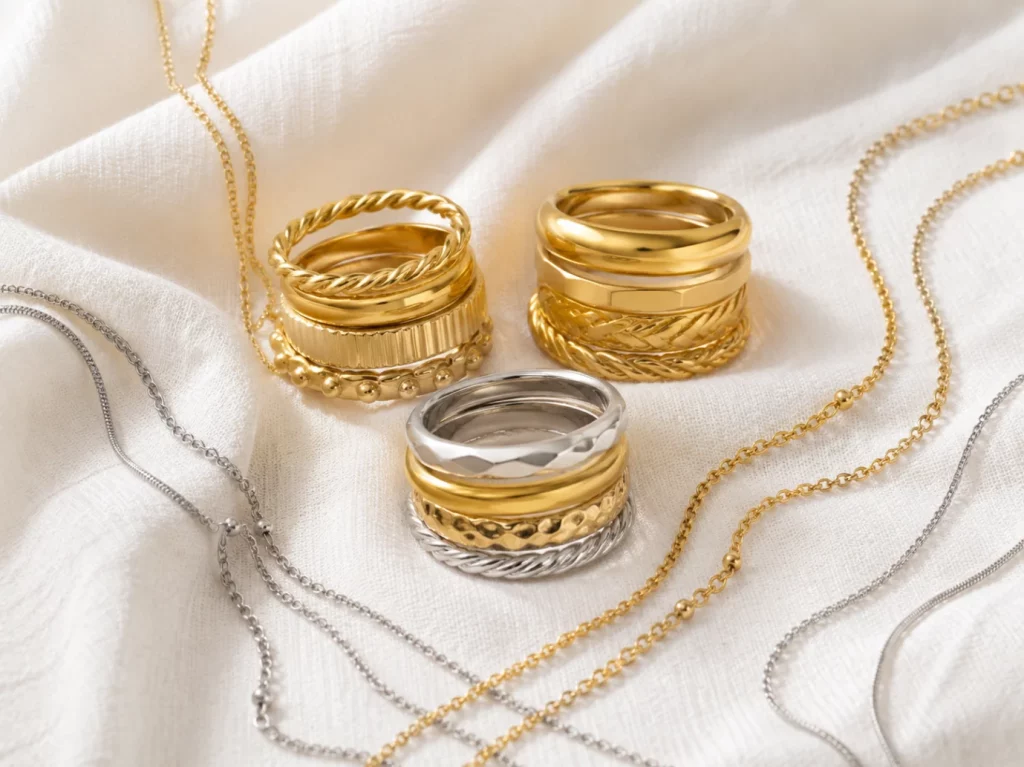
PVD coating jewelry meaning refers to a vacuum-based process that bonds a thin layer of gold, titanium, or other metals to a base metal surface. It creates a tarnish-free, waterproof, and hypoallergenic finish. Whether you call it PVD coating or PVD plating jewelry, the result is the same.
The Short Answer: They Are Exactly the Same Process
The secret is out: PVD Coating and PVD Plating refer to the exact same physical and technical process in jewelry manufacturing. There is zero difference in durability, quality, or water resistance. The distinction lies purely in the vocabulary used by scientists versus salespeople.
Why the Two Different Names?
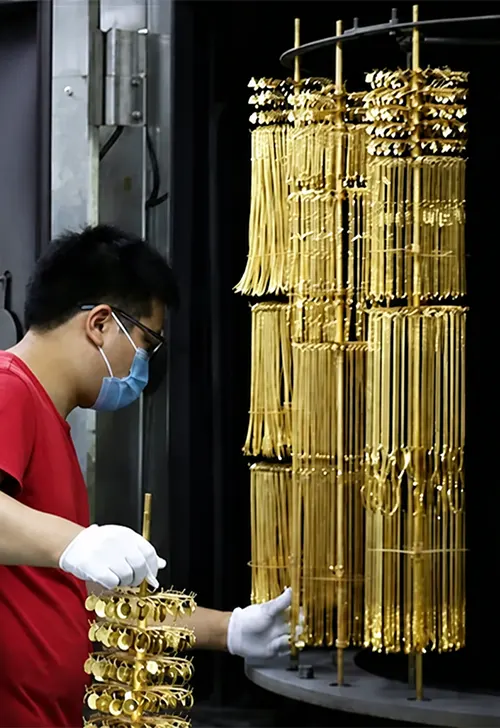
- PVD Coating (The Scientific Term): PVD stands for Physical Vapor Deposition. In the manufacturing and materials science world, this is a “coating” technology. Solid metals (like gold or titanium) are vaporized in a vacuum chamber into a plasma state and bonded to the base metal.
- PVD Plating (The Commercial Term): For centuries, the jewelry industry and consumers have used the word “plating” (e.g., gold-plated, silver-plated). To make this highly advanced vacuum technology easier for everyday buyers to understand—conveying the idea that “we are adding a layer of gold to the surface”—manufacturers and marketers adapted the term to “PVD Plating” or “Vacuum Plating.”
Learn more about our PVD process for stainless steel jewelry
The Real Trap to Avoid: PVD vs. Traditional Electroplating
Vacuum plating vs electroplating: what's the difference?
Traditional Electroplating (The Fast-Fading Culprit)
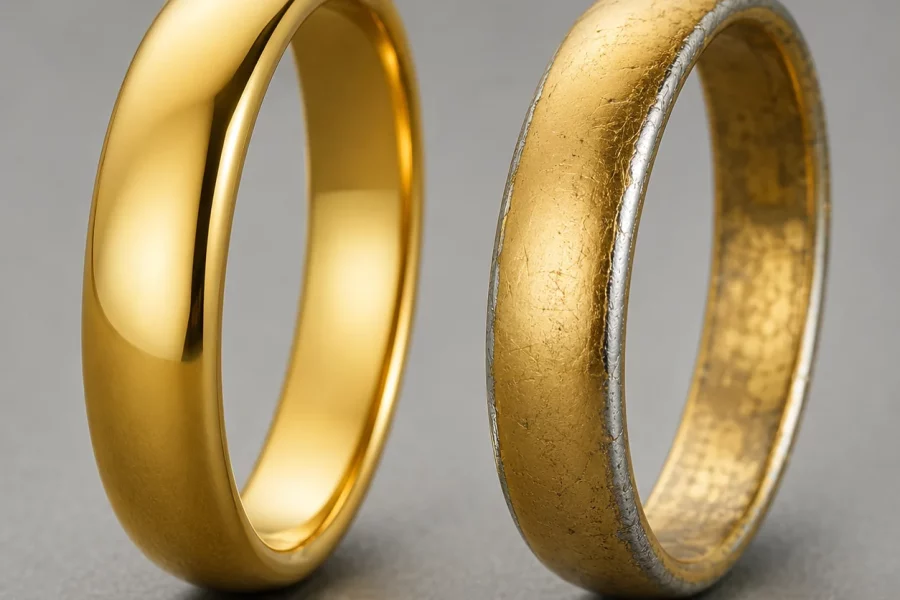
Traditional electroplating uses chemical liquid baths and electric currents to deposit metal. It is cheaper, less environmentally friendly, and creates a very thin, porous layer. This is why cheap fast-fashion rings turn your fingers green or lose their gold color within weeks.
PVD (The Tarnish-Free Armor)
PVD vs. Traditional Electroplating: Quick Comparison
| Feature | PVD (Vacuum Plating) | Galvanoplastie traditionnelle |
|---|---|---|
Processus |
Vacuum chamber, atomic bonding |
Chemical baths, electric currents |
Épaisseur |
Up to 10x thicker |
Very thin, porous |
Durabilité |
Tarnish-free, waterproof |
Fades within weeks |
Impact environnemental |
Eco-friendly, no liquids |
Less environmentally friendly |
Skin Safety |
Hypoallergéniques |
Can cause green skin |
Meilleur pour |
Long-lasting, high-quality jewelry |
Cheap fast-fashion items |
How to Talk to Your Jewelry Manufacturer
- “18K Gold PVD Coating” or “18K Gold PVD Plating”
- Ask about the thickness (e.g., “Can you provide 0.05μm – 0.1μm PVD thickness?”)
- Ask about base metals (e.g., “Is this PVD on 316L Stainless Steel?”)
RFQ Checklist for PVD Jewelry
- □ Specify “PVD Coating” or “PVD Plating” (not just “Plating”)
- □ Request thickness: 0.03μm, 0.06μm, or 0.1μm
- □ Confirm base metal: 316L stainless steel, brass, or titanium
- □ Ask for salt spray test report (ASTM B117, 72 hours)
- □ Request compliance reports: REACH, Prop 65, SEDEX
- □ Ask about E-Coating for brass and alloy items
Choose a Tarnish-Free Jewelry Manufacturer: Haosen's PVD Commitment
Why Haosen Is Your Tarnish-Free Jewelry Manufacturer
- 16+ years in jewelry and hardware manufacturing
- 200+ department stores, retailers, and global brand partners
- <1% defective rate, maintained by an independent 8-12 person QC team
- 30-120 flexible MOQ, approximately 25-day mass production lead time
- SEDEX/SMETA audit passed (2012 to present), compliant with EU REACH and California Prop 65
- US Showroom in San Diego, CA—for samples, meetings, and faster communication
Ready to partner with a factory that speaks your language?
- Visit our US Showroom: VISIONARE 1820 CAL INC., 3802 Main Street Suite 3, Chula Vista CA 91911, San Diego County
- Talk to our Team: +1 6193580328
- Meet us at Trade Shows: JCK Las Vegas 2026 (May 28-June 1, Booth 47099) | Magic Sourcing Las Vegas & New York
