
In the nascent technology involved in the production of stainless steel jewelry, the type of leather material used is frequently the point of “rip and shift.” Leather material is not just a carrier but is directly involved in the product’s functionality, compliance, and value addition.
Having spent 20 years working in custom jewelry professionally, I will delve a bit deeper into the technical differences between Full-Grain Leather and High-Density Microfiber.
Material Anatomy
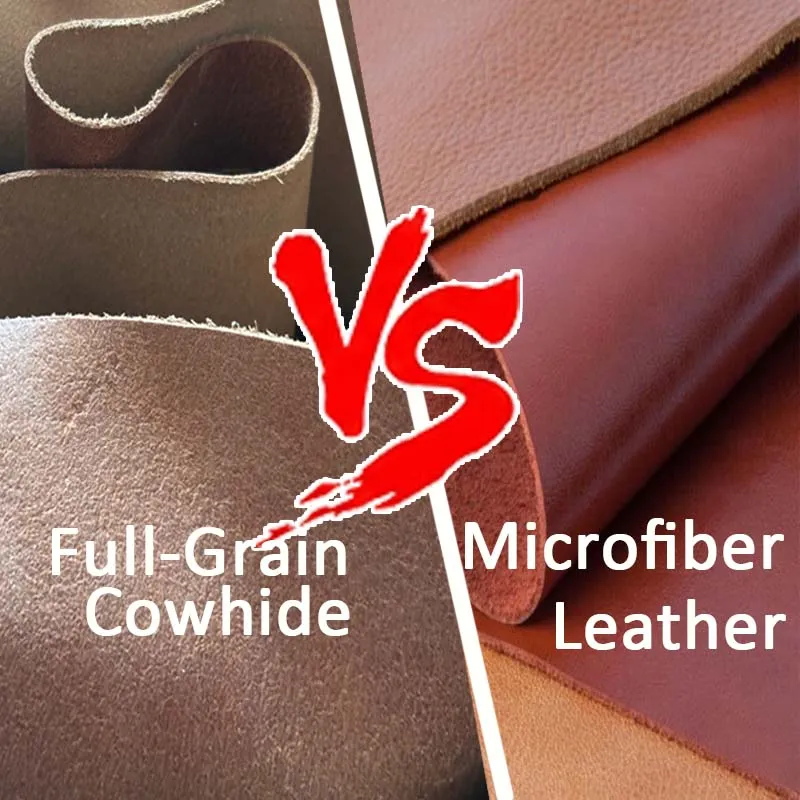
Full-Grain Cowhide:the “real deal.”
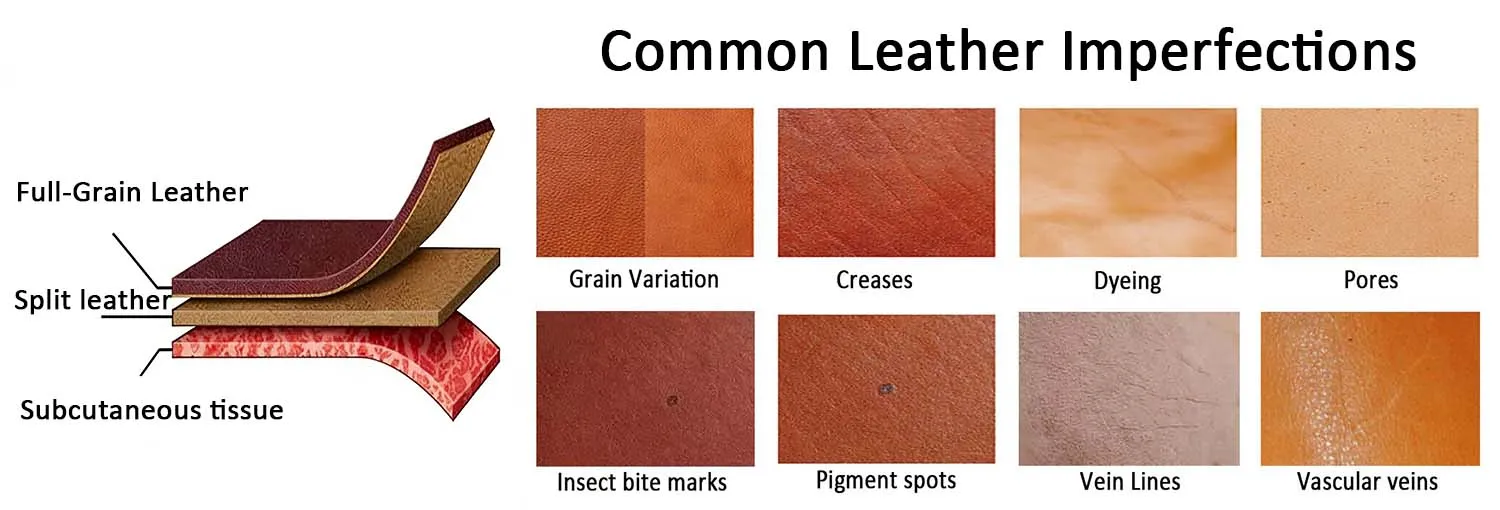
Full-grain leather is the “real deal.” It’s harvested from the top-most layer of the hide, retaining the original fiber density. Where Does Our Leather Come From?
Technical Edge: Because it has natural pores, it can “breathe.” Over time, it acquires a special patina-a rich sheen that many upscale buyers associate with authenticity.
Microfiber Leather:
- Frequently mistakenly referred to as “cheap PU,” High-Density Microfiber is in fact a high-tech synthetic that simulates the three-dimensional array found in natural collagen fibers.
- The Technical Edge: It provides 100% uniformity. Its best feature is its resistivity to hydrolysis (Hydrolysis: the chemical breakdown of materials in reaction with water, a common cause of synthetic leather peeling.).
100% Vegan & Eco-friendly: A cruelty-free, sustainable alternative to traditional leather that contains zero animal by-products.
Superior Durability: Haut tensile and tear strength that exceeds most genuine leathers, ensuring long-term wear resistance.
Low Maintenance: Highly resistant to stains and easy to clean with water or mild detergents, requiring no specialized leather conditioners.
Regarding the genuine leather, it should be noted that:
Key Dimension Comparison
To facilitate your team’s product planning, we have compiled the following comparison of actual test data.
| Feature | Full-Grain Cowhide | Microfiber Leather |
|---|---|---|
Visual Consistency |
High natural variation (requires sorting) |
100% Consistency (ideal for bulk automation) |
Résistance à la traction |
Excellent (350N+) |
Superior & Stable (400N+) |
Sweat & Water Resistance |
Maximum (3-5x more resistant than leather) | |
Unit Cost |
Higher & fluctuates with raw hide markets |
Stable & predictable with minimal waste |
In-Depth Analysis: Material Logic Under Various Brand Positions
How to Make Decisions
Determining material selection can be considered by answering these three key questions:
- What are the environmental regulations in your target market? If selling to California or Northern Europe with a “sustainable” brand positioning, then vegan leather is preferred when trying to command a marketing premium.
- What is the central function of the product? We recommend high-toughness full-grain cowhide leather strips for men’s woven bracelets that require super tensile strength. For fashion bracelets in colorful series, which highly demand long-lasting color freshness, vegan leather shows more consistent performance.
- What are the tolerance needs when it involves bulk orders? The consistent thickness of vegan leather will go well with CNC-machined stainless steel buckles and increase the yield rate to 80%.
Conclusion
“Perfect material” is a delegitimized term—just “the right material for your niche brand.” We at 96Jewelry don’t simply manufacture products, but offer risk prediction based on trial and error over two decades.
Recent Articles
Auteur

Ertian Jiang (Jasper) est le fondateur de Haosen Metal Jewelry. Depuis ses débuts à 26 ans, il associe un solide savoir-faire artisanal à une compréhension fine du marché, deux piliers sur lesquels repose l’excellence de l’entreprise.
Ertian Jiang a commencé comme artisan, spécialisé dans les pierres semi-précieuses (agate, nacre et œil-de-tigre) et l’incrustation manuelle. Il a perfectionné la pose de pierres naturelles sur des supports métalliques, sans jeu ni défaillance de la colle. Son expérience directe de la vente lui a également permis d’échanger avec les acheteurs et de comprendre leurs difficultés face aux pierres qui se détachent et aux couleurs qui s’altèrent.