

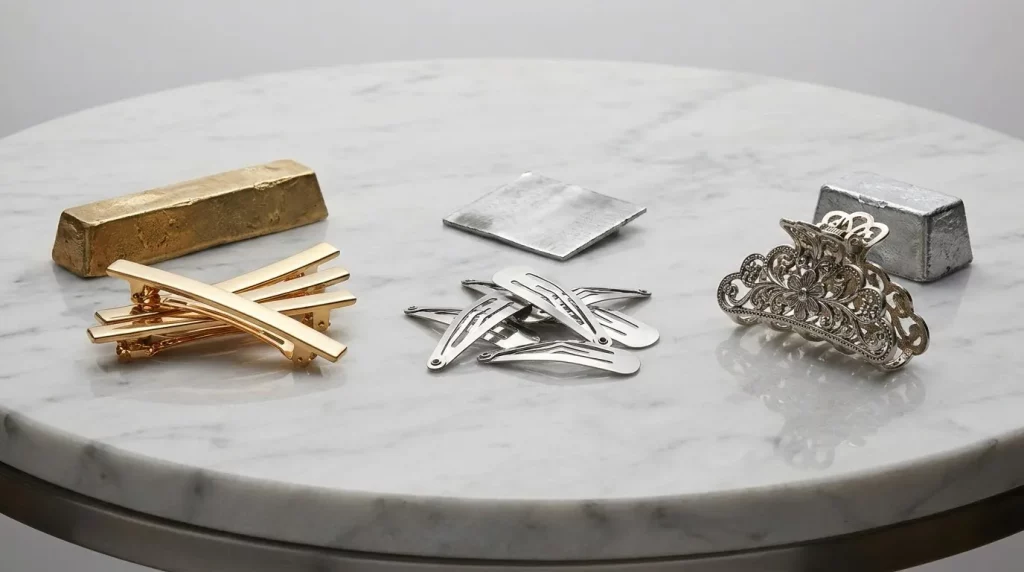
The best material for custom hair clips depends on your design: brass suits detailed premium pieces, stainless steel suits durable everyday clips, and zinc alloy suits decorative styles made in high volume. All three are proven hair clip materials, but they behave very differently in the factory. They form in different ways, take color in different ways and land at different price points. Picking the right one early saves sample rounds and protects your margin. This guide compares each metal side by side, so you can match the material to the clip you want to sell.
TL;DR
- Brass is easy to shape and takes gold plating beautifully.
- Stainless steel resists corrosion and suits flat, everyday clips.
- Zinc alloy casts sharp detail at a low unit cost.
- Springs are always a separate steel part, whatever the body metal.
- Ask for testing that matches your target market.
How Do Brass, Stainless Steel and Zinc Alloy Compare?
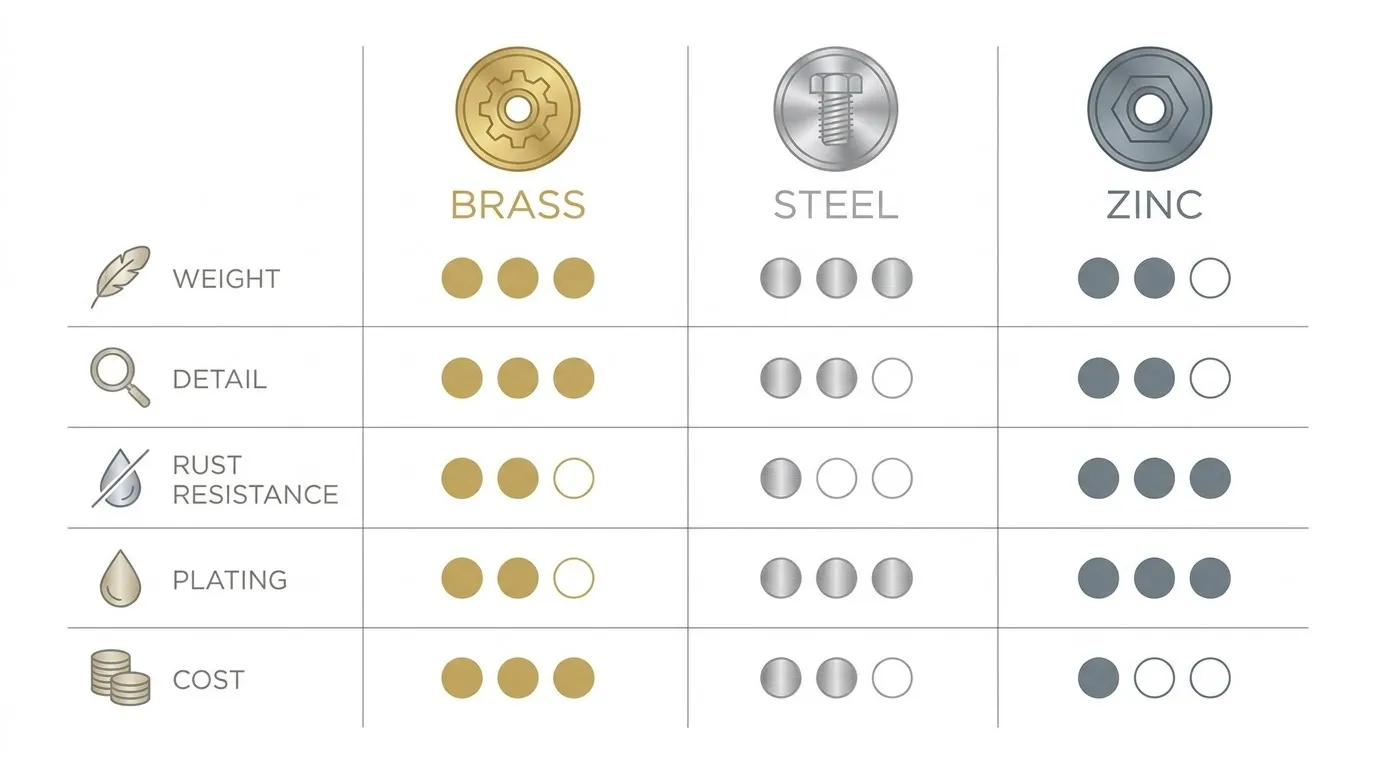
Brass, stainless steel and zinc alloy differ most in forming method, weight, corrosion resistance and plating needs. The table below gives a quick view.
| Factor | Brass | Acier inoxydable (316L) | Alliage de zinc |
|---|---|---|---|
| Best forming methods | Stamping, casting | Stamping, laser cutting | Die casting |
| Detail level | Haut | Medium | Haut |
| Relative weight | Heavy | Heavy | Lighter |
| Corrosion resistance | Needs plating or coating | Very good on its own | Needs plating |
| Coloring method | Electroplating | Revêtement PVD | Electroplating |
| Typical use | Premium decorative clips | Everyday snap clips and bars | Fashion claw and logo clips |
Why Choose Brass Hair Clips?
Brass hair clips are a strong choice because brass is easy to stamp and cast, holds fine detail and takes gold plating with a rich, even color. It is a copper and zinc alloy that jewelers have trusted for generations.
Strengths
Brass works for both flat stamped clips and detailed cast designs. Electroplating on brass can range from 0.03 to 3 μm, so you can choose a thin fashion coat or a thicker, longer-lasting layer. An optional e-coating adds extra protection. Eco-brass is also available for brands with sustainability goals.
Watch-Outs
Raw brass tarnishes when exposed to air and moisture, so it needs plating or coating. It is also one of the heavier options. To learn more about grades and forms, see our guide to brass raw materials.
Why Choose Stainless Steel Hair Clips?
Stainless steel hair clips are a smart choice when durability and corrosion resistance matter most. 316L stainless steel stays bright without plating and handles daily wear, sweat and humidity well.
Strengths
316L suits snap clips, flat barrettes, bars and laser-cut shapes. It can be left in its natural silver tone or coated by PVD. Standard PVD thickness is 0.03 μm, with an upgraded 0.05 to 0.10 μm option for higher wear.
Watch-Outs
Stainless steel is harder to form than brass. Deep 3D shapes are possible through casting, but they take longer and cost more. 316L also contains nickel, so ask for nickel release testing if you sell into the EU. Our guide to nickel free jewelry explains what buyers should check.
Why Choose Zinc Alloy Hair Clips?
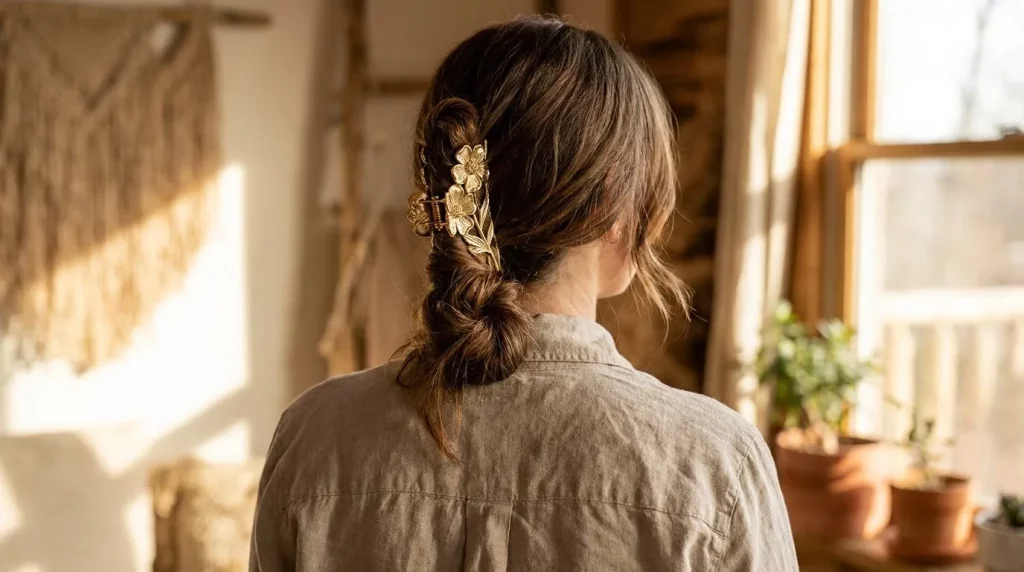
Zinc alloy hair clips are the best fit for decorative, detailed designs sold in larger volumes at fashion price points. Zinc alloy melts at a low temperature and flows easily into steel molds, so die casting captures sharp detail quickly.
Strengths
Zinc alloy is less dense than brass and stainless steel, so a cast clip of the same size weighs less. That matters for large statement claw clips. It is also cost-effective once the mold is made.
Watch-Outs
Zinc alloy is more brittle than brass or steel, so it should never be used for parts that flex. It also needs plating for color and protection. Because alloy content varies by supplier, lead and cadmium testing is important. Here is an example of a zinc alloy test report for California Proposition 65.
Which Material Fits Your Hair Clip Design?
Brass fits premium clips with fine detail, stainless steel fits simple clips worn every day, and zinc alloy fits large decorative claw clips and logo clips. A few quick rules help:
- Pick brass when you want thick gold plating.
- Pick stainless steel when your customer wants low upkeep.
- Pick zinc alloy when detail matters and volumes are high.
- Mix metals when a design needs both detail and strength.
Many brands use more than one metal in a collection. For example, a zinc alloy decorative top can sit on a steel spring base. Other hair accessory materials, such as resin, acrylic, pearls or fabric, can also be combined with metal parts.
What Testing Should You Ask For?
You should ask for testing that matches your product and the market you sell into. Common tests include material composition, XRF, plating thickness, salt spray, nickel release, and lead and cadmium content.
For brands selling in Europe or California, EU REACH and California Proposition 65 testing can be arranged where applicable. Testing is set per project, not applied to every product by default. You can browse our published raw material reports to see real examples.
FAQs
What is the best metal for hair clips?
The best metal depends on the design. Brass suits detailed premium clips, stainless steel suits durable everyday clips, and zinc alloy suits decorative clips in high volume.
Do stainless steel hair clips rust?
316L stainless steel hair clips resist rust very well in normal use. Harsh chemicals, salt water and poor cleaning can still mark the surface over time.
Is zinc alloy safe for hair accessories?
Zinc alloy is widely used for hair accessories when it meets the safety rules of the target market. Lead and cadmium testing helps confirm this.
Why are springs not made from the clip metal?
Springs need to flex thousands of times without breaking. Spring steel does this well, while cast brass and zinc alloy are too rigid.
Can I mix materials in one hair clip?
You can mix materials in one hair clip. A common example is a cast zinc alloy or brass top fitted onto a steel spring base.
Final Thoughts on Hair Clip Materials
Brass, stainless steel and zinc alloy each have a clear place in a hair accessory range. Brass brings detail and rich color. Stainless steel brings strength and easy care. Zinc alloy brings sharp detail at a lower unit cost. The best choice depends on your design, your customer and your price point. Not sure which one fits? Send your design to our custom hair accessories team, and we will recommend the right material before sampling begins.
Auteur

Ertian Jiang (Jasper) est le fondateur de Haosen Metal Jewelry. Depuis ses débuts à 26 ans, il associe un solide savoir-faire artisanal à une compréhension fine du marché, deux piliers sur lesquels repose l’excellence de l’entreprise.
Ertian Jiang a commencé comme artisan, spécialisé dans les pierres semi-précieuses (agate, nacre et œil-de-tigre) et l’incrustation manuelle. Il a perfectionné la pose de pierres naturelles sur des supports métalliques, sans jeu ni défaillance de la colle. Son expérience directe de la vente lui a également permis d’échanger avec les acheteurs et de comprendre leurs difficultés face aux pierres qui se détachent et aux couleurs qui s’altèrent.