

A brand planning an adjustable ring may hope to stock fewer sizes. The commercial question is whether one structure can cover the intended customers while remaining comfortable, stable and suitable for its stated use.
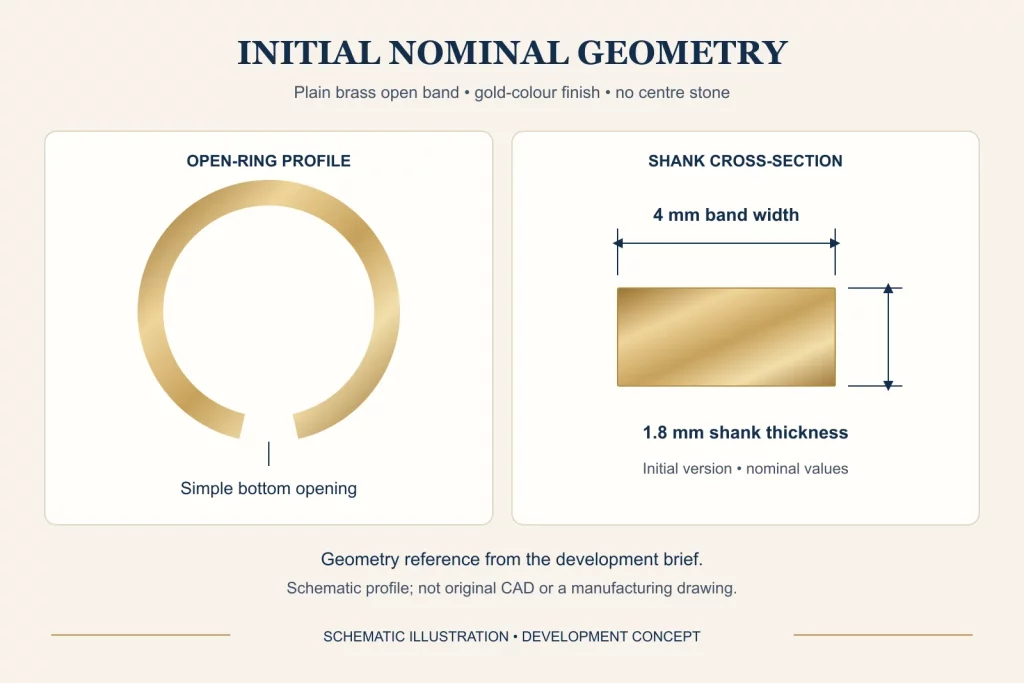
This development example starts with a brass ring intended to cover US sizes 6–9 through consumer adjustment. The brief specifies a simple bottom opening, a nominal 4 mm band width, an initial 1.8 mm thickness, no centre stone and a gold-colour finish.
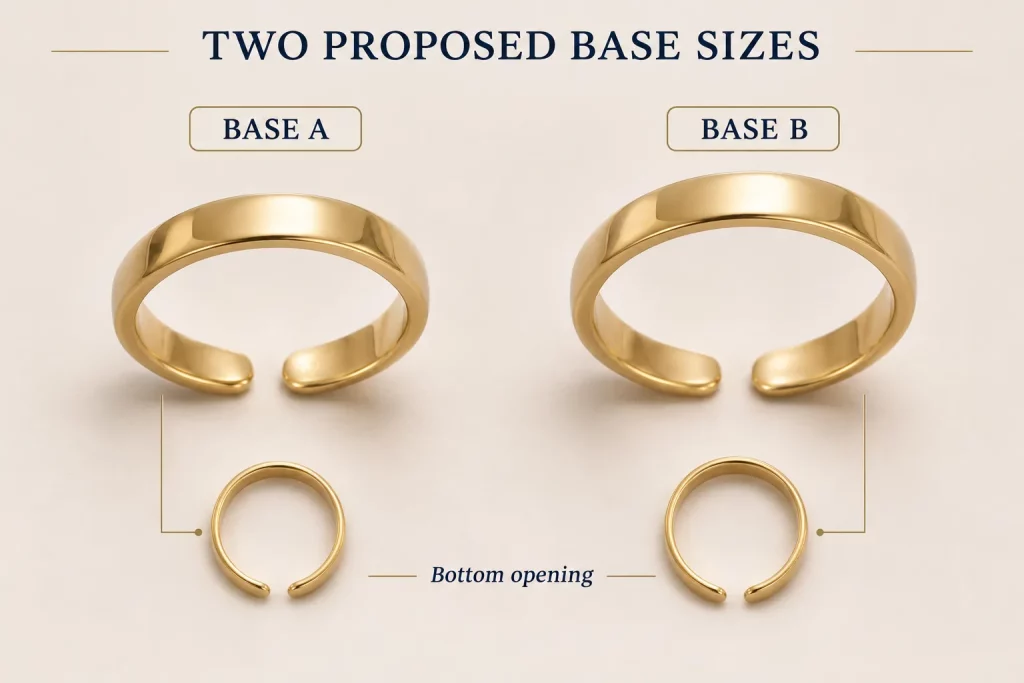
The revised development direction uses two base sizes and store adjustment for first fitting. The proposed intervals still require validation. Dividing the range changes the plan; it does not by itself prove the finished product’s fit or adjustment life.
What went wrong at the ends of the original range?
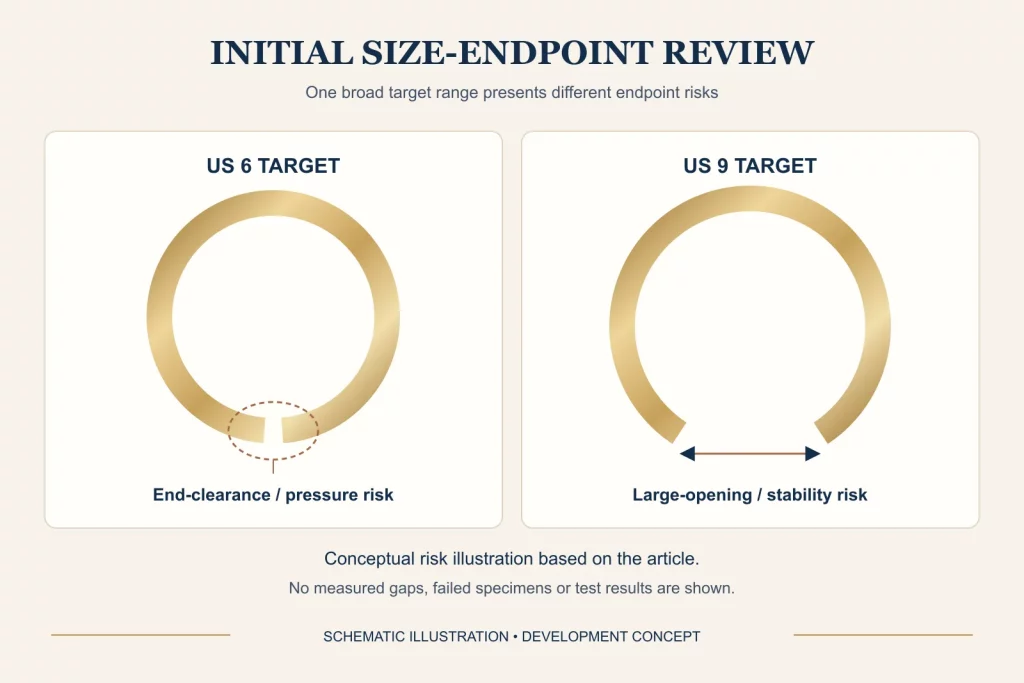
The initial development feedback identifies different problems at the endpoints: near US 6, the ends approach interference and the inner surface creates pressure; near US 9, the opening is large and the face tends to turn. These are separate fit problems that a single “adjustable” label does not describe.
The feedback also identifies fine cracks near the plated opening after repeated bending and deterioration in adjustment response. The revised plan therefore needs to address surface condition as well as fit.
They did not establish a fixed half-size or one-size limit for all open brass rings. The useful question was whether this particular geometry could meet the intended range under a defined adjustment method and still provide acceptable fit and surface condition.
Why did the intended adjustment method matter?
The original brief did not separate occasional first fitting from repeated adjustment by a consumer. Those are different uses. A ring set to a selected size by a store does not need to be marketed as a piece that customers can repeatedly bend to fit different fingers.
The revised brief therefore defined who would adjust the ring and when. Testing could then be tied to that intended use, rather than treating "adjustable" as an unrestricted promise.
Which alternatives were considered?
| Option | Reason for considering it | Trade-off to review |
|---|---|---|
| One structure for US 6–9 | The fewest base-size variants. | The initial sample did not support the proposed range and use. |
| Two base sizes | A smaller adjustment span for each base structure. | More inventory variants and clear selection instructions. |
| Fixed sizes with an open appearance | Retain the design without selling adjustment as a feature. | Separate size inventory and a different product description. |
| A different adjustment mechanism | Explore a sliding or clasp-based design. | New geometry, development work, cost and verification; no wider range assumed without testing. |
The preferred direction is two base sizes with the simple bottom opening retained. It avoids adding a clasp or sliding mechanism, but introduces an extra stock variant and a store-selection rule. First fitting by the store also changes the intended use from repeated consumer adjustment.
Our custom brass ring manufacturing page outlines other ring shapes, size options and information to prepare for a development enquiry.
What changed in the revised design?
| Feature | Proposed development direction |
|---|---|
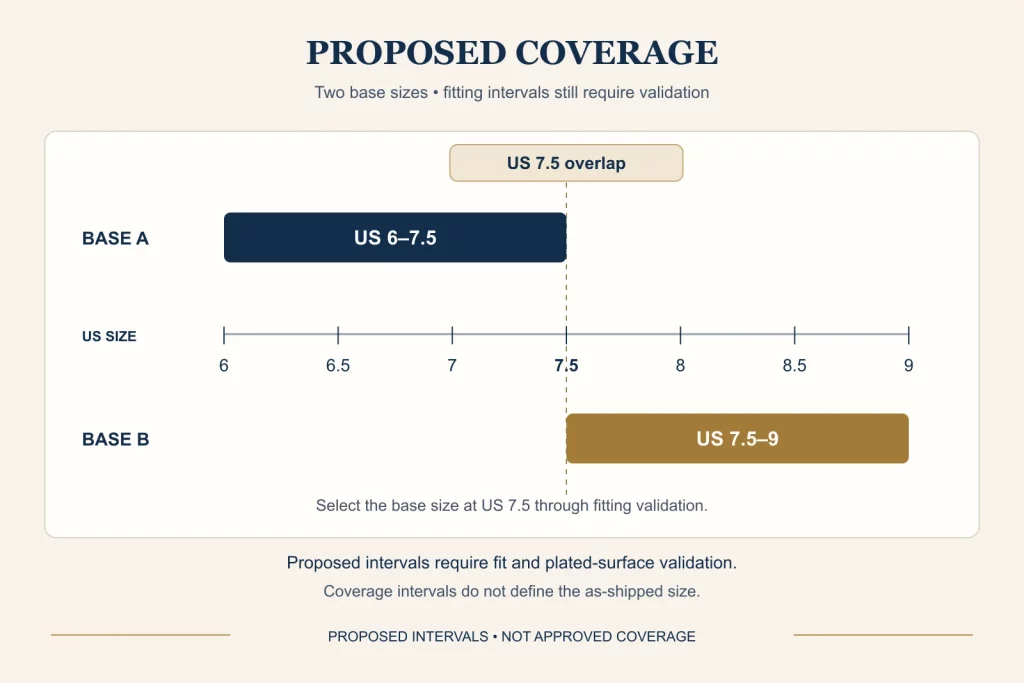
| Lower-range base size | Proposed fitting coverage from US 6 to US 7.5. |
| Upper-range base size | Proposed fitting coverage from US 7.5 to US 9. |
| Nominal shank thickness | Changed from 1.8 mm to 2.0 mm. |
| Open ends | Rounded to improve the end geometry. |
| Surface preparation | Additional attention to polishing around the opening before plating. |
| Intended use | Initial adjustment by the store, without a promise of repeated consumer bending. |
The proposed fitting intervals are US 6–7.5 and US 7.5–9, each spanning 1.5 US size increments. These intervals do not specify the as-shipped size. Each base ring needs its own initial dimensions, opening gap and identifier. The US 7.5 overlap needs a selection rule established during fitting validation.
The increase to 2.0 mm was one change within this project. It should not be read as evidence that a thicker shank is always easier to adjust or that 2.0 mm is suitable for every open ring. The combined geometry and adjustment behaviour still needed checking.
Likewise, rounding and polishing were process changes, not proof that plating cracks had been eliminated. The finished plated sample needed review after the agreed adjustment sequence. A cause-and-effect claim about any single change would require supporting evidence.
What must be validated before promising the range?
Review each base ring in its as-shipped state and at both proposed endpoints. Record opening clearance, inner contact, shape and stability using the agreed fitting conditions. A ring that reaches a gauge size can still be uncomfortable or unstable in use.
Agree the adjustment method, tools, sequence, number of adjustments and acceptance criteria before the check. Record the sample count and version. The approved coverage must come from those results, not from dividing the original range into two equal parts.
| Check | What the record should identify |
|---|---|
| As-shipped condition | Base-size ID, dimensions, opening gap, finish and sample version. |
| Lower endpoint | End clearance, inner contact and fit at the specified size. |
| Upper endpoint | Opening gap, shape, stability and fit at the specified size. |
| After adjustment | Sequence and count, dimensional retention and separate observations for cracks, peeling and other surface changes. |
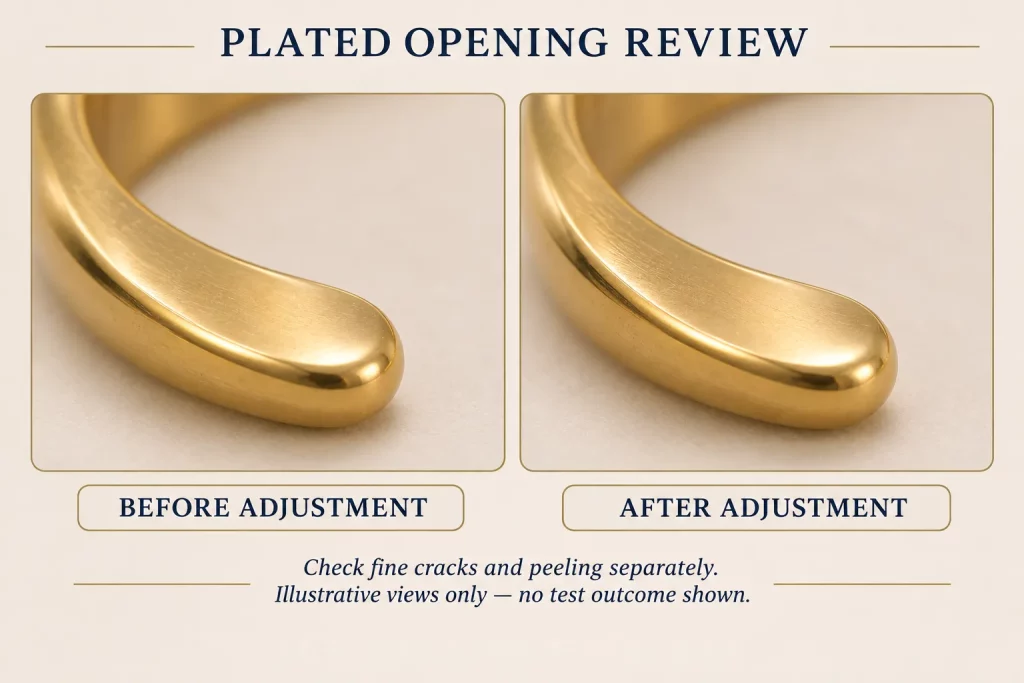
Inspect the finished plated opening after the intended adjustment sequence. Check fine cracks and peeling separately, together with dimensional retention and subsequent adjustment response. Do not translate a one-time fitting check into a repeated-bending life claim.
The original cracking concern remains a release criterion. Rounding, polishing or increasing thickness is a design change, not proof that the concern has been resolved. If the plated sample does not meet the agreed criteria, narrow the range, change the design or reconsider whether adjustment should be sold as a feature.
Our jewelry quality control process explains the wider role of inspection records and corrective-action verification.
How should the size range be communicated to stores and customers?
Once validation is complete, give each base size a clear identifier, an approved fitting range and instructions linked to the tested adjustment method. Until then, keep the intervals in the development brief rather than the retail product promise.
For the store, the selection rule should cover the overlap at US 7.5, the permitted adjustment approach and the checks to make after fitting. For the customer, the description should make clear that this is a store-adjusted first-fit product rather than an invitation to bend the ring repeatedly.
The size range, product listing, packaging and store instructions need to describe the same intended use. If the design, material condition or finishing route changes, the previous sample approval should be reviewed before the same range is promised again.
Planning an adjustable brass ring collection?
Send 96Jewelry the target size interval, opening location, band width and thickness, sales market and intended adjustment method. Include reference images, plating requirements, order quantity and a target purchase price where available.
Tell us whether the wearer will adjust the ring repeatedly or whether a store will set it for first fitting. We can review the development options and the sample checks needed before the range becomes a product claim.
Auteur

Ertian Jiang (Jasper) est le fondateur de Haosen Metal Jewelry. Depuis ses débuts à 26 ans, il associe un solide savoir-faire artisanal à une compréhension fine du marché, deux piliers sur lesquels repose l’excellence de l’entreprise.
Ertian Jiang a commencé comme artisan, spécialisé dans les pierres semi-précieuses (agate, nacre et œil-de-tigre) et l’incrustation manuelle. Il a perfectionné la pose de pierres naturelles sur des supports métalliques, sans jeu ni défaillance de la colle. Son expérience directe de la vente lui a également permis d’échanger avec les acheteurs et de comprendre leurs difficultés face aux pierres qui se détachent et aux couleurs qui s’altèrent.