

“The sample was right. Why does the bulk order look lighter?”
I’m Jasper, founder and technical lead at 96Jewelry. Keeping the gold color consistent between samples and bulk orders is something we find difficult in actual production, especially when the quantities are very different.
I understand why this frustrates buyers. You approved a physical sample and expected the order to look like it. A slightly cooler pendant or paler chain can affect the appearance of the whole collection.
From the factory side, the difficulty is reproducing that appearance when moving from a few samples to a production quantity. That is the part I want to explain before we discuss color names or inspection numbers.
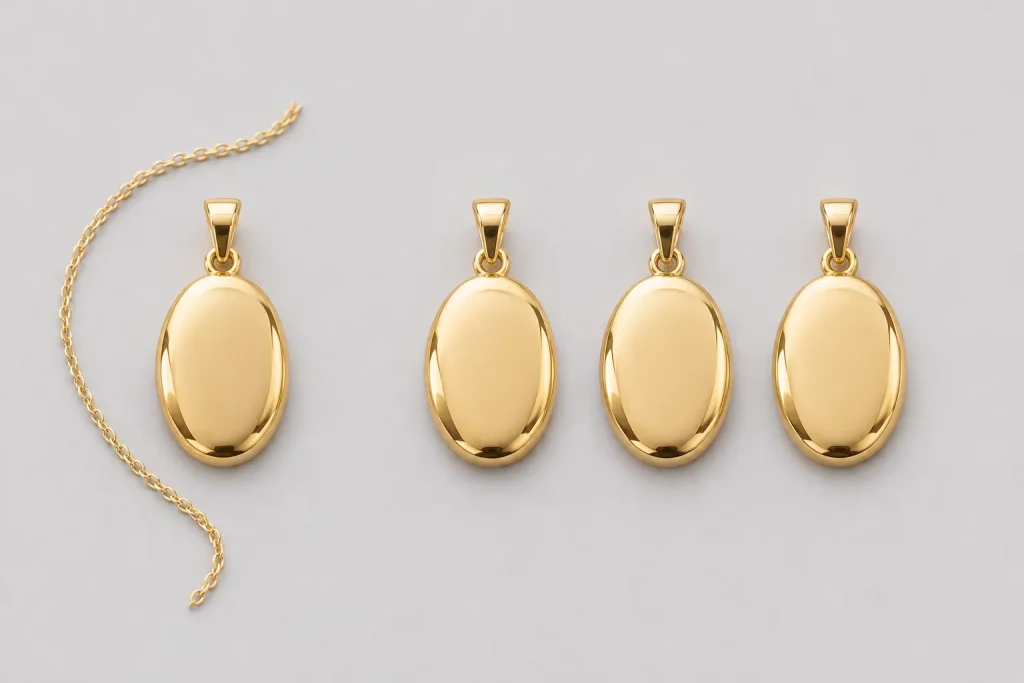
Why Does the Change in Quantity Matter?
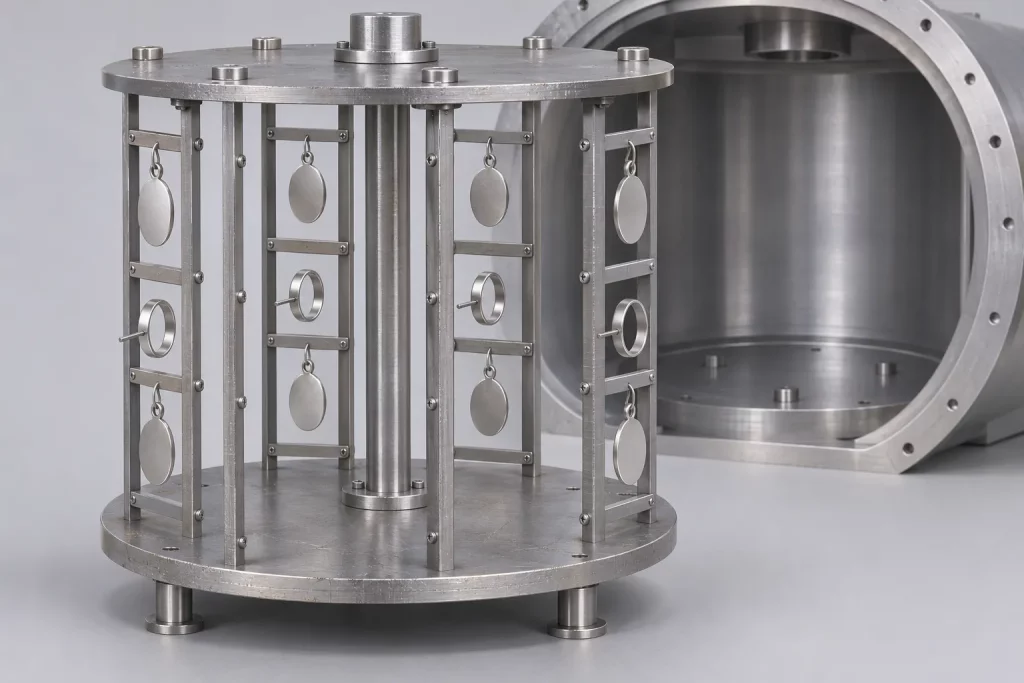
A few development samples and a bulk order can involve different loading arrangements during PVD coating.
Pieces are held on fixtures inside a chamber. Their spacing, orientation, and position affect how the coating reaches the surfaces. As the quantity changes, those arrangements may change too. Larger orders may also pass through several coating runs.
Depending on the coating system, variation in deposition can affect the finished appearance.
For us, this is one of the practical difficulties behind sample-to-bulk color consistency. The approved sample is there on the desk, but reproducing its appearance across the order still requires production control and comparison.
When discussing an order, I therefore want to know the quantity early. I also want to know whether the products will be sold individually, worn as a set, or placed beside stock from an earlier shipment. Those situations create different matching expectations.
A color difference becomes particularly troublesome when a buyer combines a new pendant with an existing chain.
What Are We Matching When You Say "18K Gold"?
If you send me a photograph and ask for “18K gold,” I can use it to understand the direction you want: warmer, paler, brighter, or more muted.
Before production, we need a physical reference.
“18K gold PVD” does not define one exact appearance across suppliers. It also leaves out the surface finish. A polished pendant and a brushed pendant reflect light differently, which affects how the gold looks.
There is another distinction worth making here: “18K gold” may describe a color reference. The name alone does not confirm that the deposited layer is an 18K gold alloy. Coating composition needs separate confirmation when it forms part of your specification or product claim.
For appearance, I would bring the discussion back to three questions:
- Which physical sample are we matching?
- What surface finish does it have?
- How much variation will you accept?
The third question can be uncomfortable before an order starts. It becomes much harder after the goods are finished.
When the Color Looks Wrong, Where Would I Start?
I would put the approved sample and production pieces together first.
Comparing a photograph taken in a warehouse with a sample viewed in an office leaves too many variables. Use the same agreed light source, such as D65, a neutral background, and consistent viewing distances and angles. Check that the surfaces are clean.
Then I would look closely at the polishing or brushing.
Is the production surface as reflective as the sample? Is the brushing coarser? Does the difference appear across the piece, or mainly around textured areas?
This matters because an apparent color difference can involve the surface preparation as well as the coating. Repeating the coating without checking the surface could leave the same problem unresolved.
If the difference remains, the next step is to review the coating runs and loading conditions. I would want to establish whether the mismatch affects:
- Most pieces in the order.
- One coating run.
- Particular components or areas.
That gives the investigation a direction. “It is the same process” tells the buyer very little about why the finished pieces look different.
What Would I Agree With a Buyer Before Production?
I would keep the approval record short enough to use when a real question comes up.
| Item | What we need to establish |
|---|---|
| Master sample | The identified physical sample and revision governing the order |
| Surface finish | The required polishing, brushing, or texture |
| Acceptance range | Written criteria and, where practical, approved limit samples |
| Comparison method | Lighting, background, viewing distance, and angles |
| Production checkpoint | When representative production pieces will be reviewed |
A master sample shows the target. Limit samples help both sides understand how far production can vary and still be accepted.
Because quantity is part of the challenge, I would also discuss how the production checkpoint represents the actual order. Another small development sample may leave the bulk-production question unanswered.
Where feasible, initial production pieces should be reviewed before the remaining quantity proceeds. If the order involves several coating runs, comparisons need to continue across those runs.
This review takes time. It belongs in the production schedule, especially when color matching is a priority for the collection.
Would a ΔE Requirement Solve the Problem?
If a buyer asks me to work to a ΔE limit, my first question would be how we will measure it on the product.
We need an agreed formula, instrument setup, measurement location, and orientation. The tolerance should be established using actual samples and a method both parties can repeat.
Curved rings and fine chains can be difficult to measure consistently. A flat witness coupon is useful for monitoring a coating process; finished jewelry still needs assessment in its actual shape and surface finish.
I would avoid putting a precise-looking number on the order before establishing a reliable method. In that situation, defined visual comparison with physical references gives both parties a more usable basis for approval.
What About Matching Sets and Repeat Orders?
Tell me at the start which pieces need to match.
For a necklace, that includes the pendant, chain, and visible connectors. For a collection, put the earrings, ring, and necklace together during approval. Differences that are easy to overlook on separate inspection trays may become obvious in the finished set.
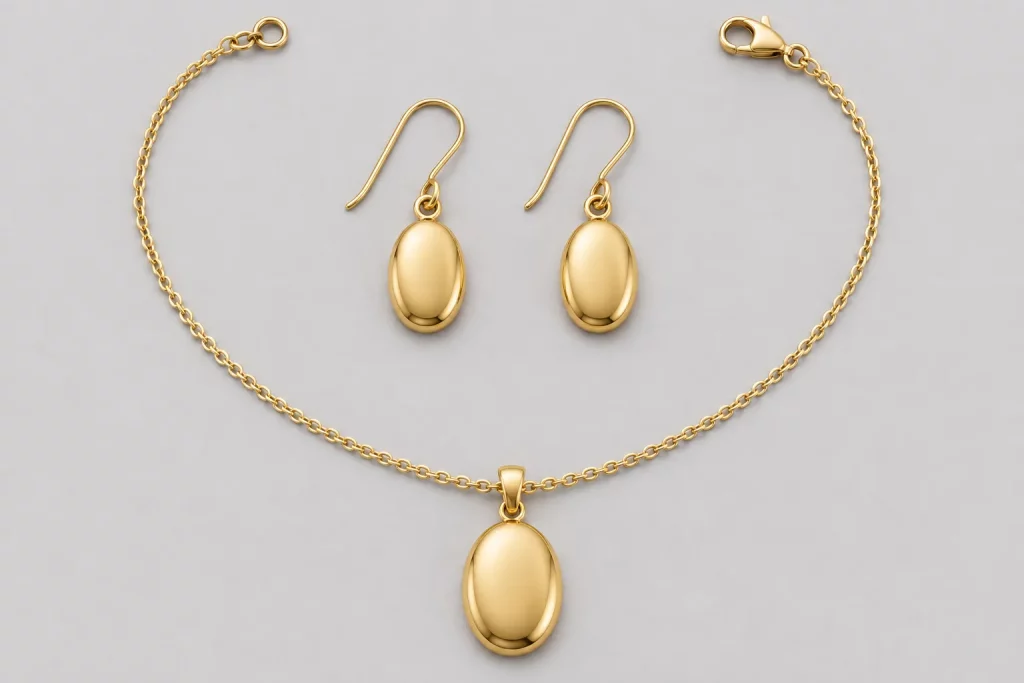
Reorders need the same attention. If the new shipment will sit beside existing stock, include that stock in the comparison while keeping the designated master as the governing reference.
Comparing every new batch only with the last shipment can allow the color to drift gradually. Retained references also need protection: contamination, scratches, or damage can make comparison less reliable.
And if a batch falls outside the agreed range, it needs to be held for review before shipment. Any acceptance of a deviation should identify the affected batch and state whether the original specification remains in force.
At 96Jewelry, the quantity difference between samples and bulk production is a challenge we have to account for. I want that discussion to happen while we can still agree on references, arrange checks, and plan the order properly.
For related questions, see our guides to verifying gold PVD composition et une bonne choosing between 14K and 18K gold tones.
Planning a gold-tone order? Send us your designs, expected quantities, and color reference. Let us know which pieces must match and whether you have existing stock to coordinate with. Those details help us review the appearance requirements before sampling and quotation.
Auteur

Ertian Jiang (Jasper) est le fondateur de Haosen Metal Jewelry. Depuis ses débuts à 26 ans, il associe un solide savoir-faire artisanal à une compréhension fine du marché, deux piliers sur lesquels repose l’excellence de l’entreprise.
Ertian Jiang a commencé comme artisan, spécialisé dans les pierres semi-précieuses (agate, nacre et œil-de-tigre) et l’incrustation manuelle. Il a perfectionné la pose de pierres naturelles sur des supports métalliques, sans jeu ni défaillance de la colle. Son expérience directe de la vente lui a également permis d’échanger avec les acheteurs et de comprendre leurs difficultés face aux pierres qui se détachent et aux couleurs qui s’altèrent.