
- Jasper Jiang
- No Comments
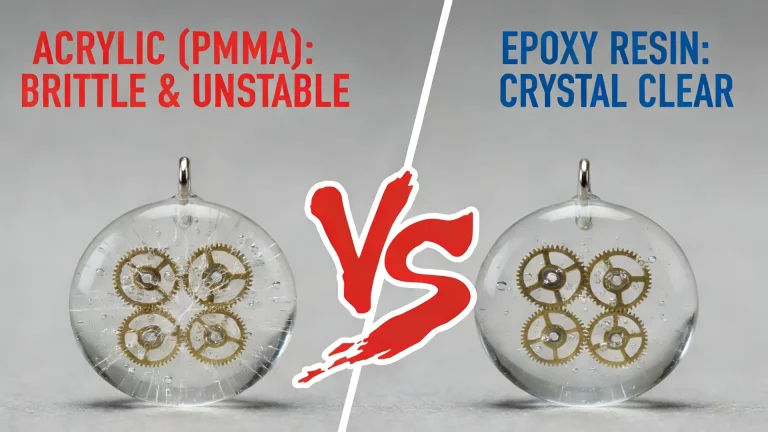
Since I myself oversee a huge amount of design plans each week, one of the dominant designs that is currently sweeping the market is the concept of “floating metal jewelry,” where raw metal parts are wrapped inside transparent materials. But when reviewing plans, up to 90% of plans designate “acrylic (PMMA)” as the material, which, in reality, is a highly costly engineering error.
In the trade-off consideration between acrylic and resin jewelry, the two may look similar, at least according to the drawings. However, upon closer examination, it can be noted that the physical properties of the two are worlds apart. Because of the stress and the coefficient of thermal expansion difference between the acrylic and the metal, the acrylic would continuously “repel” the metal it encloses.
From the perspective of jewelry manufacturing engineering, resin casting is the only solution that can achieve industrial-grade durability. The low shrinkage, flexible stress buffering, and excellent metal adhesion ensure that the “floating” design is not just a visual concept but a durable work of art. Choosing resin means essentially choosing responsibility for the product lifecycle.
Craftsmanship Challenges of Metal-Encased Jewelry: Why Material Selection is Crucial
Metal-encased jewelry has its special appeal in the appearance, but presents many challenges in jewelry making because of the main difficulties in achieving clear and durable encapsulation. For example, air bubbles can easily appear in the embedded material, and material shrinkage or thermal expansion/contraction can cause cracking or de-lamination, putting extremely high demands on durability and optical purity of the encapsulation material.
Second, resin casting and acrylic are the two most popular alternatives. Acrylic is very rigid and tends to have inherent stress; however, resin casts very fluid and gently clamps the metal. In the face of these stringent production challenges, which material will then find a way to harmoniously meld both the art and the engineering aspects of production? This directly impacts the quality of the end product.
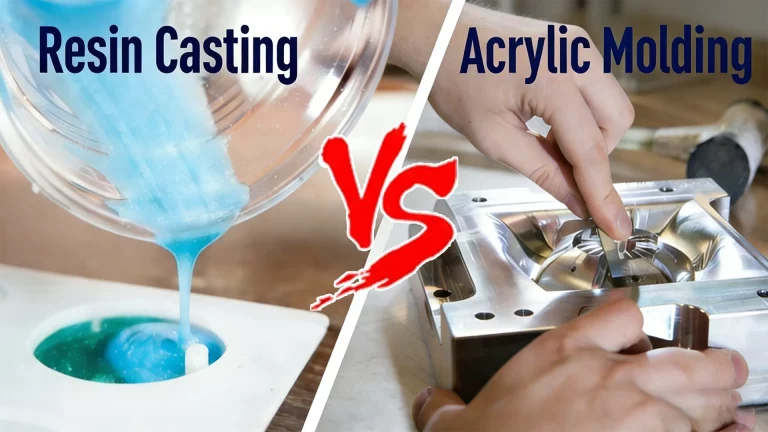
Comparison of Resin Casting vs. Acrylic Molding Principles
The basic difference is based on the molding principles followed by each, which are directly related to the quality and reliability of the encapsulated device. Resin Casting: Liquid Chemical Curing Method It is semi-transparent and remains in a liquid state. However, it solidifies due to a chemical reaction. It has the ability to be entirely encapsulated without any voids and is well-bonded with the metal. Additionally, its shrinkage is low (<1%).
| Comparison Dimension | Resin Casting Process | Conventional Acrylic Thermoforming |
|---|---|---|
|
Starting State |
Low-viscosity liquid |
Solid sheet/rod |
|
Molding Nature |
Chemical curing, molecular-level cross-linking |
Physical deformation and bonding |
|
Bonding with Metal |
Liquid encapsulation, forming microscopic mechanical interlocking and chemical adhesion |
Assembly and surface bonding under solid-state processing |
|
Typical Shrinkage Rate |
0.1% – 1% (low stress) |
Thermal expansion/contraction rate of approximately 0.07% / °C (high risk of internal stress) |
|
Encapsulation Integrity |
Seamless, fully three-dimensional, integrated |
Often involves seams or adhesive layers, resulting in enclosed encapsulation |
5 Major Advantages Explained: Why Resin is the Superior Choice for Jewelers
1. Unparalleled Encapsulation: Achieving "Amber-like" Permanent Encapsulation
The flowing nature of resin is the primary benefit in jewelry making. Similar to how amber encases insects, it completely saturates and fills each link, each etched texture, and even tiny scratches on the metal chain, eliminating air bubbles right from the source. Acrylic cannot achieve this perfect encapsulation effect since its method of processing is solid and can only “surround” rather than “immerse.”
2. Excellent Adhesion and Durability: Ensuring Secure Metal Encapsulation
In the curing process, the resin forms a strong chemical and mechanical bond with the metal surface. Thus, this secure metal encapsulation enables the finished product to effectively withstand impacts during daily wear, and its anti-yellowing rating, such as UV resin, is incomparably better than ordinary acrylic. That means the pendants or rings can keep the metal fragments encapsulated for a really long time in stability without delamination or crack appearance.
3. Operational Flexibility and Creative Freedom: Ideal for Handmade DIY Jewelry
Resin casting is also not dependent on expensive heat bending or cutting facilities, as the mixing and pouring process can be carried out at room temperature, which is ideal for a DIY jewelry making process. Designers can also easily encompass photos, silk, or plants, which increase the designer’s creativity, as the use of acrylic to achieve a similar structure is quite costly.
4. Extreme Optical Performance: Presenting High-Transparency Resin Art
High-quality high-transparency resin has a degree of optical purity equal to that of crystal; it is possible to achieve unlimited color mixing. Thus, to create metal-clad jewelry artwork featuring a gradient starry sky or fluorescent patterns embedded into the material, high-quality high-transparency resin becomes a preferred material for its realization due to its unmatched visual appearance compared to standardized acrylic.
5. Significant Overall Cost-Effectiveness: Optimizing the Process from Prototype to Product
The resin solution saves much time and tool cost for complicated single pieces or small-batch orders. There’s no need to perform multi-processes like precision CNC machining, polishing, and bonding on acrylic; the resin solution allows one-step casting. Material utilization is almost 100%, with almost zero waste, making the total cost of encapsulation for irregularly shaped metal parts far more competitive.
Application Scenarios: Resin Casting Unlocks Jewelry Design Possibilities
Compared with other modelling materials, resin has unparalleled physical properties, expanding creative options for designers to ultimately carry wearable art. Here are a few typical examples:
- Emotional Encapsulation: A loved one’s signature can be transferred onto metal foil and encapsulated in resin permanently. It is a way to personalize your jewelry, but it lends you a memory piece of jewelry; the liquid resin ensures that every detail is clear regarding the handwriting, without any flaws.
- Natural Aesthetics: Fragmented gold leaves are cast together with dried flower petals, as well as miniature metal pieces, to create earrings. The embracing fixative quality of resin is utilized to securely capture these delicate components, thus creating multi-level resin art jewelry.
- Mechanical Art: Creating miniature rings and cufflinks resembling steampunk accessories. This is one of the best examples of metal and resin design. The resin material very effectively penetrates each and every nook and corner of these intricate metal parts.
Examples above prove that resin is not simply a material or medium but is in fact the ultimate tool to achieve creativity and expression.
Practical Guide for Creators: Start Your Resin Casting Journey
The first step into resin casting can be much easier than you think. With this guide, you can be assured to complete your first resin casting successfully.
Step 1: Prepare Your Essential “Jewelry Making Tools”
In the A basic kit would consist of: Two-part high transparency and low bubble epoxy resins ; Silicone molds; Electronic scale; Disposable cups/mixing sticks
Step 2: Master “Epoxy Resin Usage Techniques”
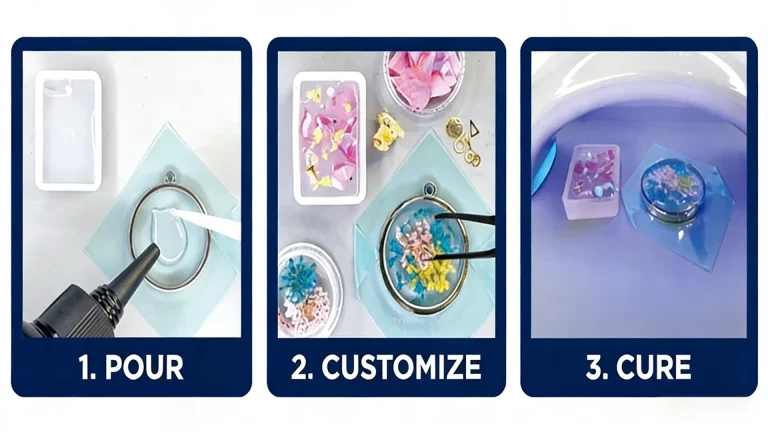
First is preparation in casting: the metal components must be free from dust and moisture. When combining the resin and hardener components, mix it slowly in the same direction based on the weight ratio until the mixture is clear and free from bubbles—3 to 5 minutes is recommended. After casting, you can either carefully remove bubbles with a heat gun or simply wait until the bubbles are released on their own.
Step 3: Beginning with a small project
In order to learn select a pendant or ring mold that is quite simple. Try encasing a bit of metal foil or a dried flower. This is a complete mini tutorial for making jewelry out of resin. It should help you grasp a bit about its properties. Safety is the key to creation. Be careful and wait patiently for it to cure, and you will be able to transform your idea into a physical object.
FAQs
1. What is the minimum order quantity (MOQ) for custom resin with metal jewelry?
To support emerging brands, e-commerce sellers, and designer jewelry labels, we offer a low MOQ policy to help you start with small-batch production:
Earrings: MOQ is 30 pairs per design, single color
Bracelets / Necklaces / Rings: MOQ is 30 pieces per design, single color, single size
This flexible MOQ is ideal for brands testing new collections, launching products, or creating limited editions. For large wholesale buyers and established brands, we also provide bulk order discounts—the higher the quantity, the lower the unit cost, maximizing your profit margin.
2. What customization options do you offer for resin jewelry?
Resin Jewelry offers a wide range of customization options. Our common OEM/ODM services include:
- Design & Structure Customization: New development or style modification based on sketches or 3D files.
- Material Selection: Stainless steel, brass, zinc alloy, titanium, tungsten, and more.
- Surface Finishing: Polishing, brushed texture, sandblasting, matte effects, etc.
- Color & Plating Options: (PVD/Electroplating) gold, rose gold, black finishes, plus enamel/epoxy Resin filling for enhanced visual depth.
- Logo Engraving & Branding: Laser engraving, stamping, etching, color-filled or plated logos.
- Stones & Decorations: CZ stones, natural gemstones, crystals, pearls, and other embellishments.
- Size & Specifications: Custom length, width, thickness, and detailed measurements.
- Packaging Customization: Jewelry cards, gift boxes, and fully branded packaging solutions.
In addition, different jewelry categories support more detailed customization, such as: Extension chains, charms, and custom clasps for bracelets and necklaces; Customized earring backs, posts; Ring size adjustments, thickness changes, and inner engraving; Customization helps strengthen brand identity and is especially suitable for designer brands, cross-border e-commerce sellers, and bulk jewelry production.
3. Can I order samples before placing a bulk order?
Yes, we highly recommend ordering samples before mass production to verify product quality and avoid risks.
Sample Ordering Process:
Design submission → Material & finish confirmation → Quotation (sample fee + mold fee if needed + shipping) → Payment → CAD/3D design (1–3 days, 2 free revisions) → Sample production (5–15 days) → Polishing & plating → Quality inspection → Shipping (3–7 days)
Sample Cost & Lead Time:
Sample fee: USD 50–200 per style; Mold fee (if required): USD 100–500; Shipping fee: USD 30–80; Total sample delivery time: 2–4 weeks.
4. What is the production lead time for bulk jewelry orders?
Our standard bulk production lead time is 20–30 days, depending on the design complexity and order quantity. In general, mass production for jewelry orders takes around 15–45 days, based on the factors below:
- Jewelry type & craftsmanship: Simple designs usually take 15–25 days, while stone-set or highly customized styles may require 30–45 days.
- Order quantity: Larger wholesale orders need more time for scheduling and quality inspection.
- Mold or sampling requirement: New styles may need an additional 7–15 days for mold development and sample approval.
- Material & stone availability: Lead time may vary based on raw material and gemstone supply.
- Factory capacity & peak seasons: Production schedules can be affected during busy periods.
To shorten lead time and improve on-time delivery, we recommend confirming designs early, placing consolidated orders, and working with a reliable stainless steel jewelry manufacturer like Haosen with a stable supply chain and efficient production management.
5.Are your resin jewelry tested and compliant with international standards?
Yes. All of our xx undergo strict quality testing and meet international compliance standards for global export.
- Common certifications and tests include: REACH / RoHS compliance, Heavy metal testing (Nickel, Lead, Cadmium)
- Physical durability tests: corrosion resistance, oxidation protection, abrasion tests
- Third-party inspection support: SGS, TÜV, BV, etc.
We can provide customized testing solutions and reports based on your target market (EU, USA, Middle East, etc.).
6.What are your payment terms?
We offer flexible payment terms depending on the cooperation model:
- Bulk orders: 30% deposit + 70% before shipment;
- Custom or mold orders: 50% deposit + balance after sample approval;
- Long-term partners: Monthly settlement or staged payment options available;
- Supported payment methods: T/T bank transfer, Alipay, PayPal (for small sample orders).
7.Do you provide worldwide shipping? What shipping methods are available?
Yes, we ship globally to North America, Europe, Australia, the Middle East, and Asia.
Available shipping options include:
- Express courier (DHL/UPS/FedEx): best for samples or small orders;
- Air freight: balanced speed and cost for medium replenishment;
- Sea freight: lowest cost for large wholesale shipments;
- Amazon FBA direct shipping: labeling, carton splitting, packing list support;
We also assist with customs clearance documents, HS codes, and Incoterms (EXW/FOB/CIF/DDP).
8. What if there is a quality problem after receiving the goods?
We provide a complete after-sales support system to ensure safe cooperation.
- Quality Issue Handling Process: Customer provides photos/videos within the required timeframe; We identify whether the issue is caused by production, shipping, or usage;
- Solution offered: replacement, repair, refund, or re-production. If it is a manufacturing defect, all related costs are covered by us;
Our QC system includes pre-shipment inspection, sample retention, and full production traceability—minimizing risk for overseas wholesale buyers and jewelry brands.
9. How does Haosen Jewelry handle air bubbles in complex resin designs?
Bubbles are a common defect in DIY or low-quality resin casting, especially with intricate metal chains. However, at Haosen Jewelry, we employ industrial-grade techniques to ensure optical purity. We utilize a professional pressure pot curing method that applies 60 PSI of pressure during the curing process.
This high pressure forces any microscopic air bubbles—that vacuuming alone might miss—to collapse and dissolve into the resin before it hardens. This technique is part of our rigorous craftsmanship process, ensuring that the final product is crystal clear and free of the visual flaws often found in standard casting or acrylic bonding methods.
10. Will the metal parts embedded inside the resin tarnish or rust?
Generally, no. The resin acts as a permanent, airtight seal. Once Haosen Jewelry encapsulates the metal, it is effectively cut off from oxygen and moisture, which are the primary causes of tarnishing. This creates a “time capsule” effect, preserving the metal’s shine indefinitely.
We recommend using Stainless Steel or Brass for the best structural results. If your design requires Sterling Silver (925), we can accommodate it, but we apply a pre-treatment tarnish protection coating before casting. This attention to material science ensures that your jewelry maintains its “floating” aesthetic without the metal degrading inside the encapsulation.
Conclusion
In the most crucial decision that creative jewelry making has to make-resin versus acrylic-the verdict is clear. For metal encapsulation designs requiring superior encapsulation, industrial-grade durability, and unlimited creative freedom, resin casting is, quite unmistakably, the best material choice.
It is the technical guarantee not only for the realization of “floating” beauty but also for a solid bridge to transform the fragile inspiration into eternal works. Every casting forms an perfect combination of imagination with the science of materials.
When both avant-garde visuals and wearable strength are needed in your design, choosing a professional partner is a must. Founded on 16 years of profound experience in jewelry manufacturing engineering, Haosen Jewelry can provide you with full-suite services ranging from personalized jewelry customization to high-ended clothes and handbag resin accessories.
Let us provide the most solid foundation for your creativity with our professional material science and craftsmanship. Contact us for free material selection advisory service and professional customization solutions today!

Jasper Jiang
Jasper Jiang is the founder of Haosen Metal Jewelry. Since the age of 26, he has combined his deep roots in traditional craftsmanship with a sharp vision for the market to build the foundation of our excellence.