

- Jasperyi
- No Comments
A premium Italian vegetable-tanned leather bracelet is delivered in a warm, honey-gold hue. Six months later, a complaint arrives: “The color has turned too dark; it doesn’t look new anymore.” Meanwhile, another brand includes this exact scenario in its product manual: “Expect this piece to evolve with your lifestyle, deepening into a color that is uniquely yours.”
- In my twenty years of custom jewelry manufacturing, I have handled countless inquiries regarding leather discoloration. Color shifting is the most debated characteristic of leather jewelry—and it is the key divide in defining a product’s value. For high-volume buyers and brand owners, the ability to scientifically understand, manage, and leverage this trait directly impacts brand reputation and return rates.
- This article lifts the lid on the “discoloration” phenomenon in an effort to demystify the three different kinds of color changes from a manufacturing standpoint.
What is the Reality with Three Kinds of Leather Color Change?
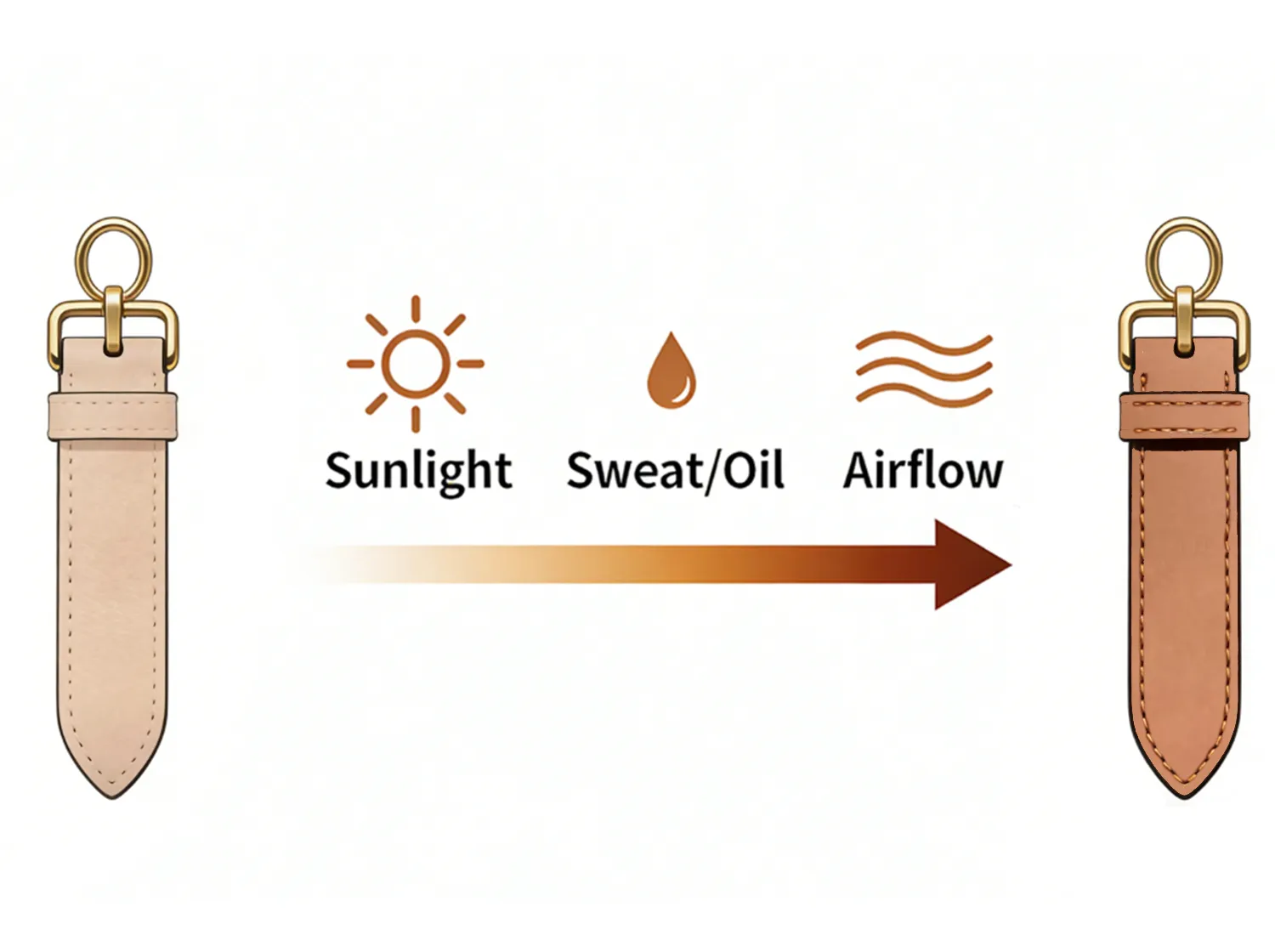
1. Characteristic Color Change
Good-quality natural leathers, particularly vegetable-tanned, oil-waxed, and horse-harness leathers, undergo natural oxidation and colour deepening when in contact with air, skin oils, and sunlight. This process is not reversible.
- Cause: Plant tannins in the leather undergo reactions with the environment. This results in contraction and tightening of the fibers as well as darker colors.
- Recommendation: This should be pointed out in the product description, and samples should be given of the colors that change.
2. Quality Defect Discolor
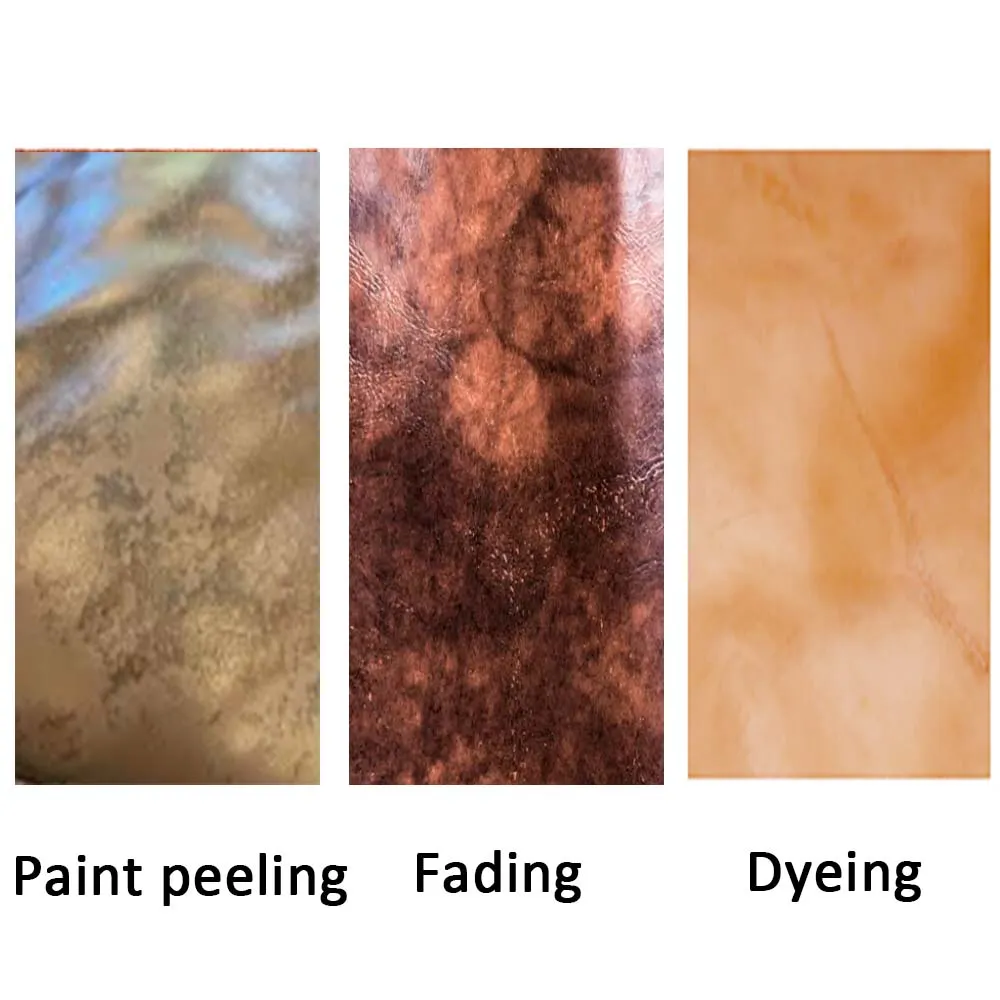
Staining of leather while wearing it, or mottled color bleeding on light-colored leather surfaces.
- Dye Migration or Staining: Leather dyes that are not fixed and transfer to the user’s skin or clothing.
- Grey or White Haze: The separation of low quality paint coats from friction, sweat, and chemicals.
- Uneven Fading: Gradual changes in the color that occur patchily from exposure to light.
- Root Causes:
The Poor quality leathers, low-grade dyes, poor color-fixing techniques, and poor quality control.
3. Accidental discoloration
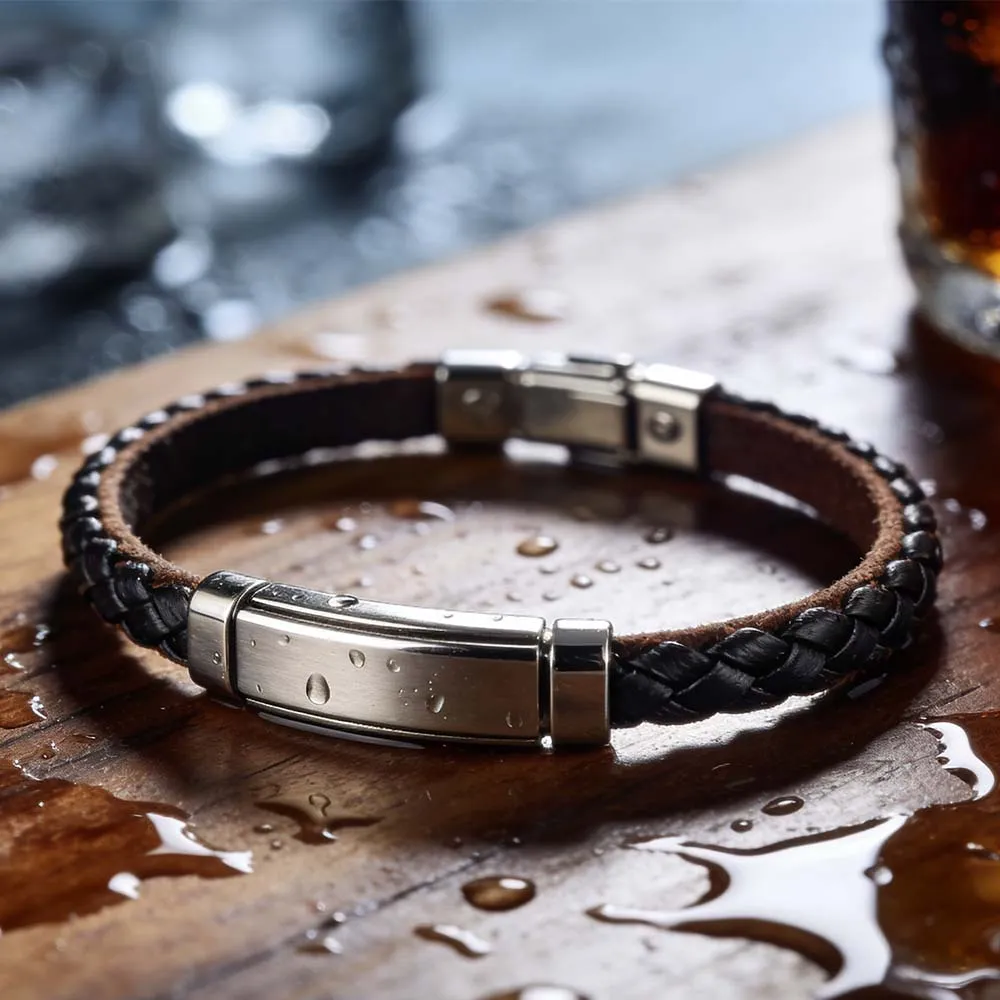
Caused by external factors like “spills of water or liquids used for beverages, sweating absorption, or cosmetic stains. Not material defects in themselves, they have a profound impact on the customer experience.”
- Advanced Treatment Process: We provide an environmentally friendly triple-proof process (waterproofing, oil-resistant, stain-resistant). With our nano-coating technology, we improve liquid-resistant properties dramatically without changing its textures or appearance. Water drips on treated leathers repel due to the beading effect.
- Structural Design Mitigation: To mitigate this design issue, during the design phase, the use of leathers or composite materials with better sweat resistance properties can be incorporated in areas that come into direct contact with perspiration, for example, the inner part of the wristband.
The Discoloration Challenge in Leather-Metal Accessories
When leather and stainless steel are combined, discoloration issues become significantly more complex. The junction between these two materials often becomes a focal point for discoloration, primarily due to the following reasons
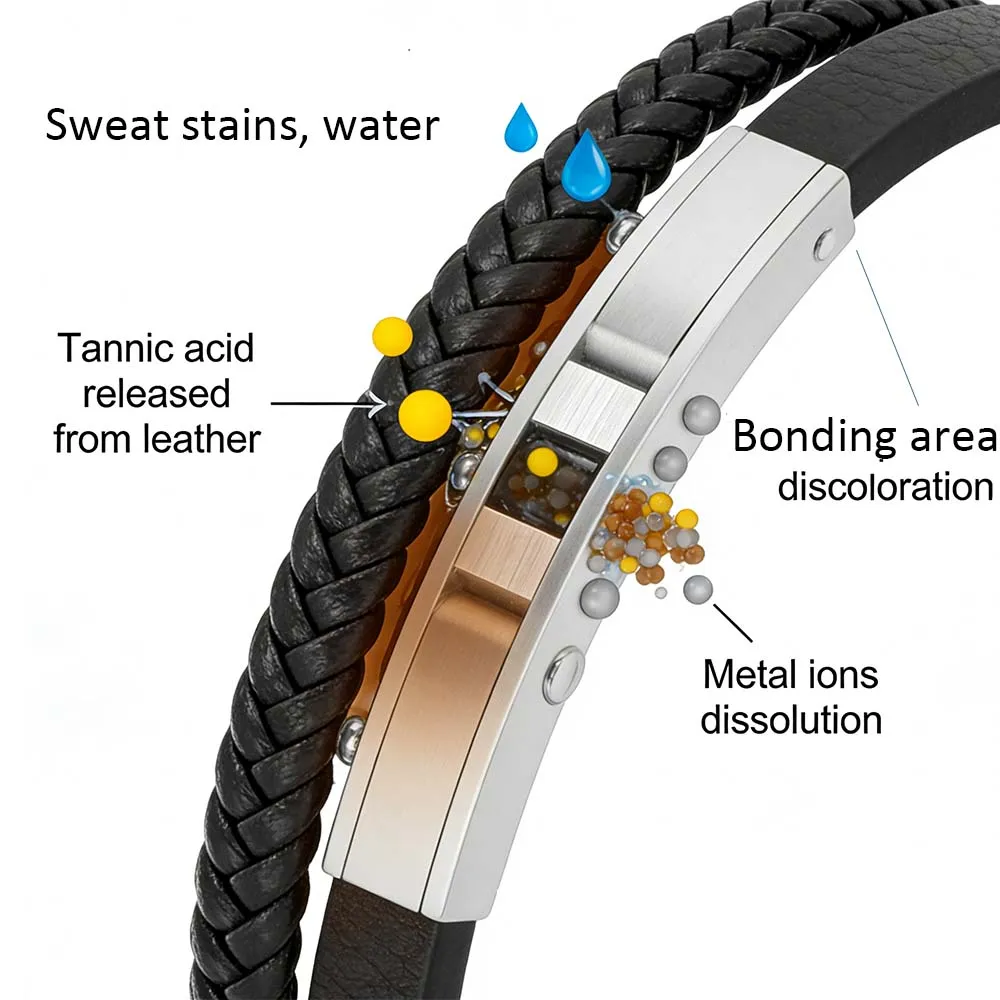
1.Micro-environment Trapping
- Moisture and sweat accumulate in the crevices between leather and metal. This trapped humidity accelerates hydrolysis and can trigger subtle electrochemical reactions between leather tannins and the steel, causing localized darkening.
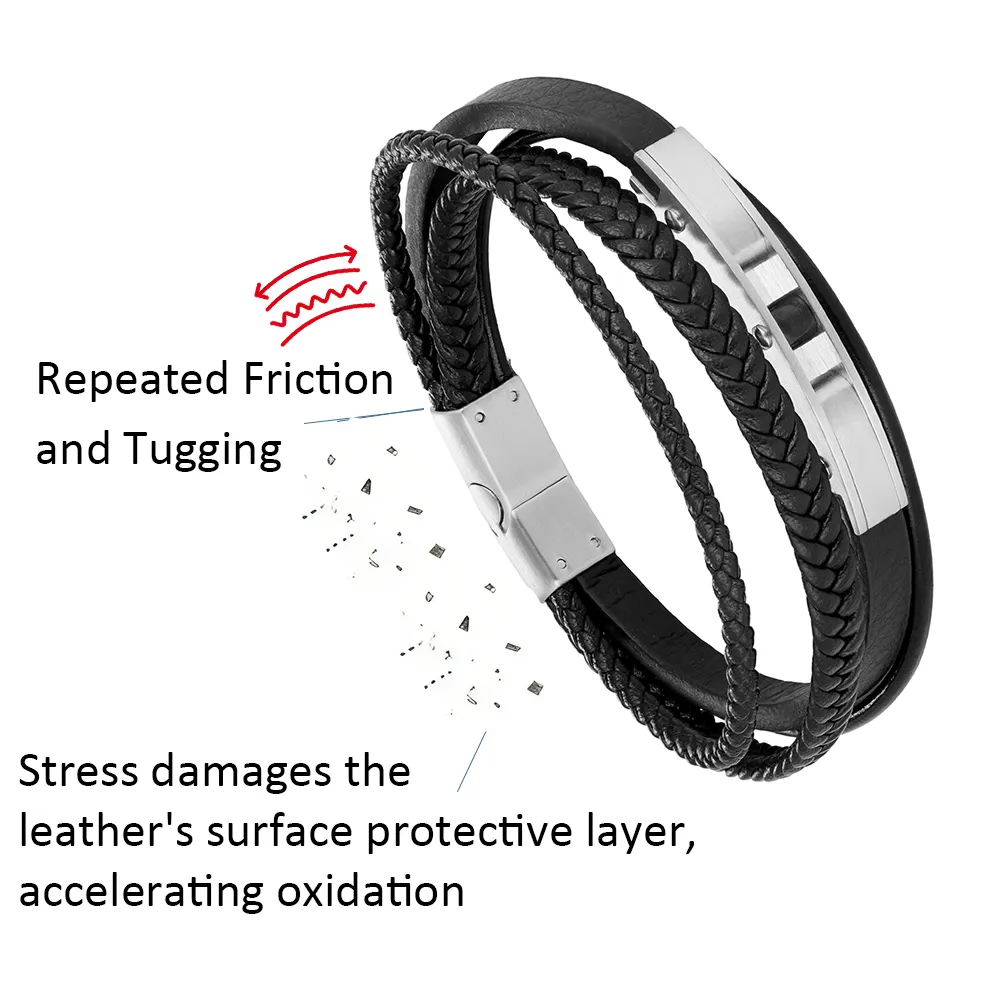
2.Stress Concentration
- At clasps and attachment points, leather endures constant friction against rigid steel. This mechanical stress compromises the finish, exposing fibers to faster oxidation and staining.
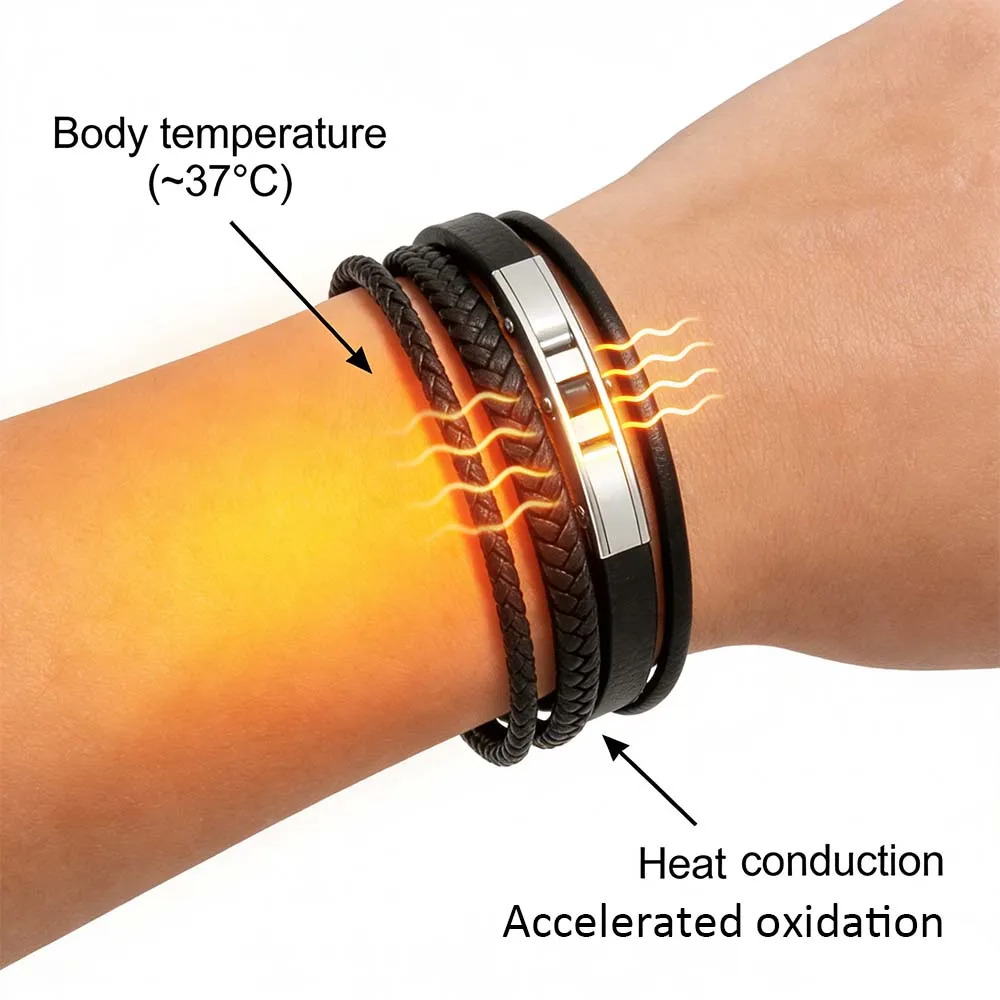
3.Thermal Conductivity
- As an efficient heat conductor, stainless steel transfers body heat directly to the leather interface. This localized rise in temperature speeds up the chemical oxidation process.
At 96Jewelry, every batch of leather undergoes three layers of quality inspection.
| Test Item | Standard & Method | Passing Grade | Issue Resolved |
|---|---|---|---|
|
Crocking (Rubbing Fastness) |
Rubbing the surface with a standard white cloth under pressure (Dry & Wet) |
Grade 4+ (Dry/Wet) |
Prevents color bleeding onto clothing |
|
Perspiration Fastness |
Soaking leather in acidic/alkaline artificial sweat solutions |
Grade 4+ |
Ensures sweat won’t cause fading or skin staining |
|
Lightfastness |
Simulated long-term UV exposure in a Xenon arc chamber |
Grade 4+ |
Prevents rapid fading in display cases or outdoors |
Maintenance Logic for Leather and 316L Stainless Steel
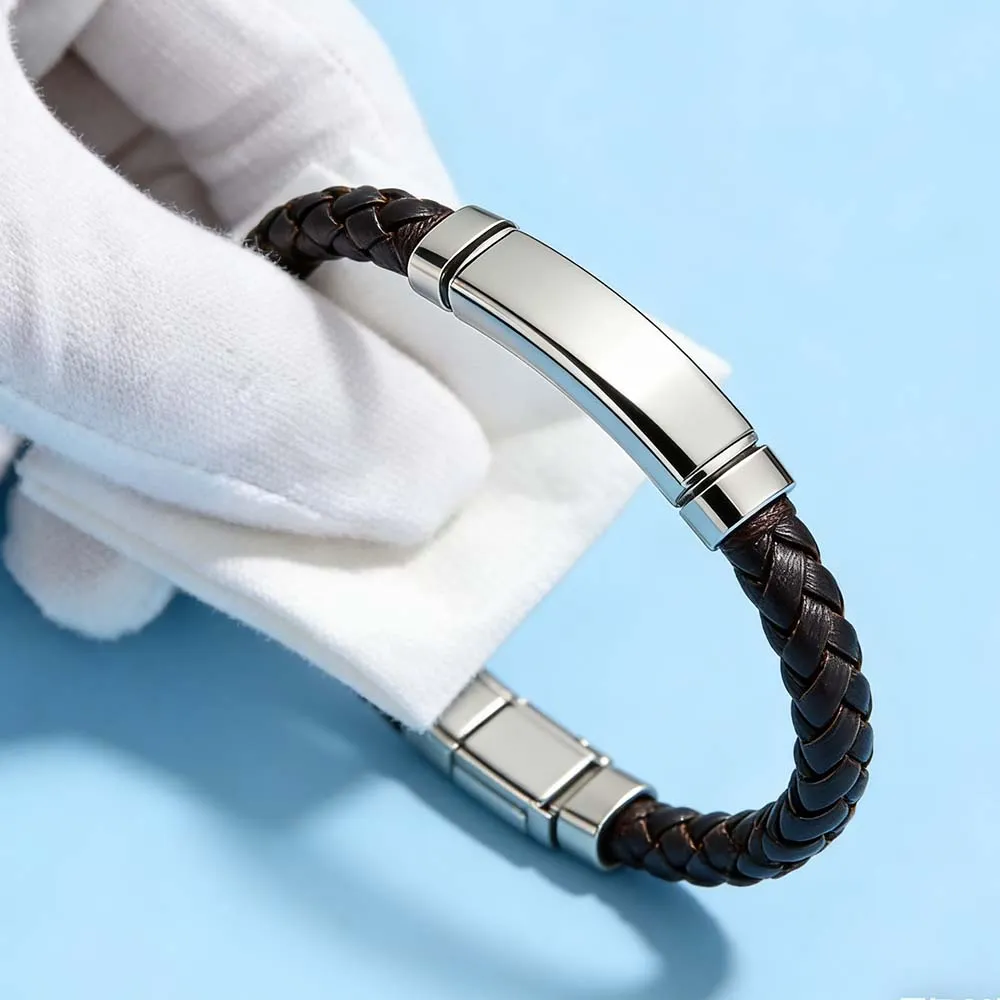
For Metal Components: Preventing “Hazing” and Oxidation
Regular Maintenance: Users are advised to clean the 316L stainless steel with a microfiber cloth. Also, if any of the leather parts are oiled with conditioning oil, users should remove any grease residue from PVD surfaces because otherwise, a “haze” effect would be created on these metal parts.
Dry Storage: Water serves as the medium for the action of leather tannins on metals, corroding them. We suggest that specialized anti-mold desiccant packets be included with the product itself and recommended for storage purposes.
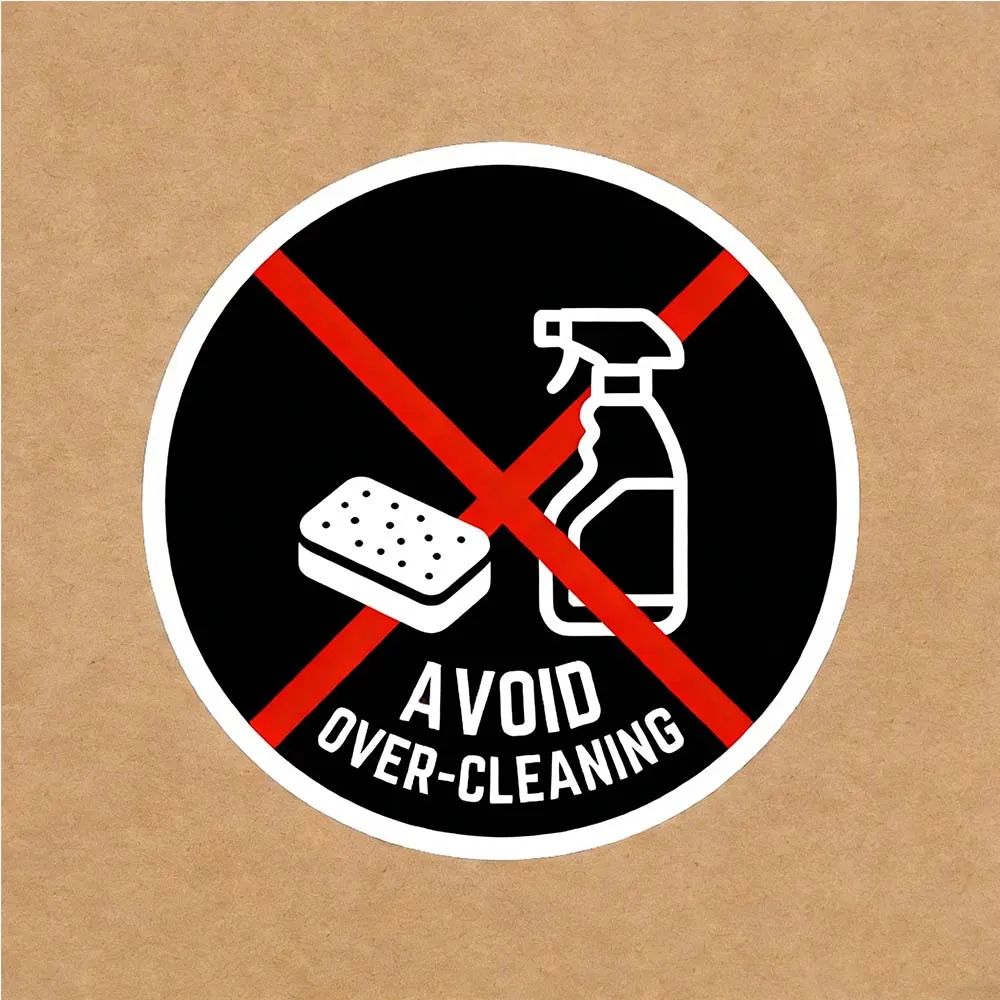
For Leather: Preventing “Hardening” and Cracking
Avoid Over-Cleaning: Too much moisture results in the evaporation of natural oils, stiffening the fibers.
Professional Care: Regular application of natural oils helps maintain leather suppleness; otherwise, cracks may appear where it connects to the rigid stainless steel buckle.
FAQ: Things You Should Know About Leather Aging
Basic Questions Concerning Leather Discoloration
Does all leather change color?
Yes, it is a characteristic of all natural leathers. It does not change to the same extent, with vegetable-tanned leathers changing more than others, while patent leathers change the least.
Is leather discoloration a quality issue?
Not necessarily. A natural occurrence, such as even and gradual oxidation, can be part of the nature of the leather itself. However, uneven discoloration could point to problems in manufacturing.
Why has my leather item turned darker?
These include oxidation of oil and light. Oils from natural skin secretions or care products interact with the leather fibers. This causes an increase in the color intensity and shine. A: This is typically as a result of light exposure that is not evenly distributed. Areas that are most often touched or are more exposed to sweat as well as more exposed to sunlight become discolored faster, which then produce distinctive patterns.
Why do regions turn darker while others do not change?
This is normally due to an uneven exposure. The areas that are touched, come into contact with sweat, or receive direct sunlight turn darker early in order to form “wear patterns.”
Can the leather discoloration process be reversed?
No. It’s a chemical change like when an apple turns brown when cut. It is part of the process of the material’s life cycle.
In what respect, color-wise, does vegetable tanned leather vary from ordinary cowhide?
Vegetable tanned leathers have substantial color variation (light yellow to deep brown), while chrome tanned leathers (top-grade cow leathers) change very little in color, mostly developing patina.
How can I determine if a loss of color is normal or a problem?
Normal discoloration will be even; mellow; the damaged discoloration may be associated with, ic, cracks, whitening, coating peeling, punching odor, et cetera.
Does the discoloration of leather reduce its lifespan?
Reasonable, even discoloration does not affect it and may even indicate well-nourished leather. Only abnormal discoloration accompanied by cracking or moldy spots will shorten its lifetime.
Can I prevent leather from changing color?
It’s almost impossible to prevent completely. However, to significantly slow down discoloration, it would be necessary to store the leather away from light and moisture, minimize direct contact, and use professional protective agents.
Causes for Discoloration of Leather
What causes the colors of the leather to change?
Four basic causes of aging are light, specifically UV rays; oxygen; oils, which include hand perspiration; and moisture.
What should I do first with newly bought leather accessories?
Use a professional treatment (like mink oil or a conditioning cream) thoroughly. This provides an initial layer protection, ensuring an evener development of the colors later on.
What is the frequency for leather maintenance?
It depends on the usage pattern. In the case of things that are used daily, maintenance should be performed every 3-6 months. In the case of things that are less frequently used it.
Is it possible to develop leather color evenly using sunlight?
Strongly discouraged. Sunlight can hardly be controlled, which may cause localized overheating, drying, and fading of the sample, with subsequent irreversible damage.
What should I do when my leather gets wet?
Blot with a lintfree cotton cloth and do not rub. Air-dry in well-ventilated areas. And never use a blow dryer/hair dryer or any heat source.
Can pre-existing stains or discoloration on the granite be removed?
Water-based stains might work, but oil-based stains definitely will. It is always best to hire a professional to clean your leathers. Never clean with random cleaners.
Can darkened leather be lightened?
It is absolutely not possible. It is an irreversible chemical reaction. “Restoring” coloring materials may have dangerous chemicals affecting leather.
Can leather accessories of different colors be stored together?
No, especially light and dark-colored leathers. Dyes may migrate between them, causing cross-staining.
How should I store leather items long-term?
After cleaning and conditioning, place them in a breathable cotton bag (avoid plastic) within a cool, dry, dark cabinet with moisture absorbers.
What is the best care product available on the market today?
There is no “best”—only the most suitable. Vegetable-tanned leather requires high-fat oils (like mink oil); smooth leather benefits from lotion-based conditioners; suede has dedicated cleaning and waterproofing sprays.
Can I waterproof leather at home?
Yes, but use branded leather-specific waterproofing sprays and test on an inconspicuous area first. Results may differ from professional treatments.
What if mold has already formed?
Gently brush off mold spots with a soft-bristle brush, then treat with a leather-specific antibacterial cleaner. Severe mold requires professional intervention, as fungal roots may have penetrated deeply.
What if the edge oil (edge sealant) cracks or discolors?
This is common wear and tear. You can purchase an edge oil repair pen to touch up and fill in the color, or send it to a professional craftsman for re-polishing and re-oiling.
What are the key care points for coated leather?
The focus is on protecting the integrity of the coating. Avoid scratches from sharp objects and use neutral, non-oily cleaning and care products to prevent the coating from dissolving.
Material Differences Affecting Leather Discoloration
What color does vegetable-tanned leather end up splashing when it changes colors?
It depends on the tanning process and oils. Typical order: natural → honey → light brown → caramel → dark brown. Every skin, however, is different.
What does the transition of the oil-waxing leather’s colors entail?
Creases or ‘lychee grain’ allow the wax to move because it is being flexed. It creates a strong contrast between dark colors.
How much does patent leather retain color?
Patent leather is coated with a layer of resin, making it have the most stable color. Patent leather, though, may become discolored around the edges when the resin layer cracks due to scratches or age, allowing the entry of impurities.
What is the color change process of suede or nubuck?
It changes color subtly. It stains easily. It is not easily removable. It is all part of its color.
Does the leathers of varying colors bleach at the same rate?
No. Darker colors (black, brown) show very little softening of the visible fading, which is seen mainly as changes in gloss. Lighter colors (white, light pink) show very noticeable fading. Colored skins may become grayish.
Does cordovan leather fade?
Yes, it is absolutely entrancing. It develops its patina to a high shine that transitions to a warm mirror finish.
Does the repaired leather change color evenly?
Usually not. The dyes used in repairs have different properties from the original leather, and it results in different aging processes and sometimes different colors.
Does PU leather change color?
Yes. However, its colour change will often involve general decay—the surface PU film will develop crusts, peel, become tacky, yellow, and lose texture—rather than the development of ‘patina’ evident in natural leather.
What about the color change features of eco-leathers (apple leather or mushroom leather)?
There is not as much known about long-term effects concerning color change because these are new materials. However, because of their complicated base material and coatings, their effects in terms of color change may be unpredictable as well.
Do rare leathers (crocodile, lizard) used by luxury brands show noticeable color changes?
Yes, significantly. Their natural scale patterns develop deeper luster and more pronounced texture as oils permeate the leather, enhancing perceived value with use.
Prevention, Maintenance, and Restoration of Leather
How can I scientifically delay leather discoloration?
Threefold treatment strategy: 1. Prevent exposure to light (when storing the picture); 2. Clean regularly (with professional cleaning solutions); 3. Treat appropriately with water-resistant materials.
What should I do first with newly bought leather accessories?
Use a professional treatment (like mink oil or a conditioning cream) thoroughly. This provides an initial layer protection, ensuring an evener development of the colors later on.
What is the frequency for leather maintenance?
It depends on the usage pattern. In the case of things that are used daily, maintenance should be performed every 3-6 months. In the case of things that are less frequently used, it
Is it possible to develop leather color evenly using sunlight?
Strongly discouraged. Sunlight can hardly be controlled, which may cause localized overheating, drying, and fading of the sample, with subsequent irreversible damage.
What should I do when my leather gets wet?
Blot with a lintfree cotton cloth and do not rub. Air-dry in well-ventilated areas. And never use a blow dryer/hair dryer or any heat source.
Can pre-existing stains or discoloration on the granite be removed?
Water-based stains might work, but oil-based stains definitely will. It is always best to hire a professional to clean your leathers. Never clean with random cleaners.
Can darkened leather be lightened?
It is absolutely not possible. It is an irreversible chemical reaction. “Restoring” coloring materials may have dangerous chemicals affecting leather.
Can leather accessories of different colors be stored together?
No, especially light and dark-colored leathers. Dyes may migrate between them, causing cross-staining.
How should I store leather items long-term?
After cleaning and conditioning, place them in a breathable cotton bag (avoid plastic) within a cool, dry, dark cabinet with moisture absorbers.
What is the best care product available on the market today?
After cleaning and conditioning, place them in a breathable cotton bag (avoid plastic) within a cool, dry, dark cabinet with moisture absorbers.
Can I waterproof leather at home?
Yes, but use branded leather-specific waterproofing sprays and test on an inconspicuous area first. Results may differ from professional treatments.
What if mold has already formed?
This is common wear and tear. You can purchase an edge oil repair pen to touch up and fill in the color, or send it to a professional craftsman for re-polishing and re-oiling.
What are the key care points for coated leather?
The focus is on protecting the integrity of the coating. Avoid scratches from sharp objects and use neutral, non-oily cleaning and care products to prevent the coating from dissolving.