

What Matters Most for Your Design?
Start with your main priority. These options provide a starting point for discussion; the final choice depends on your product’s structure, finish and intended use.
Everyday Wear
Explore stainless steel options for frequently worn chains, rings, bracelets and pendants.
Detailed Metal Designs
Compare materials for sculpted shapes, decorative details and plated finishes.
Lightweight Statement Pieces
Explore resin and acrylic components for larger designs with controlled weight.
Natural Texture & Color
Explore natural stones, pearls, shell and leather for distinctive material combinations.
Compare Base Metals
Choose the metal around the design—not just the color. Review the required shape, construction, finish and order quantity together.
| Matériau | Consider It For | Confirm Before Sampling |
|---|---|---|
Everyday jewelry, chains, rings and metal components |
Dimensions, forming method, finish and intended wearing conditions | |
304 Stainless Steel |
Selected chains and components where the specification suits the project |
Required grade, exposure conditions and the reason for choosing 304 |
Detailed decorative designs and plated jewelry |
Wall thickness, product weight, plating system and assembly details | |
Molded decorative shapes, charms and accessory components |
Tooling, minimum thickness, strength requirements and order volume | |
Other Materials |
Projects considering titane, silver or copper |
Exact material specification, manufacturing feasibility and target cost |
Compare the complete product cost. Tooling, processing, finishing, assembly and order quantity can change the quotation—not just the raw material.
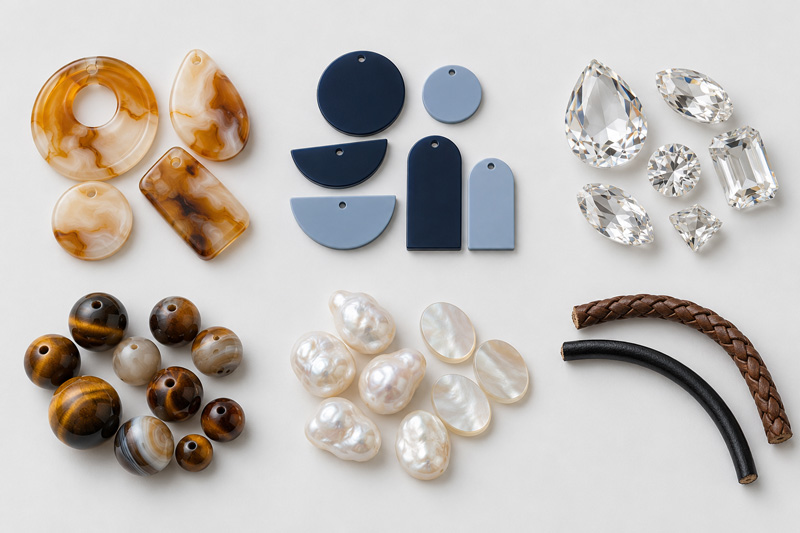
Choose Decorative Materials
Add color, texture and character with decorative materials. Confirm dimensions, attachment methods and acceptable variation alongside the metal components.
Résine
Explore cast shapes, translucent colors and embedded details. Confirm the required appearance, metal connection and aging expectations.
Acrylique
Explore cut shapes and layered components. Confirm thickness, edge finish, hole positions and assembly details.
Glass & Crystal
Add faceted sparkle or colorful glass details. Confirm shape, size, backing and attachment method.
Cubic Zirconia — CZ
Explore faceted stones for setting-based designs. Confirm stone dimensions, color and setting compatibility.
Natural Stones
Bring distinctive patterns and color variation to beaded or inlaid designs. Agree on acceptable variation before production.
Pearls & Shell
Explore soft luster and organic textures. Confirm size, shape, matching requirements and attachment details.
Leather & Cord
Add flexible texture to bracelets and mixed-material accessories. Confirm thickness, color, end fittings and construction.
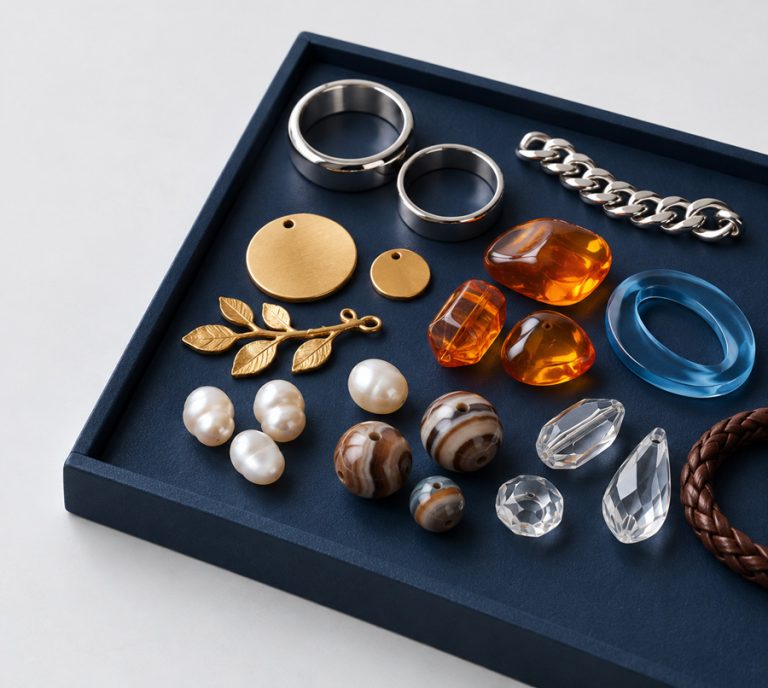
Before You Confirm a Material
A material name is only the starting point. Confirm these details to make your sample request clearer.
| Product & Construction | What are you making, and how will the parts connect? |
| Size & Target Weight | Share dimensions, thickness and any weight limits. |
| Wearing Conditions | Describe expected skin contact, wear frequency and exposure. |
| Color & Finish | Specify the desired color, texture and finish reference. |
| Quantity & Target Cost | Provide quantity per design and color, plus your target purchase price. |
| Market & Documentation | Identify the destination market and any requested testing or documentation. |
Already shortlisted your materials?
Next, define the color and surface finish for your samples.
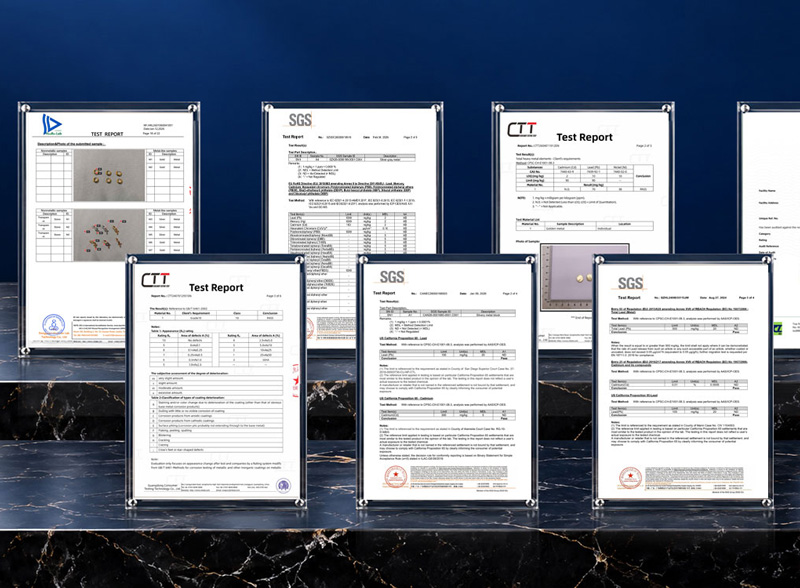
Review Documentation for Your Selected Materials
Review available material and product test reports alongside your project requirements. Check the tested sample, report date and test scope to understand how each document relates to your design.
Some reports cover materials supplied by our suppliers. These documents relate to the samples identified in each report and do not automatically cover every finished jewelry design.
FAQ
1. Which material should I choose for my design?
Start with the product’s shape, intended use, target weight, finish and purchase budget. Share a reference image or drawing so we can help shortlist materials and review manufacturing feasibility.
2. Can one design combine several materials?
Mixed-material designs can be evaluated during development. Confirm how the materials connect, how their colors work together and whether the assembly meets your product requirements.
3. Does l’acier inoxydable 316L mean nickel-free?
No. 316L is a stainless steel grade and does not mean nickel-free. Specify any nickel-release testing requirements for your finished product.
4. Does the same Quantité minimale de commande apply to every material?
No. MOQ depends on the design, material, tooling, process and finish. Selected regular designs may start from 30 pcs/pairs, while custom or process-intensive projects require a separate review.
Not Sure Which Material Fits Your Design?
Send your reference image, target quantity and material priorities. Our team can review suitable options and the details needed before sampling.