
- Jasper Jiang
- No Comments
Where cool hard metal and smooth, soft resin meet in an enclosed environment, a highly dynamic modern style results. Yet, to translate this visual art form into scalable and exquisite pieces requires a highly advanced and multi-disciplinary industrial system. It goes beyond the spontaneity of hand-made craftsmanship and combines traditional metalworking with modern materials science in an intimate and synergistic way, so that each and every piece of jewelry can attain artistic perfection and uniformity through exact proportions, standardized methods, and efficiency in post-production processing. We will now systematically examine this efficient and rigorous industrial system of production.
Industrial vs. Handmade Resin Jewelry Differences
| Feature | Industrial Production | Individual Handmade |
|---|---|---|
|
Bubble Control |
Vacuum mixer + pressure cylinder (0 bubbles) |
Toothpick manipulation + heat gun (prone to residue) |
|
Dimensional Accuracy |
CNC precision engraving (±0.05mm) |
Hand filing (larger error) |
|
Bonding Strength |
Chemical treatment + physical interlocking (not easy to detach) |
Adhesion only with glue (easy to detach) |
|
Efficiency |
Batch curing, high yield |
Single piece production, poor repeatability |
Stage 1: Resin Jewelry Metal Frame Fabrication
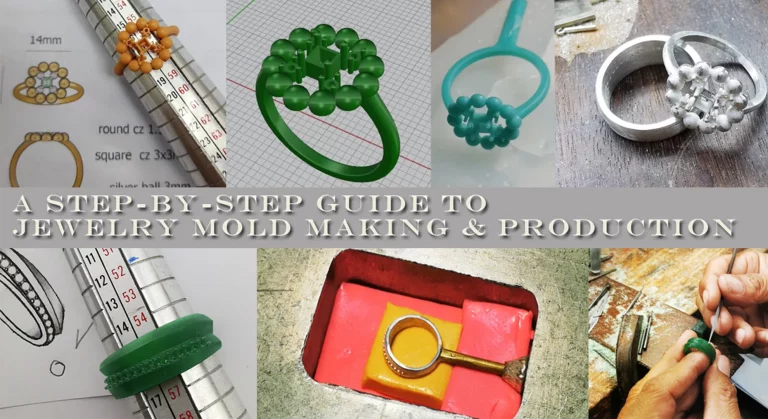
In the industrialized production of “resin + metal” jewelry, the robust and accurate metal base is the skeleton of the whole product. For example, in the production of epoxy resin earrings or necklaces with a 316L stainless steel base, the basic process generally adopts mature lost-wax precision casting technology to guarantee the perfect realization of complex shapes in mass production
1. 3D Modeling and Prototype Design:
The production starts with digital design. Haosen Jewelry engineers apply CAD software to 3D modeling. The point is to accurately design the cavities, inlay slots, or frame structures to hold the resin, and to leave the actual locking mechanisms for later bonding.
2. Precision Wax Molds and Investment Casting:
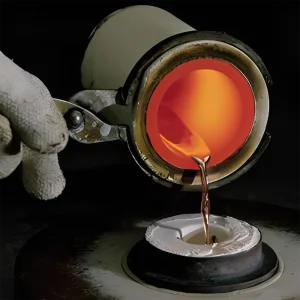
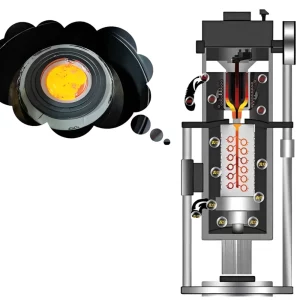
Once the design is finished, high-precision wax molds are directly created with the help of industrial-grade 3D printers. Several wax molds are combined into a “wax tree” and packed in a special plaster. After high-temperature firing, the wax molds are completely melted away, creating a hollow space. Later on, molten metal materials such as 316L stainless steel are poured into the space, and after cooling, a metal casting tree is produced.
3. Casting Treatment and Surface Engineering:
Once metal castings are cut and separated, they are treated with processes such as sandblasting and preliminary polishing to eliminate surface defects. In the case of contact surfaces, which must be bonded with high adhesive strength to resin, critical special processing is carried out at this point, including metal surface roughening by chemical etching or micromachining, or creating minute undercut features. This greatly improves the mechanical interlocking adhesion between the resin and metal, which is a crucial industrial process in preventing the separation of resin jewelry during prolonged use.
Stage 2: Resin Injection & Precision Curing
This stage is very important in defining the final look and stability of the resin jewelry. The whole process takes place in a very clean and controlled environment to guarantee maximum purity and quality of the final product.
1. Automated Proportioning and Vacuum Degassing:
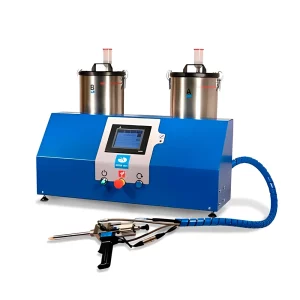
At this point in the manufacturing process, industrial-grade two-part resin (A/B adhesive) is weighed and mixed in precise proportions by an accurate automatic mixing machine, which has an accuracy of 0.01 grams. The mixed resin adhesive is then subjected to vacuum chambers where it is degassed completely, removing microscopic bubbles that cannot be seen with the naked eye. This is very important to guarantee that the finished epoxy resin earring or ring is transparent and flawless.
2. Precision Dispensing and Injection:
The degassed resin adhesive is then placed in a precision resin dispensing machine. The resin adhesive is injected in precise amounts into each groove and inlay on the 316L stainless steel metal base via program control pneumatic or screw-type dispensing heads. This method is especially suitable for resin necklace pendants with intricate designs.
3. Layered Coloring and Material Fusion:
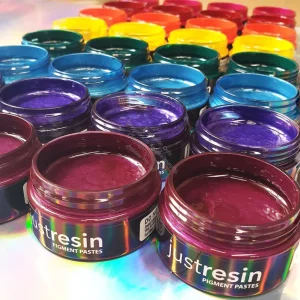
For the coloring process, Haosen Jewelry employees apply industrial-grade color paste, which is certified by a third party, for on-site mixing and layered injection molding. Metallic foil, powder, or glitter materials can be added according to the design requirements. The color paste has high concentration and good anti-yellowing properties, ensuring consistent coloring for mass production.
4. Programmed Stepwise Curing:
The molded resin part is then transferred to a program-controlled temperature drying tunnel or oven for curing. A stepped temperature increase is programmed, for example, starting from 40°C and gradually increasing to 80°C, to allow the resin to fully cross-link through a slow curing reaction over several hours. This curing process eliminates internal stress in the resin part, preventing cracking or deformation, and finally transforms it into a hard, stable polymer body bonded firmly to the metal base, changing from a semi-finished part to a beautiful art piece.
Stage 3: Precision Machining and Secondary Polishing
In the high-end production of epoxy resin jewelry, when the pattern involves intricate “metal wood combination” or “metal embedded” elements, as with the “inlay series” launched by Haosen Jewelry, the epoxy resin workpiece after curing will have an irregular shape and requires precise mechanical work to attain the smoothness and “seamless” finish associated with the final product.
CNC Precision Machining:
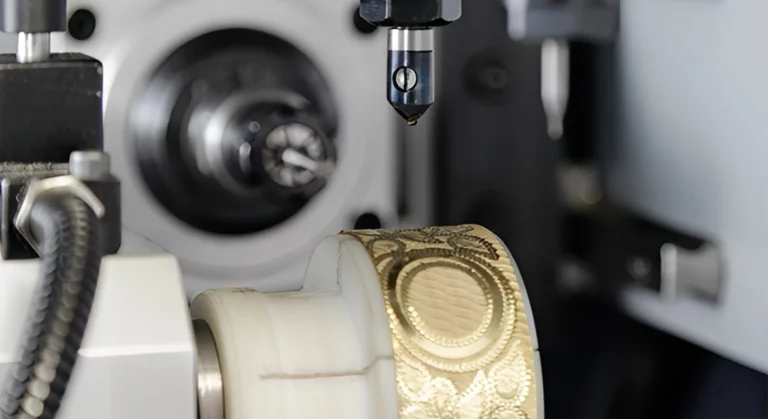
The cured workpiece, which may be a part assembled with a metal base such as stainless steel or brass, is then firmly fixed to the CNC machine. With reference to the original design drawings, precise work with a diamond or carbide tip is then utilized to perform micron-level subtraction on the excess epoxy resin material while ensuring that there is a perfect “seamless” alignment between the epoxy resin material and the edges of the metal, especially when a smooth “seamless” finish is required on the inner wall of the epoxy resin ring.
Automated Fine Grinding:
This workpiece then goes through an automated grinding process. The workpiece will tumble inside an industrial grinding machine such as a vibratory grinding machine or a centrifugal grinding machine with alloy abrasives of varying sizes to gradually smooth out the fine marks made by the CNC machining process through friction.
High-Gloss Mirror Polishing:
In order to give it gemstone-like transparency, the resin piece undergoes a chemical mechanical polishing technique. A skilled craftsperson uses a professional polishing machine and a polishing paste that can be used on polymer materials, along with soft cloth, to polish the piece and give it a high refractive index.
Enhanced UV Coating:
In order to give the pieces a higher level of durability that can withstand everyday use, some of these pieces, such as the surface of the resin rings that are frequently in contact with the user, undergo an enhanced layer that has high hardness and anti-yellowing properties through the application of protective varnish using the UV curing technique. This invisible protective layer can withstand scratches and maintain the brilliance of the jewelry pieces for a long time. This technique is used by brands such as Haosen Jewelry to give their pieces high-end quality.
Stage 4: Quality Control & Packaging
This is the last and most important line of defense before the products are shipped out of the factory. Haosen Jewelry promises that all the shipped out resin jewelry products have reached the highest standards of reliability for the industrial world and provides customers with professional brand customization services.
1. Reliability Physical Testing:
Our products are randomly tested by being subjected to high and low-temperature cycling chambers. This simulates the extremes of temperature that the jewelry may experience. This ensures that the bonding interface between the metal and the resin does not crack and separate as a result of the different coefficients of expansion. At the same time, the Shore hardness tester is used to accurately measure the curing hardness of the resin to ensure that the desired wear resistance and strength are achieved.
2. Branding and Fine Finishing:
For the products that have passed the inspection, a laser marking machine is used to finely engrave the metal components of the jewelry, such as the back of the earring post or the inside of the clasp. This allows us to permanently mark the brand logo and composition of the material. It also allows for the customization of the jewelry with proprietary symbols and numbers.
3. Professional Packaging and Delivery:
Finally, after all the processes have been completed, the products are cleaned and packed in professional packages that are custom-designed and lined to prevent them from getting scratched. At Haosen Jewelry, flexible services are offered to clients under OEM/ODM, which means that Haosen Jewelry will offer clients comprehensive services ranging from production to packaging of the products, which are fully customized to meet clients’ requirements.
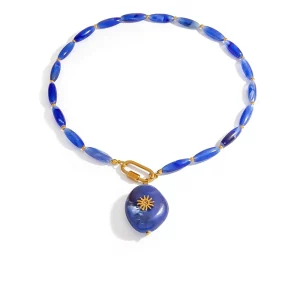
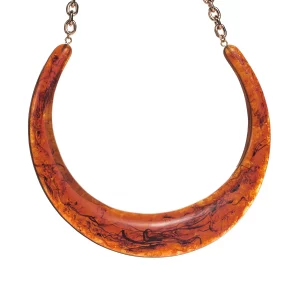
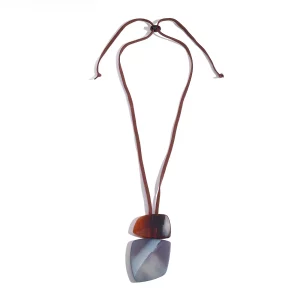
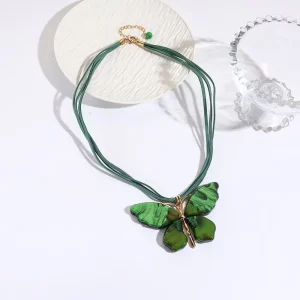
FAQs
Q1: How do you maintain color consistency in mass production of industrial-grade resin and metal jewelry?
We apply high-concentration industrial-grade color pastes, along with an automatic proportioning system that limits errors to 0.01g, to ensure that the color difference between various batches of products is within a very small acceptable range.
Q2: Will the resin part come off from the metal base after a certain period of use?
No. The industrial process involves physically “roughening” the metal surface or creating small undercut features, and has undergone high and low-temperature cyclic stress testing to ensure that the two materials do not crack or come off due to thermal expansion and contraction.
Q3: How do you remove tiny air bubbles that may form inside the resin?
Haosen Jewelry applies an industrial-grade vacuum mixer for mixing and a pressure cylinder for curing, which removes all visible and micron-sized air bubbles, beyond the capability of manual production.
Q4: What is the typical lead time for your products?
It takes about 3 to 5 weeks from the point when we confirm the 3D prototype to the time when we deliver the first batch of mass-produced products. Although it takes a long time to cure and machine, it ensures a very high yield rate and efficient assembly process afterward.
Q5: What is the minimum order quantity (MOQ) for B2B orders?
Considering the cost of developing molds, including 3D printing wax molds, a MOQ of 120 units is recommended. This way, you will be able to take greater advantage of our initial process costs, giving you a more competitive price.
Q6: Does this process support adding special materials inside the resin?
Yes, it does. We will be able to accurately add metal shavings, seashells, opal powder, or synthetic industrial materials during the layered casting process, and even improve wear resistance with a UV coating.
Q7: What measures do you take to ensure the accuracy of the sizes of the jewelry pieces to facilitate assembly?
We employ a CNC machine to subtractively cut the cured resin, and the accuracy is maintained to within ±0.05mm to ensure that all products meet the specifications as per the design drawings.
Conclusion
From precise metal casting, to resin curing, and then to mirror polishing, as well as quality inspection, our industrial production process converts our creativity into physical products with excellent quality. Haosen Jewelry offers a comprehensive solution that combines materials science, precision engineering, and artistic design. This not only means that each piece of metal resin jewelry will be not only artistic but also long-lasting, but it also means that we offer a key strength to our customers, back-end support that will offer them high consistency, complex process, and personalized customization options.
Regardless of whether you are a designer, a brand, or a retailer, Haosen Jewelry’s professional OEM/ODM service will offer you a strong foundation to support your inspiration. We look forward to helping you transform your unique idea into a range of stunning and exquisite products that will soon be in the market. Contact us today to receive free samples and start an extraordinary collaborative experience.
One-stop Customization Metal-based Resin Jewelry
- Precision CNC & Zero-Bubble Quality: Guaranteeing ±0.05 mm accuracy and flawless, bubble-free resin finishes through industrial vacuum-processing.
- Enhanced Durability & Strength: Ensuring permanent bonding via metal surface coarsening and rigorous high-low temperature stress testing.
- Scalable Solutions: Optimized for corporate procurement with a 3–5 week lead time and competitive MOQs starting at 120 pieces.
Jasper Jiang
Jasper Jiang is the founder of Haosen Metal Jewelry. Since the age of 26, he has combined his deep roots in traditional craftsmanship with a sharp vision for the market to build the foundation of our excellence.