

In the jewelry manufacturing world, many brands are caught in the “perfect sample trap.” The perfect example of this is the colorful bead pant chain, which may look perfect during the sample stage but often encounters difficulties when the process moves to mass production. This article will delve into the reasons for this and how brands will benefit from learning about the difficulties in the process, helping them make the right decisions before ordering in bulk.
The Hidden Conflict Between Design and Material Physics for Colorful Bead Pant Chains
When making pant chains and other types of jewelry, the most commonly used material for the chains is stainless steel because of its high strength and resistance to corrosion. However, when making colorful bead pant chains, there is one main conflict when working with the colorful bead material.
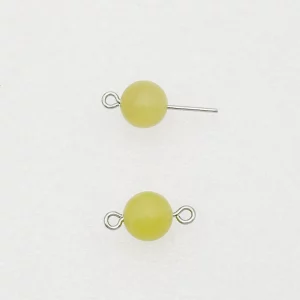
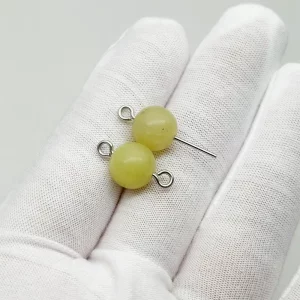
Most of the natural beads on the market today have a 1mm-1.2mm hole diameter, and we need to use 0.8mm-1.0mm diameter stainless steel eye pins to connect the beads together.
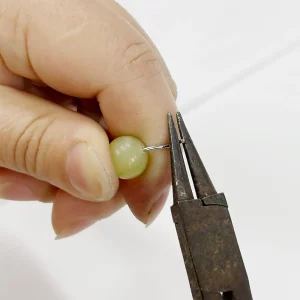
The problem is this: Machine-precision eye pins are normally manufactured with one end being perfectly rounded. However, once the pin is threaded through the hole in the bead, one end must be bent manually. However, due to the high hardness and spring-back properties of stainless steel, wherein the material tends to revert to its original shape after being bent, it is difficult to replicate the “perfect bend” during the sample phase on a mass scale.
Although during the sample phase, perfection is possible with human intervention, due to the hardness and spring-back properties of stainless steel, it is almost impossible to replicate such perfection on a mass scale without compromise. Besides, the way in which the pin is closed affects the tensile strength of the final product.
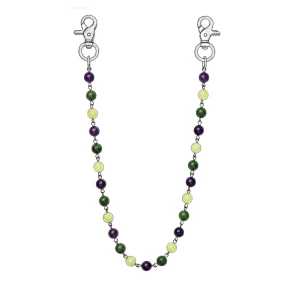
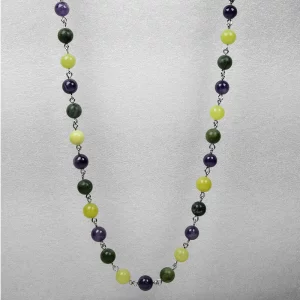
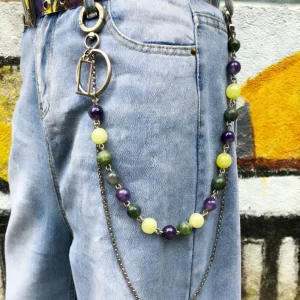
Why Colorful Bead Pant Chain Sample Perfection is a "Trap" for Brands
In the case of jewelry brands, the sample stage might represent the perfection of the product. This might lead to a problem because, during the sample stage, the limited quantity might allow artisans to spend enough time and effort to achieve perfection in handcrafting.
However, once the product enters the mass production stage, the slight differences in the handcrafted bends might become more noticeable. The stainless steel eye pin’s closure might not be round or might be flat.This might compromise the premium feeling of the product.
These minor differences might not be easily noticeable during the sample stage, but once the product enters mass production, these differences might become more noticeable and might lead to a sense of discontentment among consumers. There might be instances where bulk orders might not match the sample product, and there might be a problem with the quality control of the product.
The Mass Production Risks for Colorful Bead Pant Chains: Inconsistency and Lead Time
However, when moving into mass production, brands must consider two major risks:
1.Inherent Process Risks:
The process of handcrafting eye pin bends from 316L stainless steel is difficult due to its inherent characteristics. It is almost impossible to ensure 100% consistency in terms of eye pin bends for thousands of units. Some shape variations are inevitable when scaling production, even for the most skilled artisans.
2.Impact on Lead Time:
If brands want “perfect” eye pin bends that are similar to the sample provided, workers will have to spend time adjusting each and every one of thousands of eye pins multiple times. This will be extremely time-consuming and could result in longer lead times and delayed delivery, which could be problematic for B2B clients who value efficiency and timely delivery.
Haosen Jewelry Judgment: How We Evaluate and Solve the Issue
At Haosen Jewelry, we do not only produce jewelry, we also offer professional advice to assist our clients in making informed decisions:
- Accepting Inconsistencies: We advise clients to be willing to accept minor inconsistencies in making jewelry in order to guarantee a smooth process and competitive pricing.
- Pursuing Perfection: However, in cases where perfection is required, we advise clients to be willing to spend additional time in making the jewelry as well as pay a premium price for labor costs.
- Our Standpoint: We carry out thorough risk analysis for each project, ensuring that brands are aware of what they expect at the end of the process, hence eliminating conflict over delivery.
FAQs
1. Why use stainless steel eye pins for colorful stone bead Jean chains?
Stainless steel is the preferred material for high-quality pant chain production because it is durable and has anti-tarnish properties. When working with natural stone beads, the hole diameter is usually restricted to 1mm-1.2mm. Therefore, 0.8mm-1.0mm stainless steel eye pins are crucial for structural integrity. Soft materials like brass are easier to shape and bend, but they cannot handle tensile strength for high-end biker jewelry or streetwear products. Stainless steel ensures that jewelry connection points remain secure despite wear and tear, a quality expected by B2B buyers.
2. What causes the "spring-back" effect in stainless steel jewelry assembly?
The term “spring-back” is a physical characteristic in that metal seeks to return to its former state after being bent. This is perhaps one of the biggest challenges in making stainless steel jewelry because of its yield strength. If an operator is tasked with manually closing a loop in a pant chain, the stainless steel resists being curved, leading to an imperfectly round loop. This is perhaps one of the biggest challenges in mass-producing jewelry compared to other materials like sterling silver or gold, as they can be molded into shape immediately after being bent.
3. Why is one side of the eye pin loop more perfect than the other?
When it comes to the provision of beaded jewelry, eye pins are pre-made and manufactured using a machine. This means that one end of the eye pin is made using industrial precision and is therefore perfect and rounded. However, the other end of the eye pin is not made using a machine and therefore cannot be made perfect when the stones are inserted. This means that the end of the eye pin will not be perfect and will have a certain “asymmetry.” This is an important factor that the brand owner should take into consideration when designing high-end custom pant chains.
4. How does bead hole diameter limit the choice of jewelry wire?
The size of the hole of the natural gemstone bead determines the gauge of the wire of the jewelry chain. Most colorful gemstone beads are 1mm in diameter and are precision drilled. This means that there is no room for the thicker and sturdier 1.5mm wire. This forces the jewelry manufacturer to use thinner 0.8mm pins. However, the thinner wire is easier to bend but cannot be made perfectly circular.
5. Can manual bending affect the pull-test results of a pant chain?
Yes, very much so. If the jewelry technician does not manage to close the loop tightly because of the rigidity of the stainless steel, then the “gap” is actually a point of weakness. In B2B jewelry quality control, pull testing is common for utility items such as pant chains or wallet chains. A loop that is slightly “oval” rather than “round” will put uneven stress on the chain, which will then break. Finding a balance between a beautiful jewelry finish and successfully passing stress tests is the main reason why specialized jigs are sometimes necessary for large orders.
6. Why does manual bending often result in "flat" or "oval" jewelry loops?
Manual bending uses the leverage of pliers and the strength of the craftsman’s hand. Because 316L stainless steel is so strong, the wire will “kink” at the point of pressure rather than bend. This will produce an oval or flat-sided loop. For fashion jewelry companies who are trying to project a high-end image, these tiny details can be a deal-breaker. Recognizing that these are simply the natural characteristics of hand-assembled stainless steel jewelry can go a long way in managing quality expectations during the sampling process as opposed to the mass production process.
7. How do inconsistent loops affect the "premium feel" of a jewelry brand?
In the wholesale jewelry market, the value of a product is often related to its symmetry and consistency. If the loops of a stone bead pant chain are inconsistent, the way the light reflects off the metal is uneven, and the product looks “mass produced” in a negative way, almost “cheap.” To ensure a premium brand identity for a jewelry product, it is essential that you either embrace the “hand-made” look or invest in custom tooling to ensure consistency in the way the connections are made, even if it means a longer overall production time.
8. What is the "Sample Trap" in the jewelry manufacturing process?
The “Sample Trap” is when a factory spends hours making a single jewelry sample perfect for winning a contract. Since the master craftsman works on the sample, the loops are perfectly round. However, when making the product at a high volume, hundreds of workers are making thousands of pieces. At a high volume, it is impossible for the product to be as perfect as the sample, and we inform our customers about the importance of looking at the production yield, not just the sample.
9. Why is "Consistency" the most expensive part of jewelry production?
To produce 100% consistent handmade stainless steel jewelry, one has to constantly monitor the jewelry and work slowly. The largest expense in jewelry factories is time. If every loop has to be compared to a template and then adjusted by hand, the cost of labor becomes exorbitantly high. For B2B jewelry buyers, the expense is not just in the material costs of stones and steel; it is in the “rejection rate” and the additional time it takes to ensure that every piece in a 5,000-piece order is consistent with the approved golden sample.
10. How do you handle "visual defects" in bead chain connections?
Our jewelry QC (Quality Control) team has a tiered grading system. We rate loops that are slightly not round but still sound as “acceptable manual variation.” However, if the loops have gaps over 0.2mm, we reject them. In professional jewelry manufacturing, it is essential to set these standards early on. By establishing clear Standard Operating Procedures (SOPs) for manual bending, we ensure that the brands we work with can maintain a high visual standard without making the colorful stone jewelry too expensive for the retail market.
11. Does "perfect loops" necessarily result in delays in delivery?
Yes, it inevitably does. In jewelry supply chain management, one has to make a compromise between speed and accuracy. If a brand wants every manual bend on a stainless steel pant chain to be as round as a machine-made one, then there is a 40-50% decrease in assembly speed. This “perfectionist” approach will result in a massive backlog on the jewelry assembly line. We always recommend our clients to plan their marketing campaigns with a “buffer period” if they require high accuracy in assembly, as quality cannot be hurried.
12. What is a realistic delivery time for custom beaded pant chains?
If a brand orders 500-1,000 pieces, then a realistic jewelry production time is 30-45 days. However, if a brand wants to receive their order in 15 days, then there is a high probability of “rushed” bending, which will result in inconsistent loops. As a result, for jewelry importers worldwide, it is crucial to respect the physical laws involved in assembly for a high-quality and reliable delivery.
13. Why do you recommend custom jigs for large-scale jewelry orders?
Custom jigs are special tools designed to hold the wire in a specific arc while bending. This is particularly useful in large-scale production of jewelry because it minimizes the reliance on “worker hand feel” and ensures a much higher degree of circular consistency. Although there is a one-time cost associated with jewelry tooling, it can speed up production and lower the rate of reject units significantly. This is the best way for a streetwear jewelry brand to achieve a high-end look while still meeting the volume required for international distribution.
14. Can I change the material to reduce the lead time?
If you change the material to a softer metal such as brass or copper, it will undoubtedly speed up the jewelry assembly process because the material is easier to work with. But in return, you give up the “rugged” look and durability of a stainless steel accessory. So if your brand value is based on “toughness” and “luxury streetwear,” we would suggest sticking with steel and adjusting your shipping schedule instead. Our purpose as a jewelry manufacturer is to help you weigh the pros and cons of your material selection against your delivery schedule.
15. How do you handle client expectations on “hand-made” vs “machine-made”?
Education is the best policy. We show our B2B clients videos of our jewelry production process, including the actual manual bending process. When a client realizes how difficult it is to manually bend 304 stainless steel, they quickly realize that 100% perfection is just not possible. By being upfront about the jewelry production process, we gain their trust. We establish what “Industry Standard” vs “Premium Grade” is early on in the process to avoid any surprises when the final bulk delivery is received at their warehouse.
16.What happens if the loops on my pant chain are too loose?
Another significant issue with loose loops in the jewelry industry is that the loop can catch on clothes, especially knits and wool. Eventually, the chain will come apart. In the production of quality jewelry, we ensure that the “snap” of the wire overlap is secure. In the event that we discover that there are loose connections in the entire batch, we will re-work the entire 100%. Hence, the importance of the “Lead Time” risk – we will delay the shipment of the products rather than sending out defective products.
17.Why do some stones crack during the eye pin looping process?
In the use of natural stones, there are inclusions in the stone, which can be defined as “cleavage planes.” If too much pressure is applied with the pliers too close to the stone in an attempt to force the stainless steel loop into place, the stone will shatter. This is common in the production of semi-precious stone jewelry. To avoid this, we ensure that there is a small “buffer gap” between the loop and the stone. By understanding the “safety gap,” the brand will comprehend why the beads appear to move slightly on the pin – it’s to prevent the stone from breaking.
18. How can I avoid Snagging issues in my bead chain designs?
The snagging is usually caused by “burrs” on the ends of the wire. In our process of making jewelry, we make sure that the end of the stainless steel wire is neatly cut and tucked into the loop. We sometimes add a “tumble polish” on the pant chain if it is meant to be a heavy-duty chain, which will help smooth out any sharp edges on the chain. This is what separates the good suppliers from the low-cost makers who will try to skip this last smoothing process.
19. What is the benefit of "annealed" stainless steel in making jewelry?
The “annealed” or softened state of stainless steel is sometimes used so that the bending process will be made easier. It will help reduce the spring-back of the stainless steel, which will enable the creation of rounder loops on the jewelry. However, it will also make the chain less hard. We will discuss this with our clients so that we can come up with the “sweet spot” between lead time and the strength of the final product, which is the fashion accessory.
20. Why should I choose Haosen Jewelry for my bead chain production?
As a professional jewelry producer, Haosen Jewelry is more than just a company that accepts orders; we are problem solvers. Our experience in pant chain production means that we are able to spot potential problems, such as inconsistencies in eye pins, before they become expensive errors. It is through our blend of jewelry-making expertise and production management that we are able to offer brands the transparency and reliability they require to grow. We are your partners in ensuring that your “perfect design” becomes “perfectly delivered” in bulk.
Conclusion
In assessing a jewelry factory, the best gauge of capability is not how beautifully one item is crafted, but how well 1,000 items are crafted equally well. This is the hallmark of a mature and capable jewelry factory.
In the case of the colorful bead pant chain, the differences that exist between the sample and mass production, because of the bead hole size limitations and the manual bending of the stainless steel eye pins, can have a material effect on the final product. It is important that you are aware of these craftsmanship trade-offs before you place an order.
If you are contemplating mass production of colorful stone bead pant chains or any other stainless steel jewelry items, it is important that you are aware of these potential risks to ensure smoother production and better decision-making.
For more professional advice on jewelry production and how to avoid common pitfalls, please contact Haosen Jewelry.
OEM Stainless Steel Jean Chain Direct Factory
- Risk-Free Mass Production Consulting;
- Quality Consistency Control;
- Fast Quoting & Technical Feasibility Audit;
- Reliable Lead Time for Global Brands.
Author

Ertian Jiang (Jasper) is the founder of Haosen Metal Jewelry. Since the age of 26, he has combined deep roots in traditional craftsmanship with a sharp vision for the market to build the foundation of the company’s excellence.
Ertian Jiang started on the ground floor as a craftsman, specializing in semi-precious stones (agate, mother of pearl, tiger’s eye) and manual inlaying—perfecting how to fit natural stones into metal bases without gaps or glue failure. He also worked on the front lines of sales, speaking face-to-face with buyers and listening to their frustrations about fallen stones and fading colors.