

316L stainless steel chains are available in many structures, including Cuban, curb, cable, cross, paperclip, box, snake, herringbone, rolo, rope, and fancy chains. The right option depends not only on the chain family, but also on width, wire diameter, link dimensions, profile, surface structure and the intended jewelry application. The sample ranges in this guide are based on our current chain sample collection and should be treated as product-development references rather than universal industry limits.
What Is a 316L Stainless Steel Chain?
A 316L stainless steel jewelry chain is made from interconnected, formed, or woven stainless steel components designed for applications such as necklaces, bracelets, charm jewelry, and decorative chain sections. The term 316L stainless steel chain does not describe one fixed construction.
The final appearance can change according to:
- chain type
- link shape
- chain width
- wire diameter
- link length and width
- cross-sectional profile
- spacing
- surface treatment
- decorative details
This is why two chains made from the same material can have very different visual proportions and structures.
Why Is 316L Stainless Steel Used for Jewelry Chains?
From a jewelry-material perspective, 316L stainless steel is commonly used when a project requires a metal that combines durability, corrosion resistance, and compatibility with a range of forming, polishing, and finishing processes. For chain development, however, material grade is only one part of the specification.
The structure of the chain often has just as much influence on the finished product as the material itself. A jewelry chain should therefore be evaluated through both: Material + Chain Construction, rather than material alone.
A note on material grades
This guide focuses on 316L stainless steel chain structures. If you are also evaluating whether to use 304 or 316L for your jewelry line, the choice affects corrosion resistance, skin safety, cost, and long-term durability.
For a detailed breakdown — including composition differences, tarnish resistance, price comparison, and how to verify real 316L from suppliers — read our full guide: 304 vs 316L Stainless Steel for Jewelry: Which Grade Should Your Brand Use?
Types of 316L Stainless Steel Chains
Our current 316L stainless steel chain sample collection covers a wide range of structures, including Cuban, Curb, Cable, Cross, Paperclip, Box, Snake, Herringbone, Rolo, Spaced Bead, Rope and Fancy chains, with multiple size and structural variations within many categories.
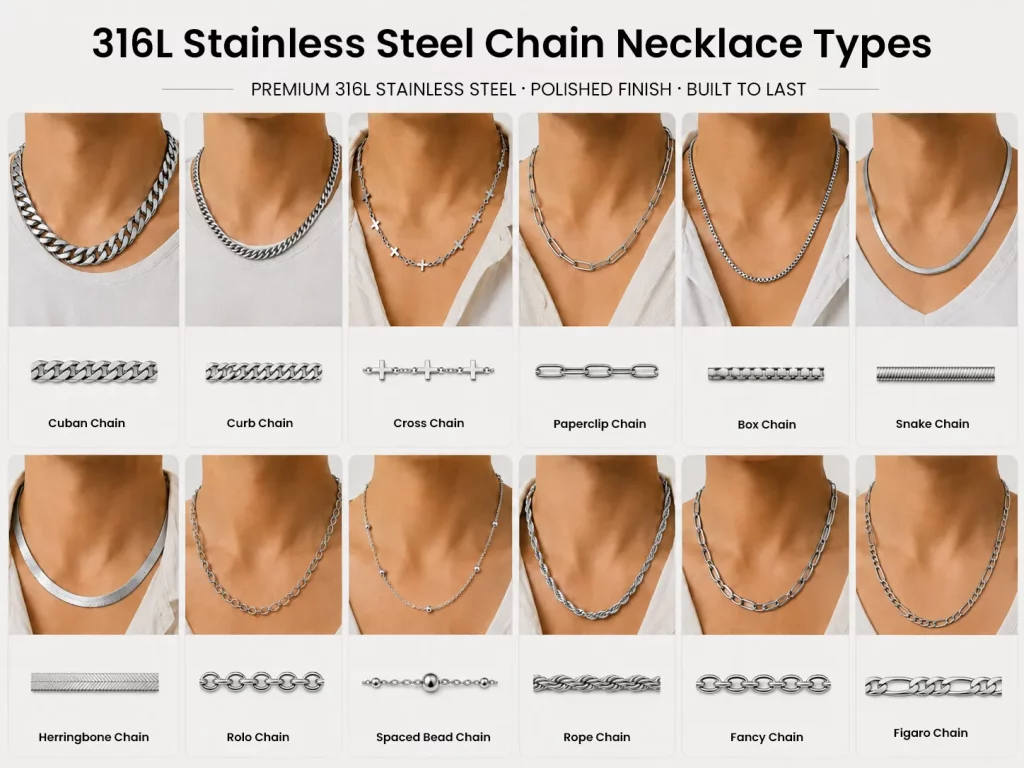
| Chain Type | Key Specs | Suitable For |
|---|---|---|
Cuban/Curb |
Width + wire diameter |
Standalone chains & bracelets |
Cable |
Link size + wire diameter |
Pendants, charms & connectors |
Cross |
Link size + surface finish |
Decorative chain designs |
Paperclip |
Link L × W + wire diameter |
Open-link chains & charms |
Box |
Outer width + inner size |
Pendants & geometric styles |
Snake |
Diameter / width + profile |
Fine to prominent chain designs |
Herringbone |
Width + blade width |
Flat necklaces & bracelets |
Rolo |
Link width or L × W |
Pendants, charms & open links |
Spaced Bead |
Chain + bead size + spacing |
Decorative bead chains |
Rope |
Overall width + wire diameter |
Textured chain designs |
Fancy |
Structure-specific dimensions |
Decorative or connector sections |
1.Cuban Chain
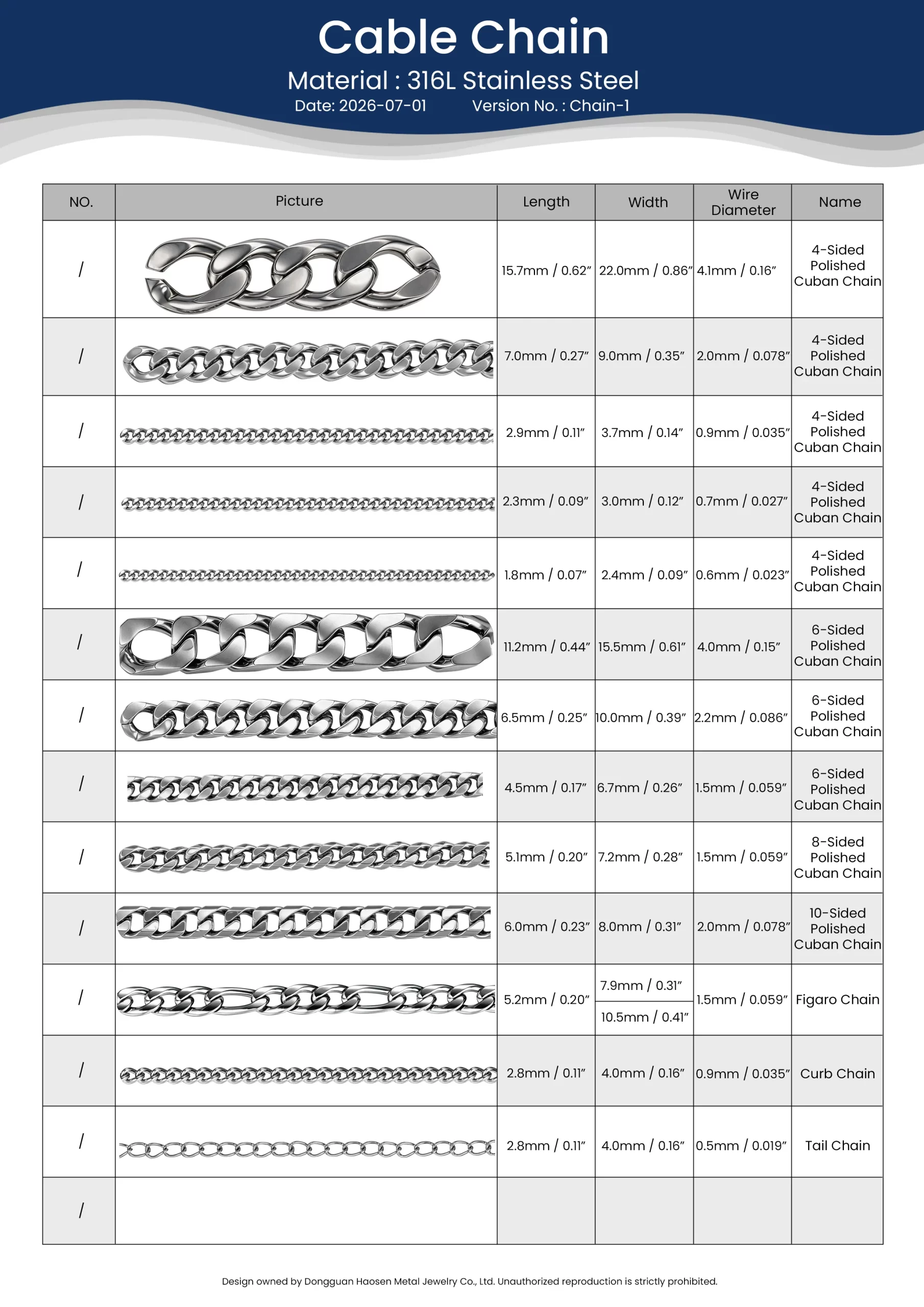
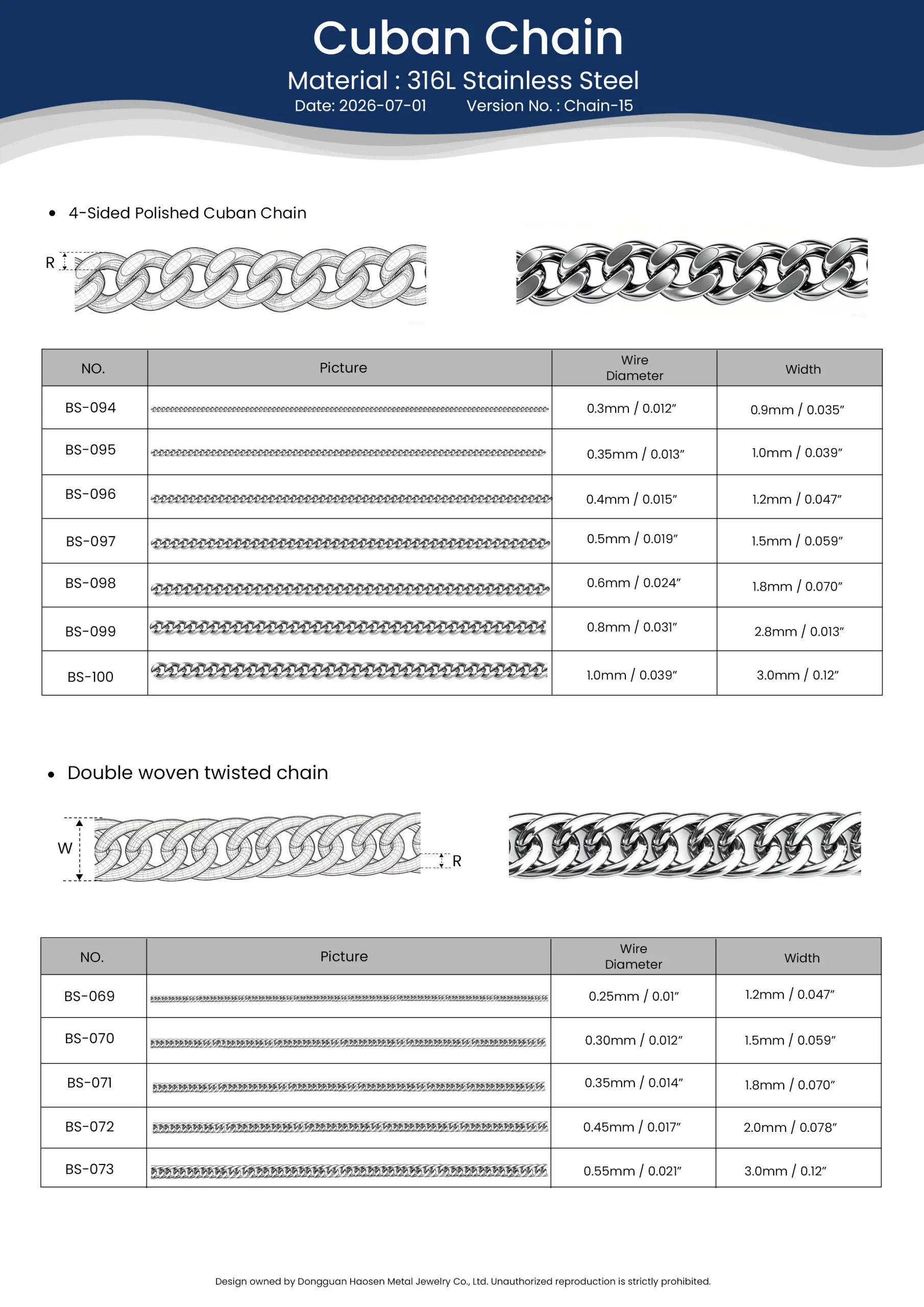
Cuban chains use closely interlocking links to create a dense and continuous appearance. The sample collection contains multiple polished Cuban structures, including:
- 4-Sided Polished Cuban Chain
- 6-Sided Polished Cuban Chain
- 8-Sided Polished Cuban Chain
- 10-Sided Polished Cuban Chain
Different facet counts, wire diameters, and chain widths can create significantly different visual effects within the same Cuban chain family. Another Cuban Chain sample page includes several fine 4-sided polished versions and a Double Woven Twisted Chain, showing how the broader Cuban-style category can be developed through both dimensions and construction.
2.Curb Chain
Curb Chain also uses repeated interlocking links, but its proportions and surface structure may differ from multi-faceted Cuban designs. For product development, it is better to specify Chain Type + Width + Wire Diameter + Link Proportion + Finish instead of requesting only a “Cuban Chain” or “Curb Chain.”
3.Cable Chain
The sample card labeled “Cable Chain” groups several reference structures, including open-link, Figaro, Curb and polished Cuban-style chains. Because these samples do not all represent the same chain construction, a visual reference and dimensional specifications should be used when identifying the required style.
4. Cross Chain
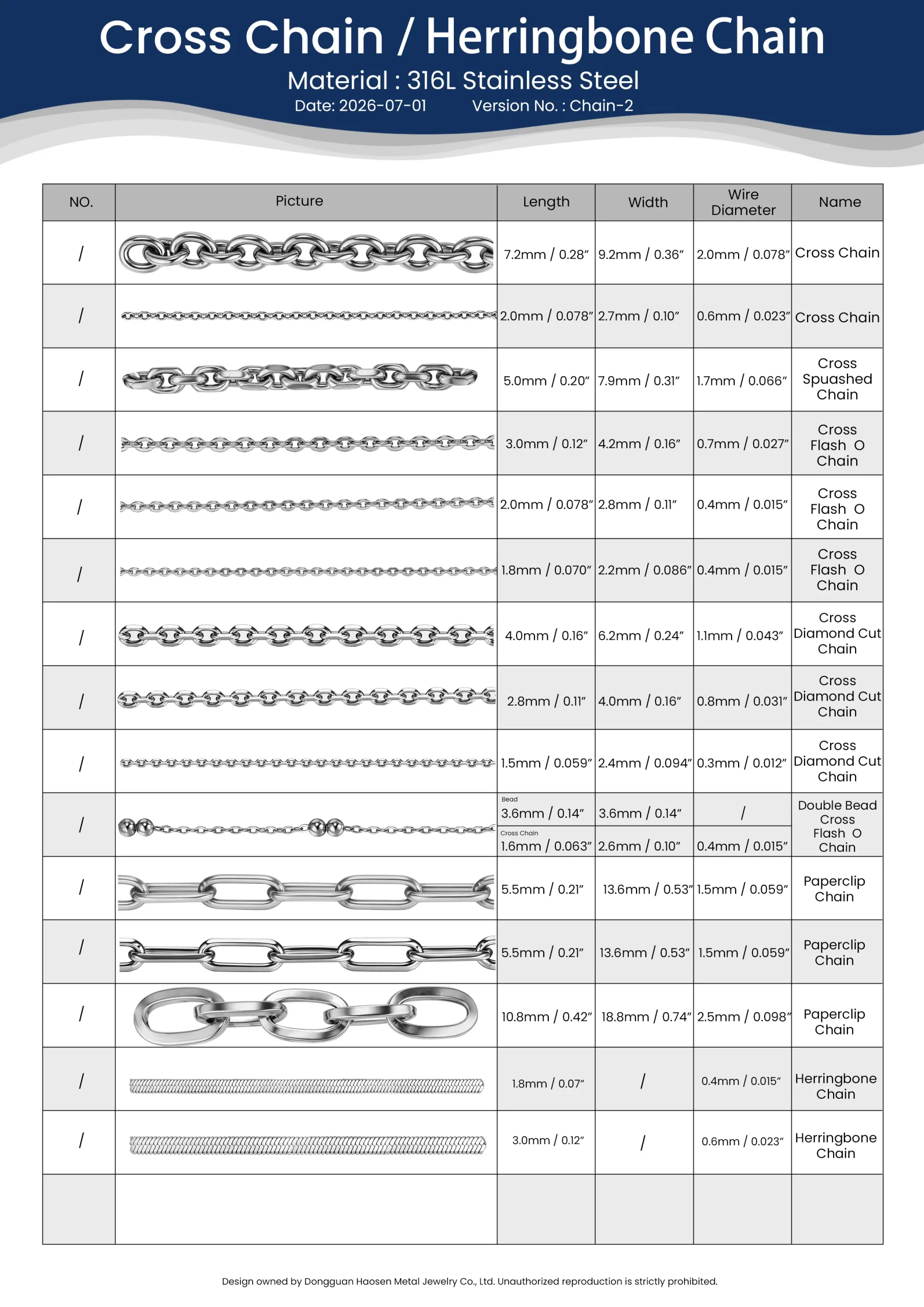
The broader Cross Chain collection contains considerably more structural variation. Examples include:
- Cross Chain
- Cross Snapshaped Chain
- Cross Flash O Chain
- Cross Diamond Cut Chain
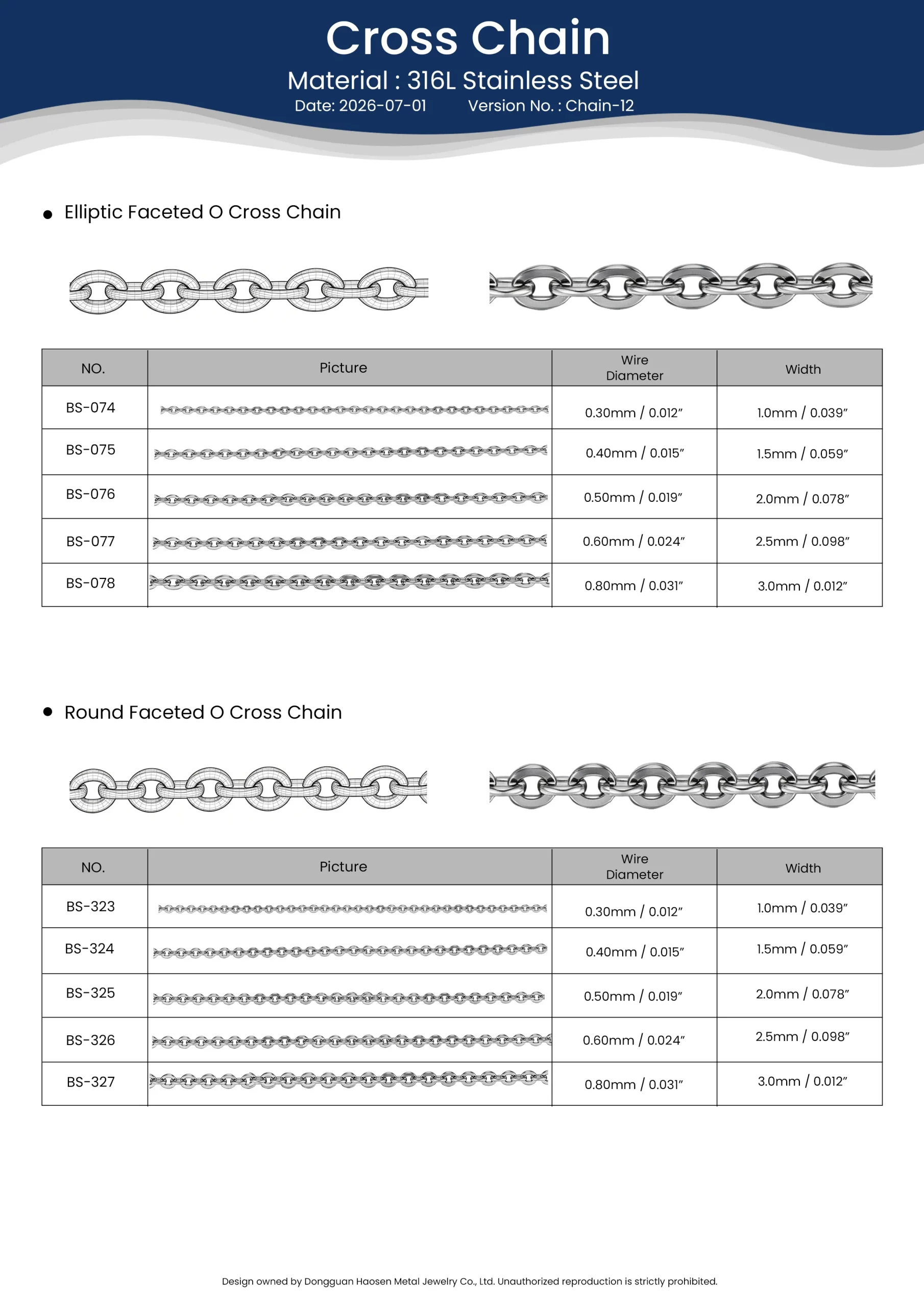
- Elliptic Faceted O Cross Chain
- Round Faceted O Cross Chain
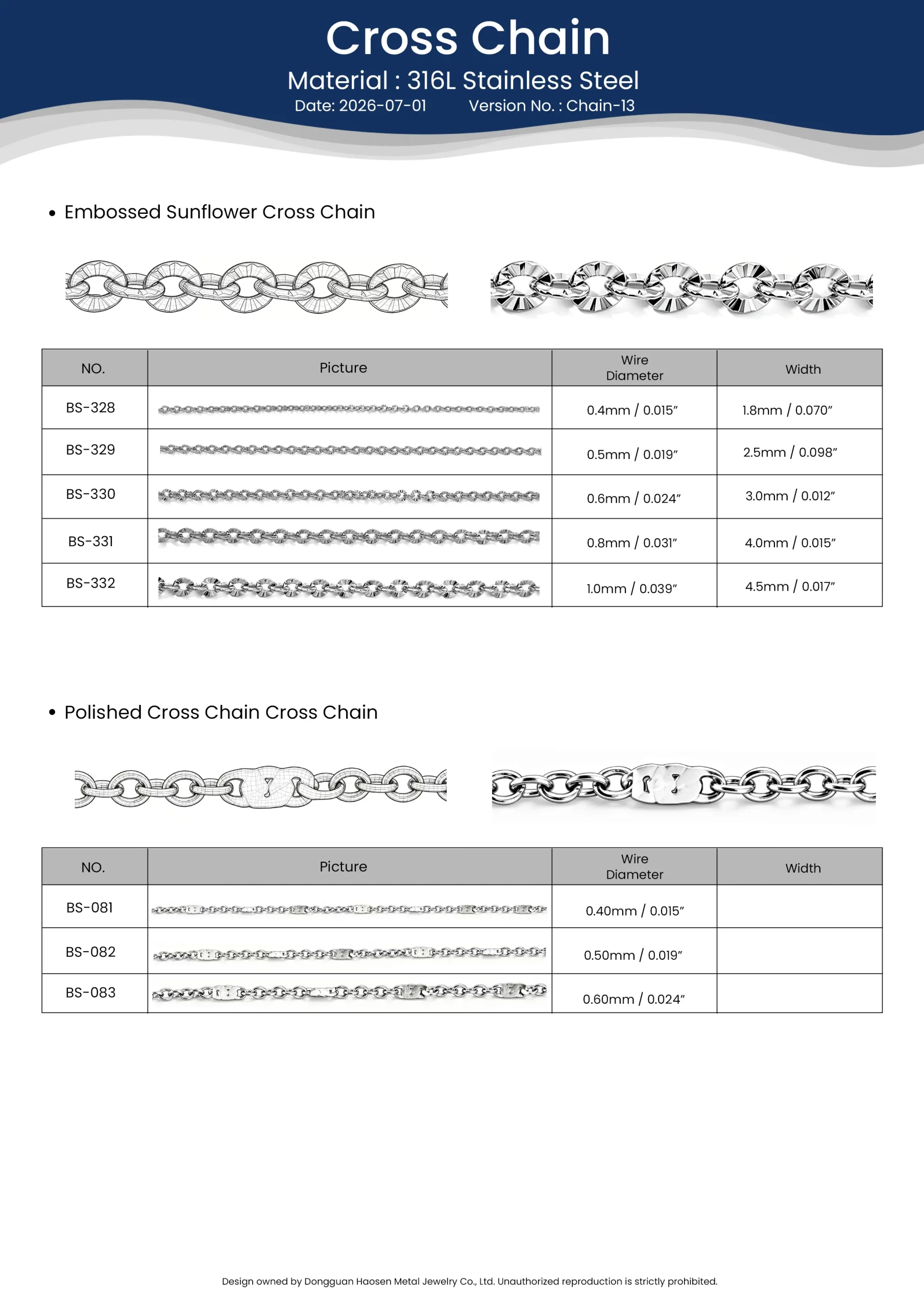
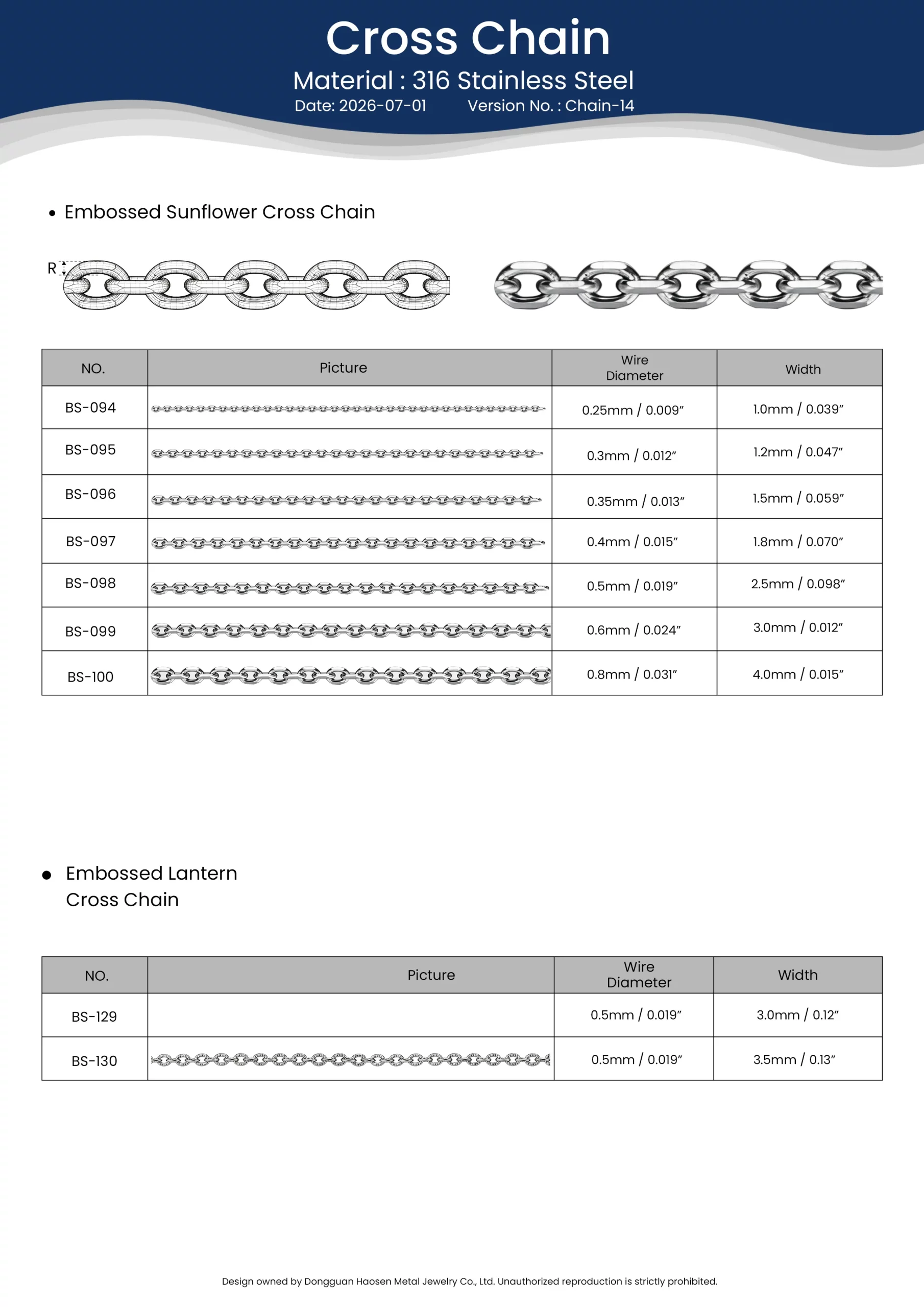
- Embossed Sunflower Cross Chain
- Embossed Lantern Cross Chain
Some designs change the geometry of the basic link, while others add faceted, diamond-cut or embossed details. This makes Cross Chain a useful example of how one basic chain family can develop into multiple product directions.
5. Paperclip Chain
Paperclip Chain uses elongated links that create more open space between each section of metal. The sample collection includes several Paperclip Chain constructions with different link dimensions. For this type of chain, four dimensions are particularly important: Link Length → Link Width → Wire Diameter → Spacing.
Longer links usually create a more open visual rhythm, while shorter or heavier links create a denser appearance. This means “Paperclip Chain” alone is not a complete product specification.
6. Box Chain
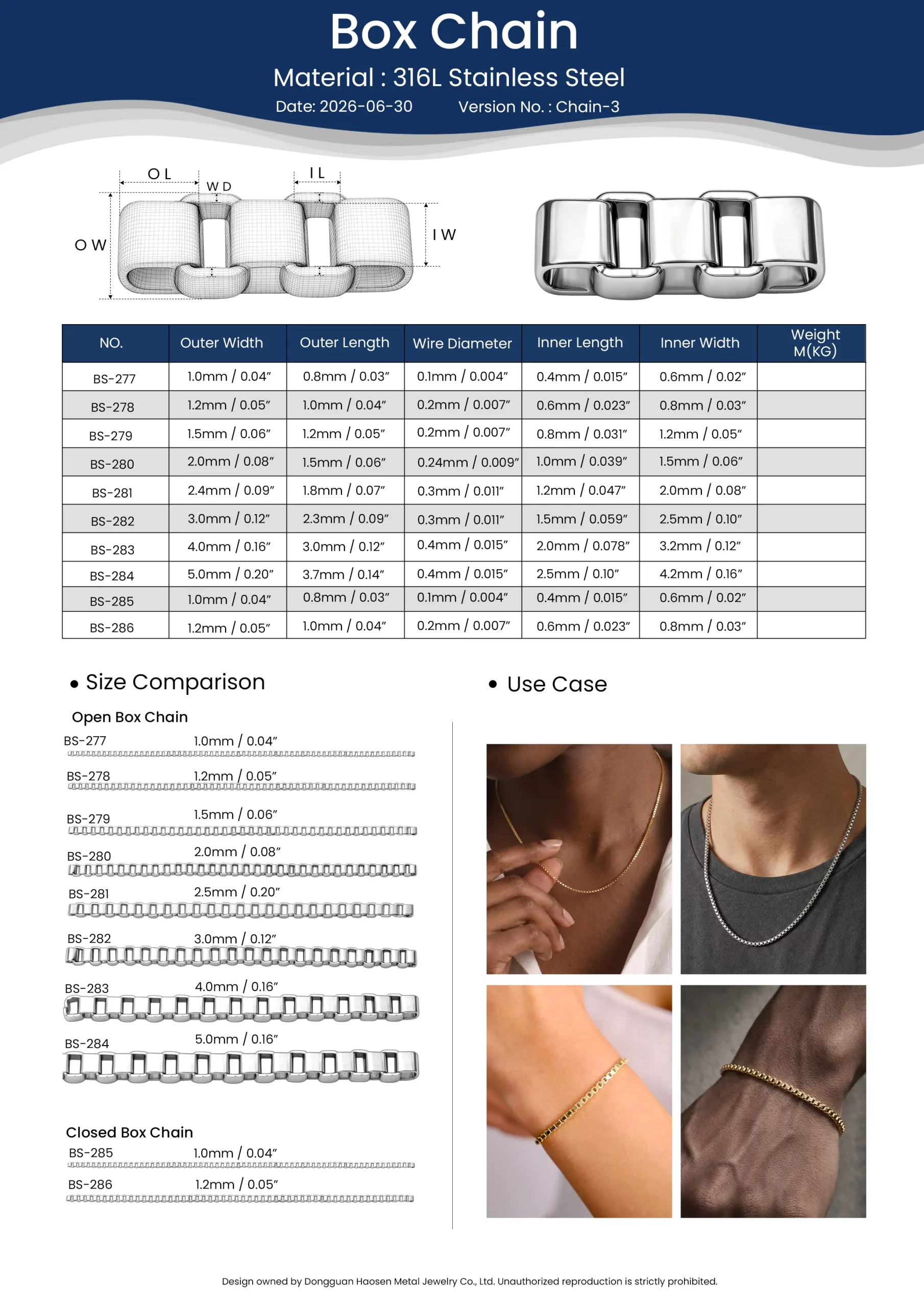
Box Chain uses repeating geometric links and is represented in both Open Box Chain et Closed Box Chain structures. The Open Box Chain samples cover outer widths from approximately 1.0 mm to 5.0 mm, while smaller Closed Box Chain sizes are also included.
This demonstrates a useful principle: Chain type determines the basic structure, while chain size determines much of the visual impact. A fine 1 mm Box Chain can serve a very different design direction from a wider 4–5 mm version.
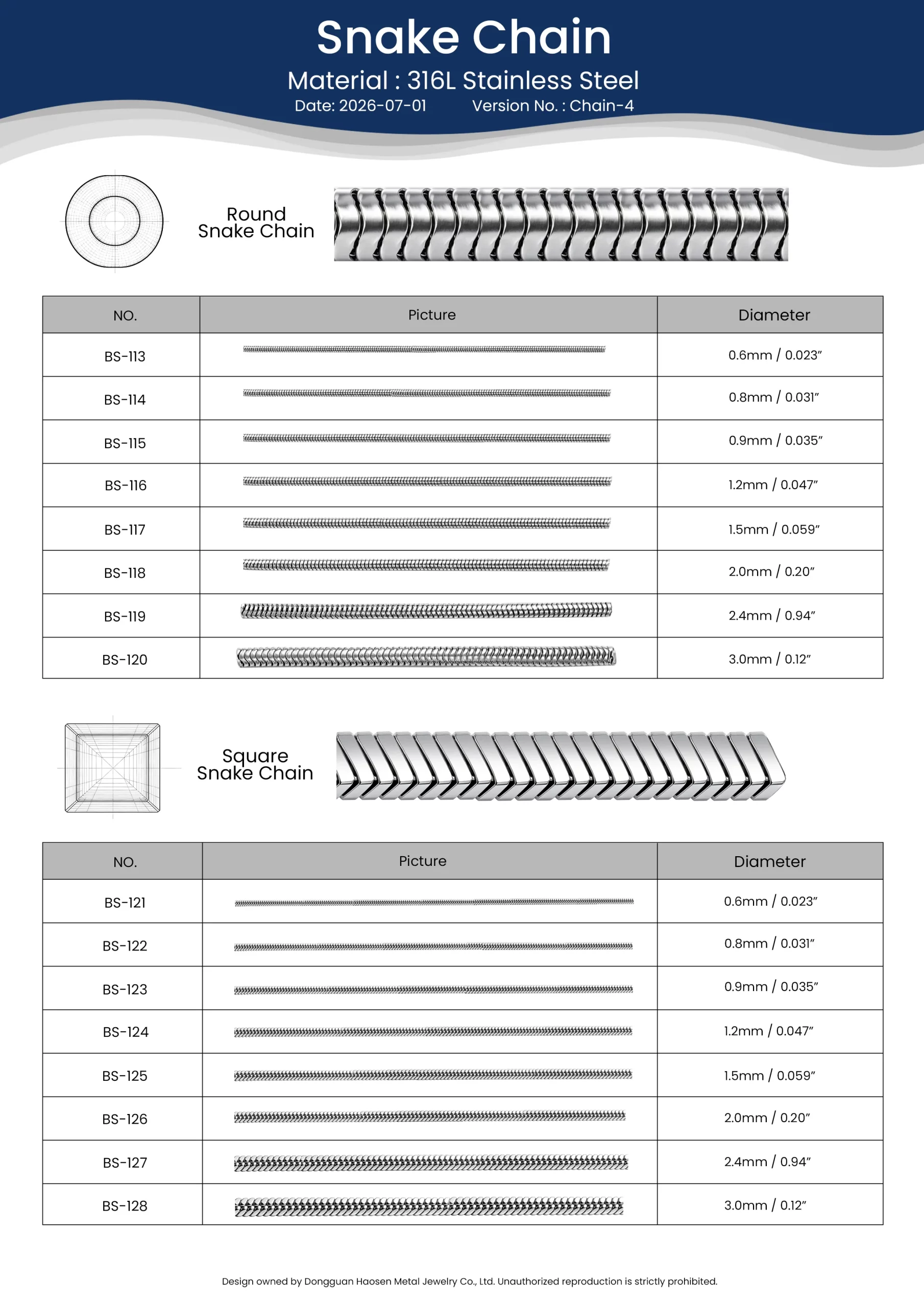
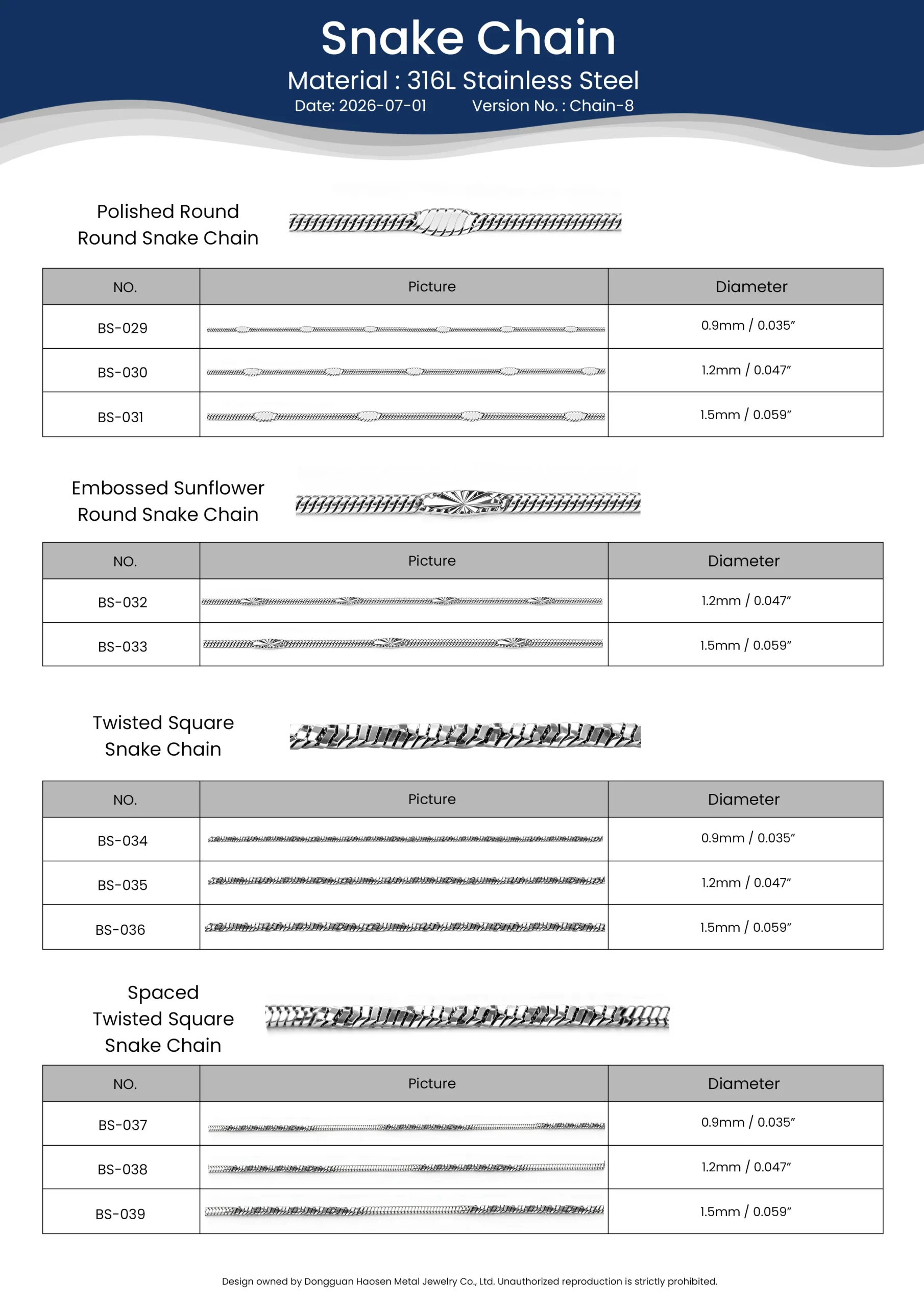
7. Snake Chain
Snake Chain is one of the most extensively represented categories in the sample collection. Rather than using highly visible open links, these structures create a more continuous surface.
Round Snake Chain
The Round Snake Chain samples range from approximately 0.6 mm to 3.0 mm in diameter. This allows the same structural concept to be adapted from fine jewelry chains to more visually prominent designs.
Square Snake Chain
Square Snake Chain uses a more angular cross-sectional profile. The sample sizes also extend from approximately 0.6 mm to 3.0 mm.
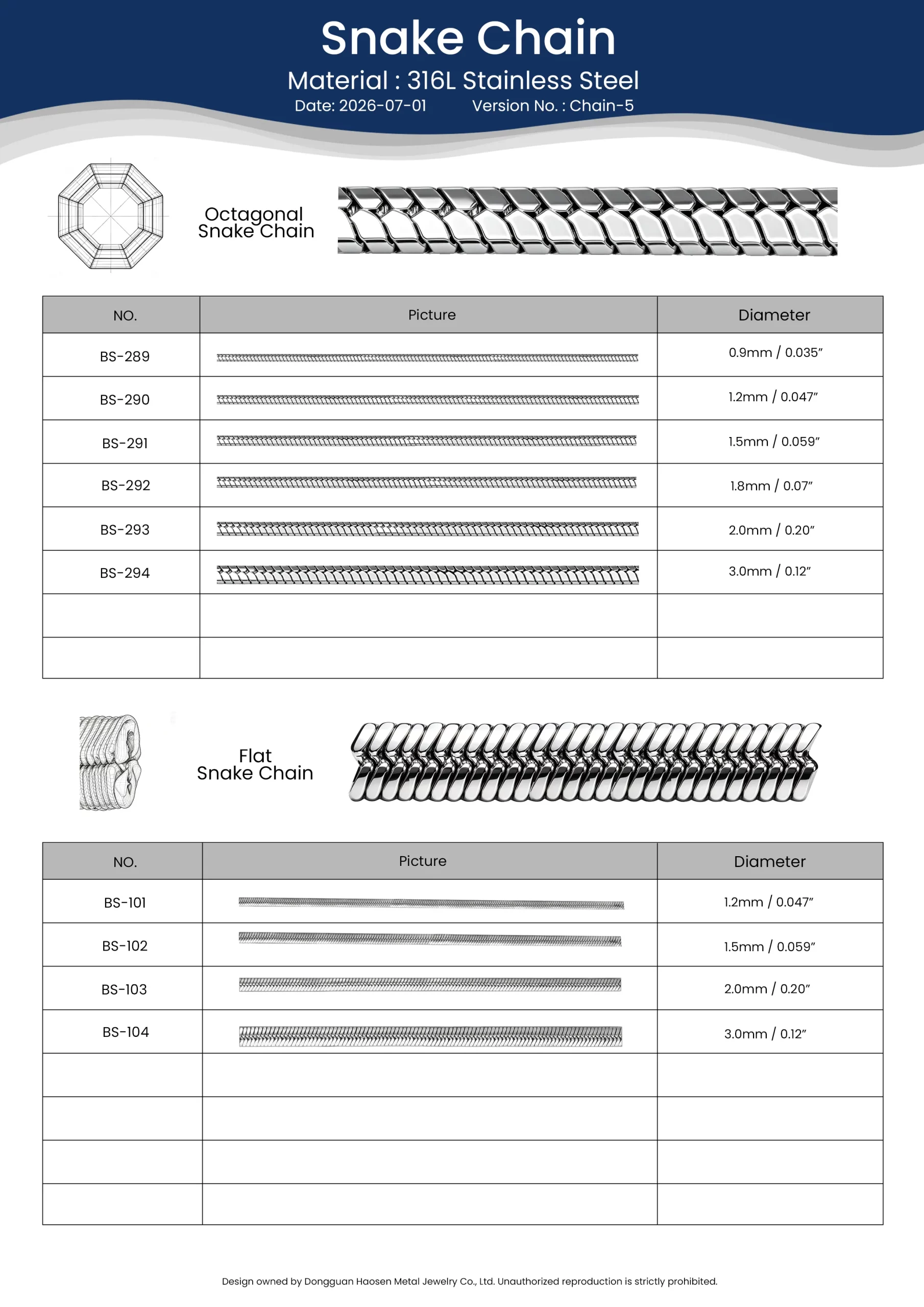
Octagonal Snake Chain
The catalog includes Octagonal Snake Chain samples from approximately 0.9 mm to 3.0 mm.
Flat Snake Chain
Flat Snake Chain samples include approximately: 1.2 mm / 1.5 mm / 2.0 mm / 3.0 mm options.
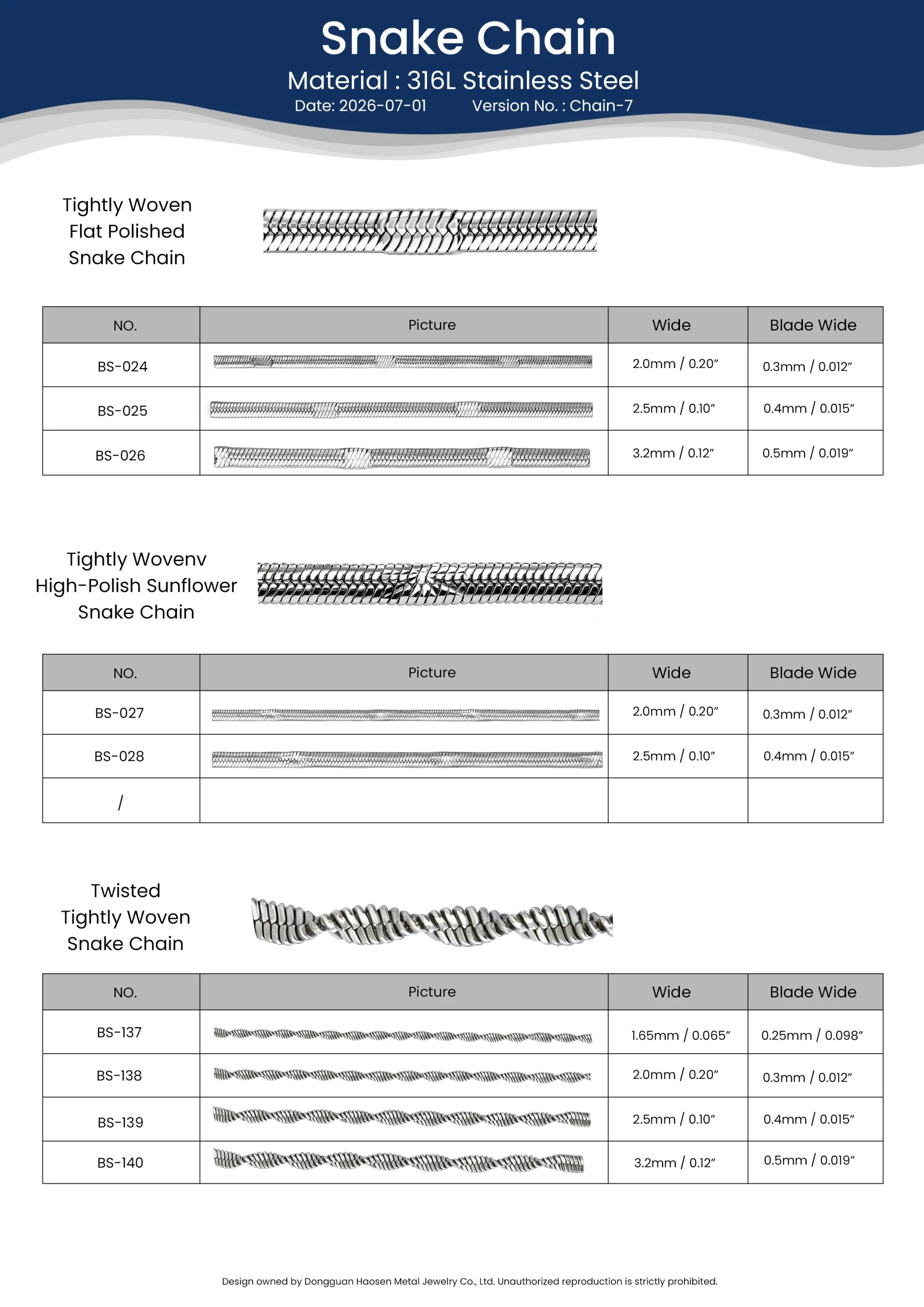
Decorative Snake Chain Structures
Additional variations include:
- Tightly Woven Flat Polished Snake Chain
- Tightly Woven High-Polish Sunflower Snake Chain
- Twisted Tightly Woven Snake Chain
- Polished Round Snake Chain
- Embossed Sunflower Round Snake Chain
- Twisted Square Snake Chain
- Spaced Twisted Square Snake Chain
These structures show that “Snake Chain” is better understood as a chain family rather than a single fixed design.
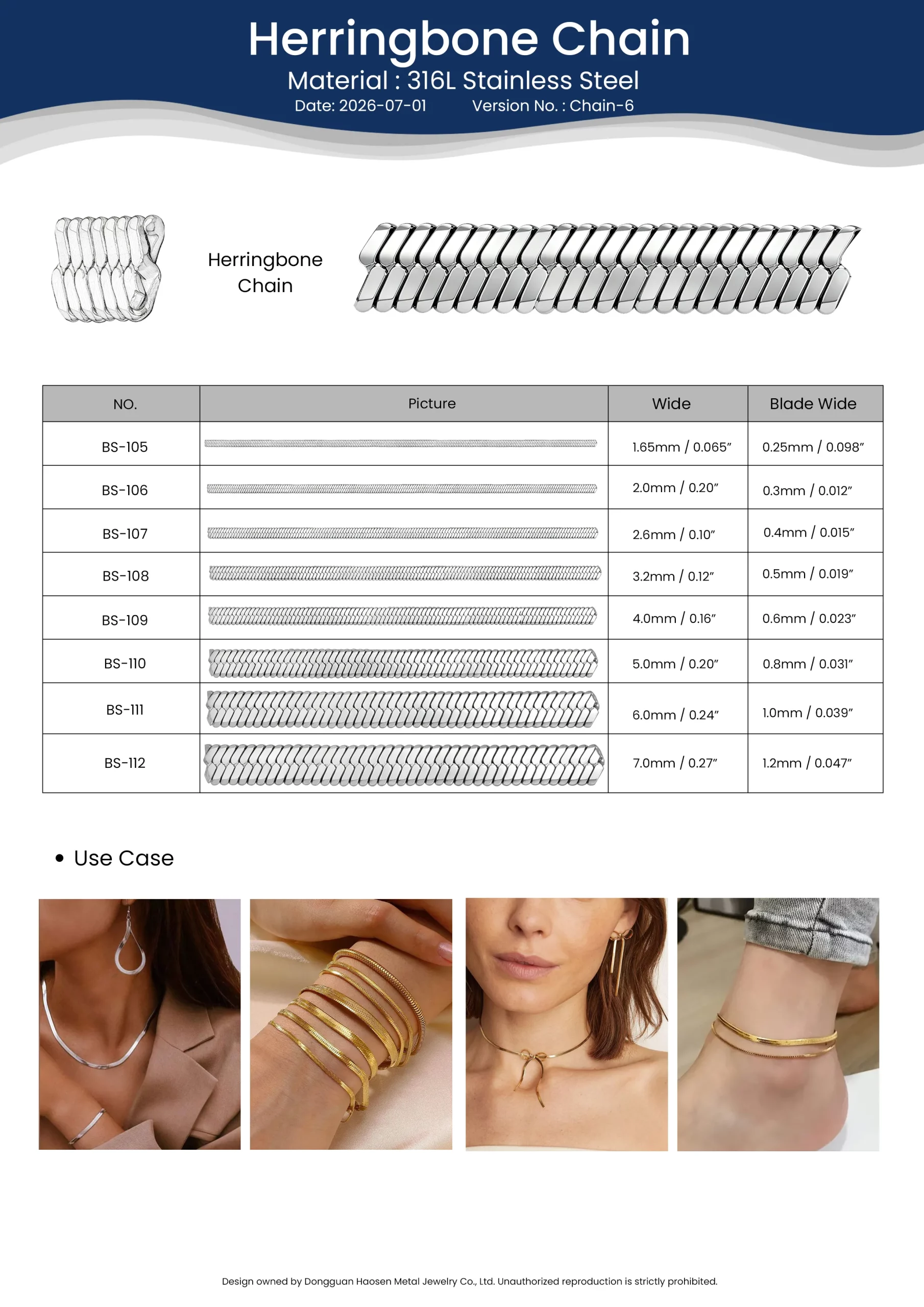
8. Herringbone Chain
Herringbone Chain uses closely arranged components to create a flat, visually continuous surface. The sample collection includes widths from approximately 1.65 mm to 7.0 mm, with different blade widths listed for each size.
For product development, a more useful specification would therefore be Herringbone Chain + Chain Width + Blade Width + Length + Finish, rather than simply “Herringbone Chain.” Its flat profile also makes width particularly important because even a small increase can noticeably change the visual presence of the finished jewelry.
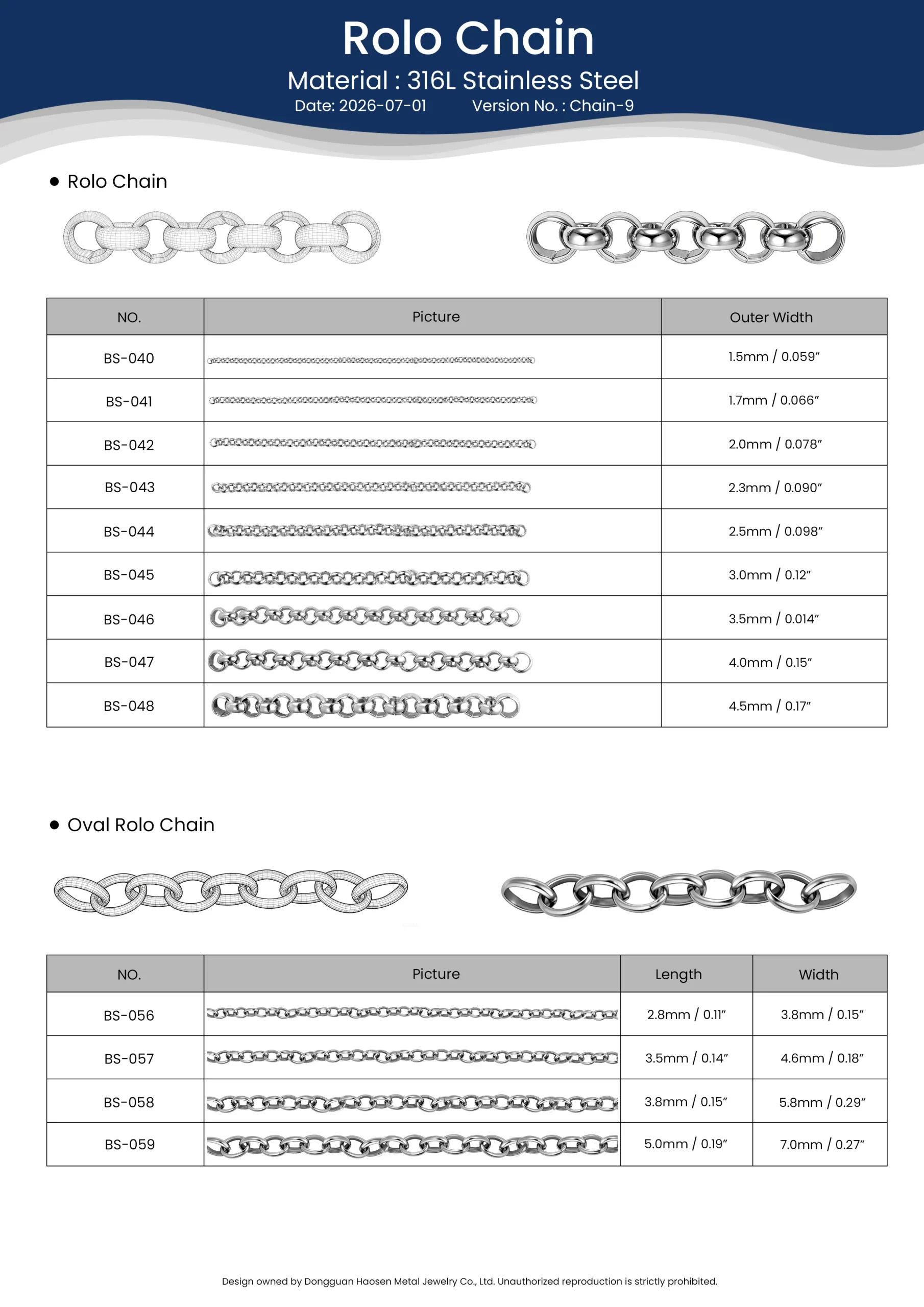
9. Rolo Chain
Round Rolo Chain
Rolo Chain uses repeating rounded links. The sample collection includes outer widths from approximately 1.5 mm to 4.5 mm.
Oval Rolo Chain
The catalog also includes Oval Rolo Chain structures. Representative link dimensions include approximately:
- 2.8 × 3.8 mm
- 3.5 × 4.6 mm
- 3.8 × 5.8 mm
- 5.0 × 7.0 mm
Changing from a round to an oval link affects the openness, spacing and rhythm of the chain even though both belong to the Rolo family.
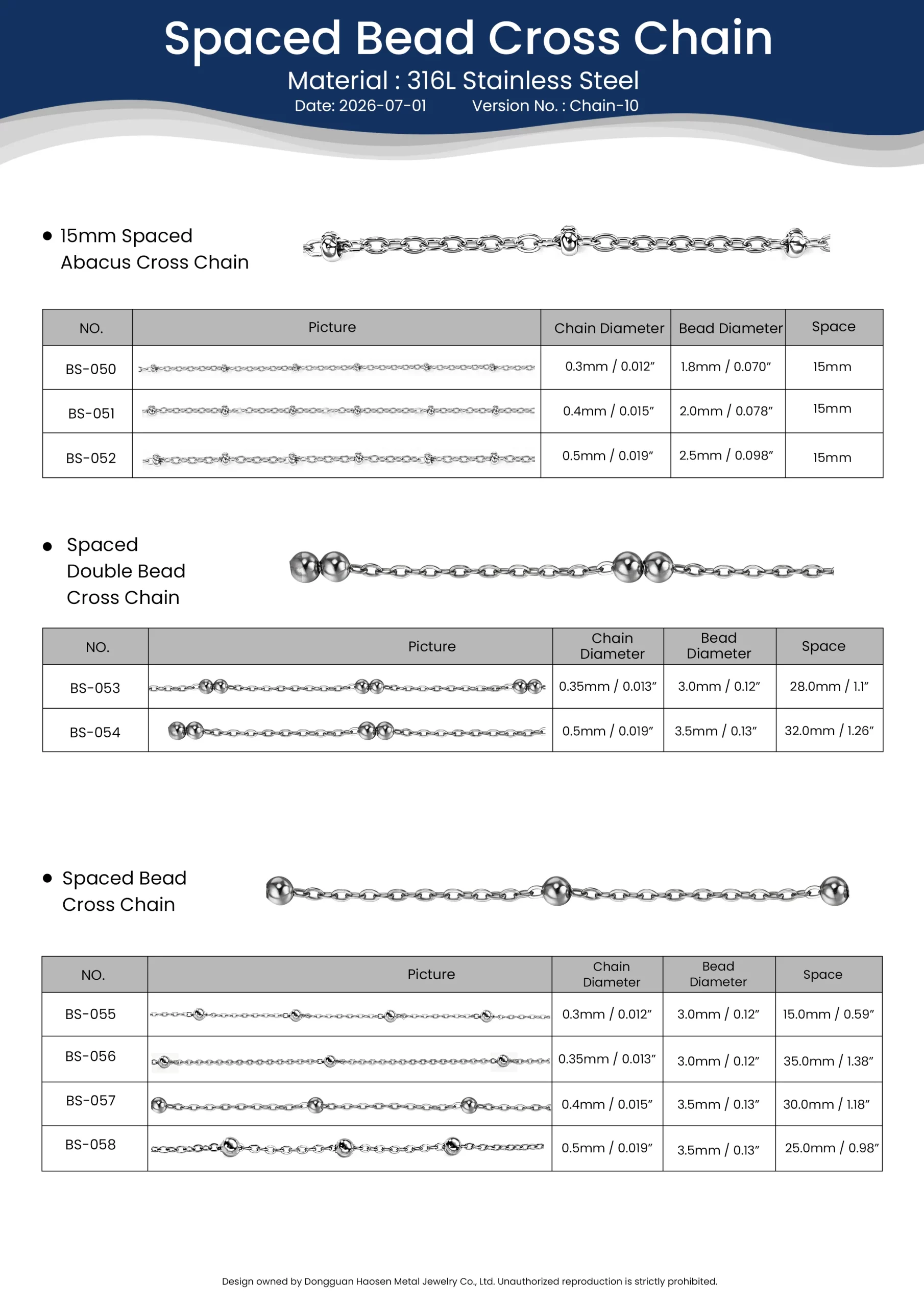
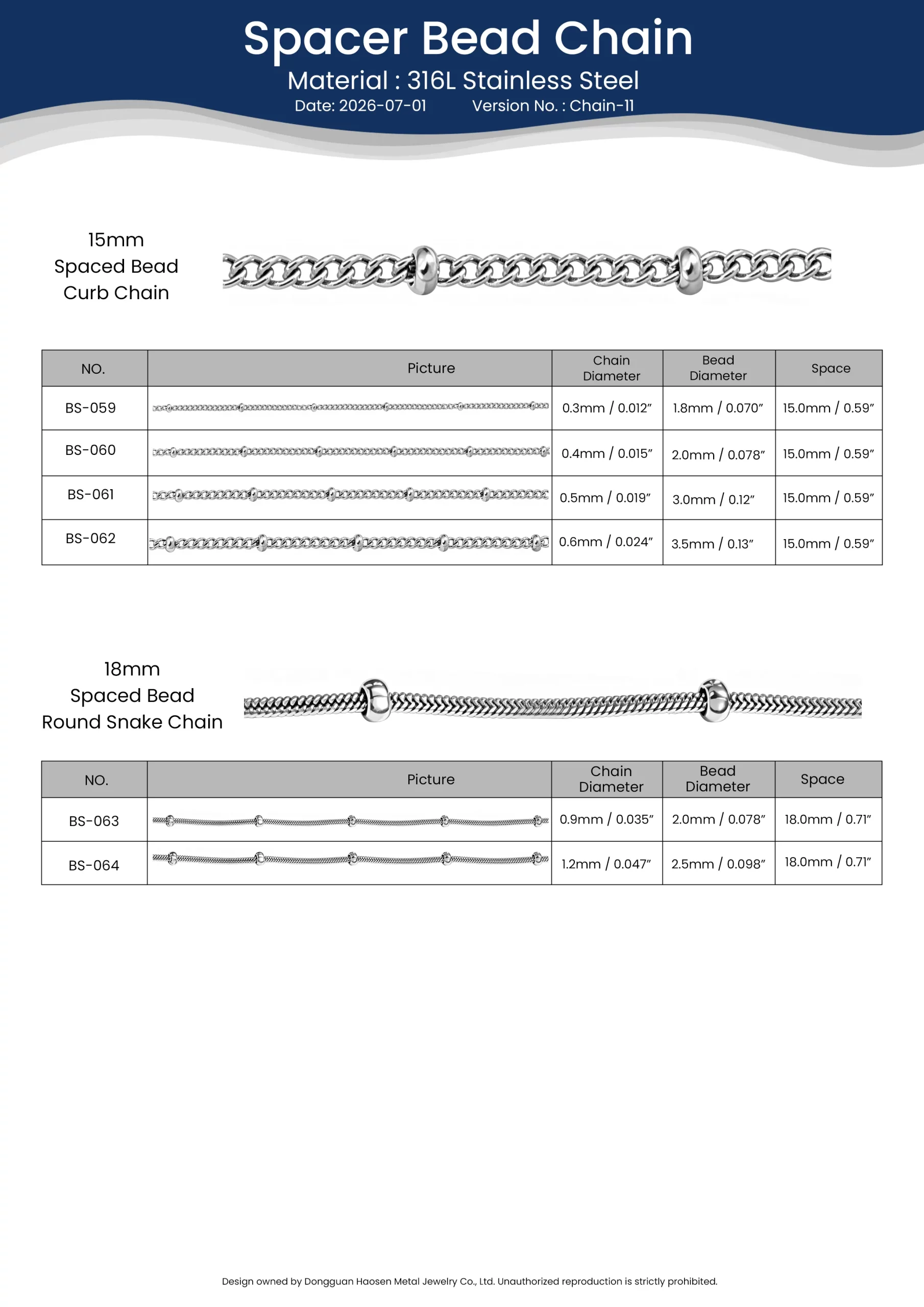
10. Spaced Bead Chains
Decorative beads can also be integrated into a chain at controlled intervals. The sample collection includes:
Spaced Bead Cross Chain
Single or double bead elements are positioned along sections of Cross Chain.
Spaced Bead Curb Chain
Decorative beads are combined with a Curb Chain base.
Spaced Bead Round Snake Chain
Round Snake Chain can also be combined with spaced bead elements. For these designs, specifications include Chain Diameter + Bead Diameter + Space, which makes bead spacing a functional part of the design rather than simply decoration.
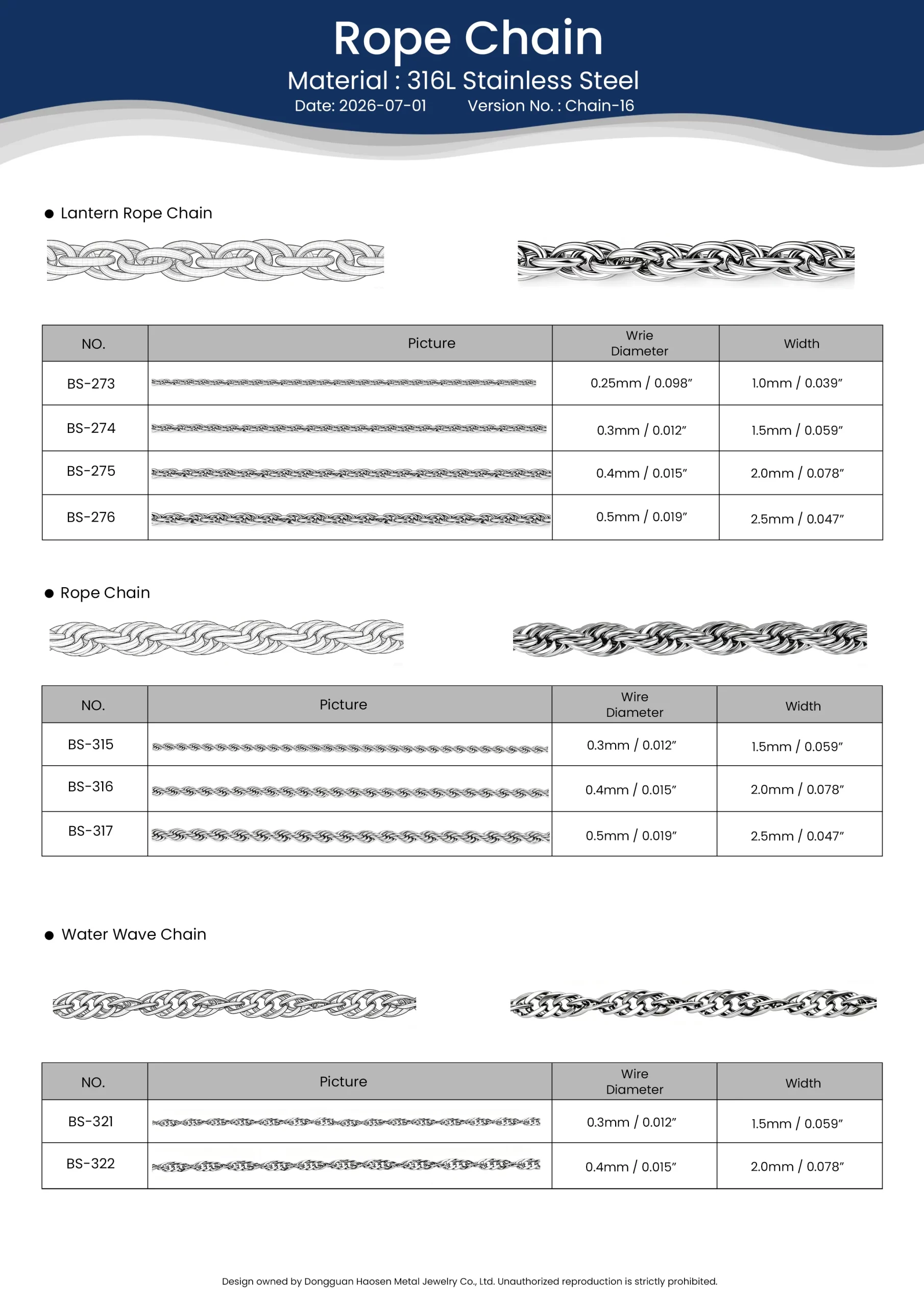
11. Rope Chain
The Rope Chain family creates a twisted or woven visual rhythm. The samples include:
- Lantern Rope Chain;
- Rope Chain;
- Water Wave Chain.
Wire diameter and overall width vary within these structures, so the finished visual effect should be evaluated through dimensions as well as the chain name.
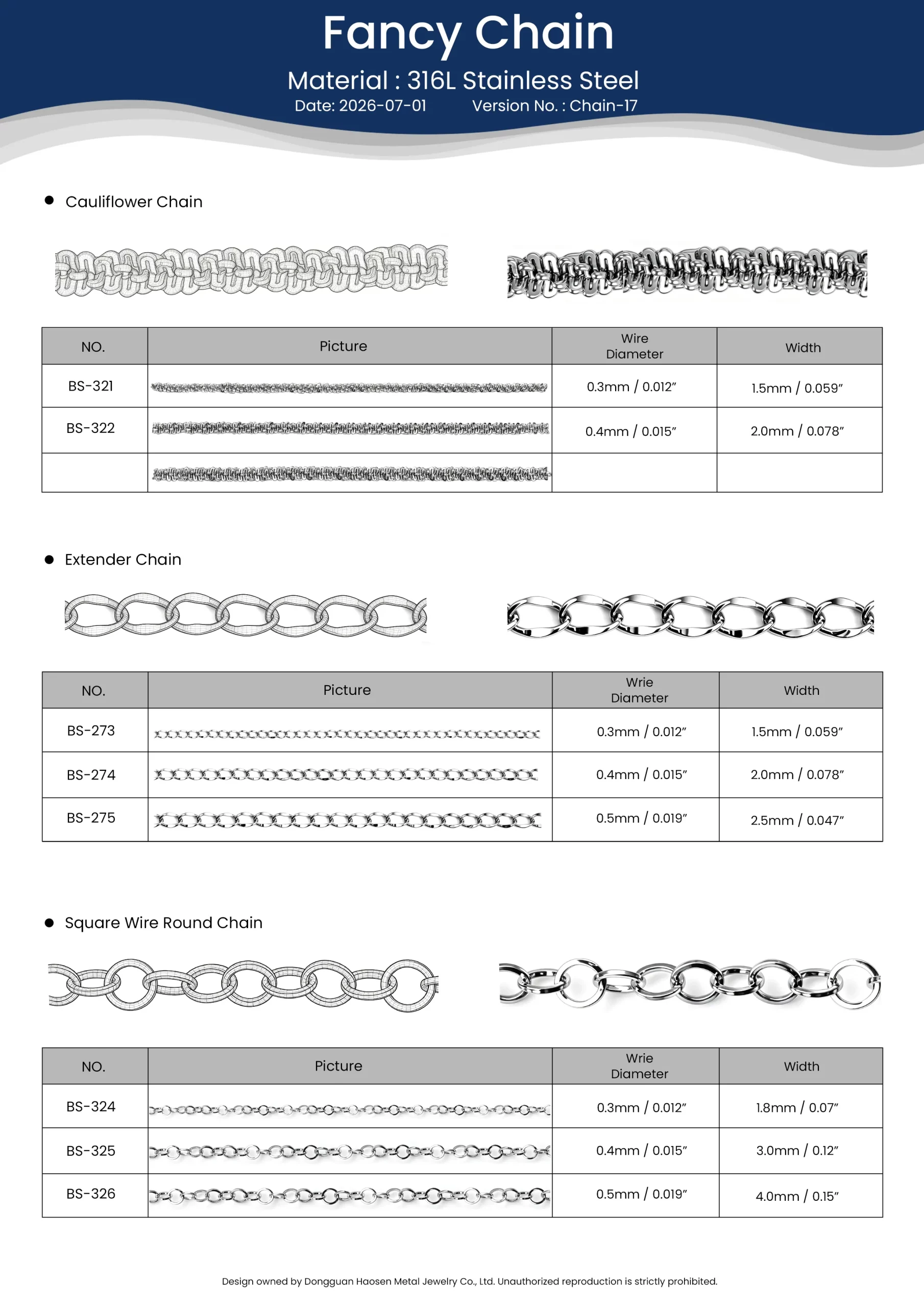
12. Fancy Chain
Some structures do not fit neatly into the main chain categories. The Fancy Chain sample page includes:
Cauliflower Chain
A repeating decorative construction creates a more textured appearance.
Extender Chain
Open repeating links create a structure that can also be used in adjustable or connecting sections.
Square Wire Round Chain
This structure combines round link geometry with a different wire profile. It demonstrates how a familiar link shape can change when the cross-section of the wire changes.
How to Choose a 316L Stainless Steel Chain
1. Define the Jewelry Application
Start with the finished product. Is the chain intended for a pendant necklace, a standalone chain necklace, a bracelet, charm jewelry, layering, a decorative chain section or an extender? The application helps narrow down the required structure and dimensions.
2. Select the Chain Family
Choose the overall design direction first: Cuban, Snake, Box, Herringbone, Rolo, Rope, Paperclip, Cross or another structure.
3. Choose the Width or Diameter
Next, determine how visually prominent the chain should be. For example, moving from a 1.2 mm Snake Chain to a 3.0 mm Snake Chain changes the visual proportion even though the chain family remains the same.
4. Check Link Dimensions
For open-link structures, confirm Link Length + Link Width + Wire Diameter rather than using overall chain width as the only reference.
5. Select the Surface Finish & Detail
Depending on the design, options in the current sample collection include polished, multi-sided polished, diamond-cut, faceted, embossed, high-polish, and twisted finishes or structural details. For colored stainless steel chains, surface development can also include PVD coating. The color card below provides a practical reference for selecting the visual direction before sampling.
PVD Color Options for 316L stainless steel chains
Once the chain structure, dimensions, and surface finish are defined, color can be specified as an additional development detail. The current PVD chain color references include 14K Gold, 18K Gold, 24K Gold, Rose Gold, Rhodium, Black, Light Blue, Coffee, and Rainbow. These names should be treated as color references for coated stainless steel rather than statements about solid-gold purity. Because the final appearance can change with chain geometry, polishing, and lighting, an approved physical color sample is recommended when exact color matching is important.

6. Match the Chain With the Pendant or Charm
When a pendant or charm is involved, the chain should also be evaluated against the scale and connection method of the component. Pay attention to chain width, connector dimensions, pendant bail opening and visual proportion.
7. Confirm the Clasp and Connection Structure
The clasp and connecting components should be considered before the chain specification is finalized. This avoids developing a chain first and then discovering that the connector or pendant system does not match the selected dimensions.
Chain Selection by Application
| Application | Options de chaîne | Key Check |
|---|---|---|
Pendant necklace |
Box, Cable, Snake, Rolo |
Bail opening + chain width |
Standalone necklace |
Cuban, Herringbone, Rope, Snake |
Width + profile + finish |
Bracelet |
Cuban, Rolo, Paperclip, Cross |
Link size + clasp |
Charm jewelry |
Rolo, Cable, Paperclip, Cross |
Link opening + connector |
Layering |
Fine or contrasting chains |
Width + visual proportion |
Extender / Connector |
Open-link / Extender Chain |
Link opening + connector size |
316L Stainless Steel Chain Size References
One of the most important points when choosing a chain is that chain type and chain size should never be evaluated separately. The table below summarizes representative dimensions from the current sample collection.
About the dimensions in this guide
The size ranges below are sample-card references from our current 316L stainless steel chain collection. They are intended as product-development references rather than universal industry size limits. Different structures may require different dimensions to describe them accurately.
| Chain Type | Sample Range | Main Check |
|---|---|---|
Open Box Chain |
approx. 1.0–5.0 mm |
Outer width |
Round Snake Chain |
approx. 0.6–3.0 mm |
Diameter |
Square Snake Chain |
approx. 0.6–3.0 mm |
Diameter |
Octagonal Snake Chain |
approx. 0.9–3.0 mm |
Diameter |
Flat Snake Chain |
approx. 1.2–3.0 mm |
Width / diameter |
Herringbone Chain |
approx. 1.65–7.0 mm |
Width + blade width |
Chaîne rolo |
approx. 1.5–4.5 mm |
Outer width |
Oval Rolo Chain |
approx. 2.8 × 3.8 to 5.0 × 7.0 mm |
Link L × W |
Understanding Chain Width, Wire Diameter and Link Dimensions
1.Chain Width
Chain width describes the overall visible width of the chain. It strongly affects visual presence. A 1 mm chain and a 5 mm chain can belong to exactly the same structural family while creating very different jewelry.
2.Wire Diameter
Wire diameter describes the thickness of the wire or metal section used to form a link. It is not the same as overall chain width. Two chains may have similar outer widths but different wire diameters and therefore different link proportions.
3.Link Length and Link Width
These measurements are especially important for open-link chains such as Paperclip, Rolo, and similar structures. A change in link length affects openness, spacing, visual rhythm, and proportion.
4.Inner Dimensions
For structures such as Box Chain, the sample specifications may include:
- Outer Width
- Outer Length
- Wire Diameter
- Inner Length
- Inner Width
These parameters describe the chain much more accurately than width alone.
5.Bead Diameter and Spacing
For spaced-bead constructions, bead diameter and spacing become part of the core chain specification. Two designs using the same base chain can look very different simply by changing bead size or spacing distance.
What Can Be Customized on a Stainless Steel Chain?
For a custom jewelry project, chain development can involve more than selecting an existing chain name. Depending on the project, specifications may include:
| Specification | Define | Examples |
|---|---|---|
Chain Type |
Chain structure |
Cuban / Snake / Box |
Taille |
Width / diameter |
Relevant dimensions |
Length |
Finished chain length |
Necklace / bracelet |
Link Structure |
Shape / profile |
Round / oval / flat |
Surface/Color |
Finish / texture / PVD color |
Polished / faceted / twisted / PVD color |
Components |
Connection system |
Clasp / connector / extender |
Branding |
Branded details, if needed |
Branded components |
The exact customization scope depends on the selected structure and project requirements.
316L Stainless Steel Chain Specification Checklist
A clear inquiry or development brief can include as many of the following items as relevant:
| Chaîne | Dimensions | Components |
|---|---|---|
☐Chain Type |
☐Width/Diameter |
☐Clasp Type |
☐Surface/Finish/Color |
☐Wire Diameter |
☐Connector Dimensions |
☐Chain Length |
☐Link Length/Width |
☐Pendant/Charm |
☐Sample Reference |
☐Target Dimensions |
☐Branding (if required) |
Have these details ready? Send your chain specifications to our team for evaluation.
Providing a sample reference or drawing can make the development process clearer, especially when a chain name can refer to multiple structural variations. Chain development can also be integrated into a broader custom stainless steel jewelry project.
From Chain Sample to Custom Jewelry Development
A sample card works best as a technical reference rather than just a style catalog. A practical product-development process can look like this:
Step 1 — Select the Chain Family: Chaîne Serpent
Step 2 — Select the Profile: Round Snake Chain
Step 3 — Select the Diameter: 1.2 mm
Step 4 — Define the Length: For example, according to the planned necklace or bracelet dimensions.
Step 5 — Confirm the Surface Requirement: Polished, twisted, embossed, or another specified structure.
Step 6 — Define the Connection System: Clasp, connector, extender, pendant or charm.
Step 7 — Evaluate the Sample: Confirm the visual proportion and structural details before moving forward with the finished jewelry project.
This process gives designers, buyers, and production teams a much clearer reference than a chain name alone. Learn more about our custom jewelry development process, from design review and sampling to production and quality control.
Related Guide: See a real 316L stainless steel jewelry manufacturing process from design review to finished production.
Explore 316L Stainless Steel Chain Options for Your Jewelry Project
A 316L stainless steel chain should be selected based on more than appearance alone. The chain family, width, wire diameter, link dimensions, profile, and surface structure all influence the final jewelry design.
From fine Box and Snake Chains to flat Herringbone structures, open Paperclip links, Cuban Chains, and decorative Rope, Cross, or Fancy Chains, different constructions can support very different product directions.
Already have a chain sample, drawing or target dimensions?
Send your reference together with the chain type, width or diameter, link dimensions, length, finish, and clasp requirements. We can use these details to discuss suitable chain options for your jewelry project.
Nous contacterFrequently Asked Questions
Q1: Is 316L Stainless Steel Good for Jewelry Chains?
316L stainless steel is commonly used for jewelry chains because it can support a wide variety of chain structures and finishing processes while providing the durability expected from stainless steel jewelry. However, chain quality should not be judged by material grade alone. Link construction, dimensions, finishing, and connection quality also matter.
Q2: What Is the Difference Between Chain Width and Wire Diameter?
Chain width refers to the overall visible width of the finished chain. Wire diameter refers to the thickness of the wire or metal section used to form individual links. They are different specifications and should be recorded separately.
Q3: Are Snake Chains Available in Different Shapes?
Yes. The current sample collection includes Round, Square, Octagonal, and Flat Snake Chains, as well as woven, polished, twisted, and embossed variations.
Q4: Can the Same Chain Type Be Made in Different Sizes?
Yes. The sample collection shows multiple sizes within Box, Snake, Herringbone, Rolo, Cuban and other chain families. For this reason, chain type and size should always be considered together.
Q5: What Chain Is Suitable for a Pendant?
There is no single chain type that works for every pendant. The selection depends on the pendant size, visual style, connector structure and required chain proportion. Box, Cable, Snake, Rolo and other structures can all be considered depending on the specific design.
Q6. How do I specify a custom stainless steel chain?
A useful specification should include as many of the following as relevant: Chain Type + Width/Diameter + Wire Diameter + Link Dimensions + Length + Surface Structure + Clasp + Pendant/Charm Requirements. Providing a sample reference or drawing can make the development process clearer.
Q7. Can a Chain Be Developed From a Reference Sample or Drawing?
Yes. A reference sample, drawing, or clear image can help identify the chain family, profile, and structural details. For more accurate evaluation, include available dimensions such as chain width, wire diameter, link length and width, finished length, and connector requirements.
Q8. How should chain width be evaluated for a pendant?
Check the chain width together with the pendant scale, bail opening, connector dimensions, and overall visual proportion. The appropriate width depends on the specific design rather than one universal size rule.
Author

Ertian Jiang (Jasper) is the founder of Haosen Metal Jewelry. Since the age of 26, he has combined deep roots in traditional craftsmanship with a sharp vision for the market to build the foundation of the company’s excellence.
Ertian Jiang started on the ground floor as a craftsman, specializing in semi-precious stones (agate, mother of pearl, tiger’s eye) and manual inlaying—perfecting how to fit natural stones into metal bases without gaps or glue failure. He also worked on the front lines of sales, speaking face-to-face with buyers and listening to their frustrations about fallen stones and fading colors.