

- Jasperyi
- No hay comentarios
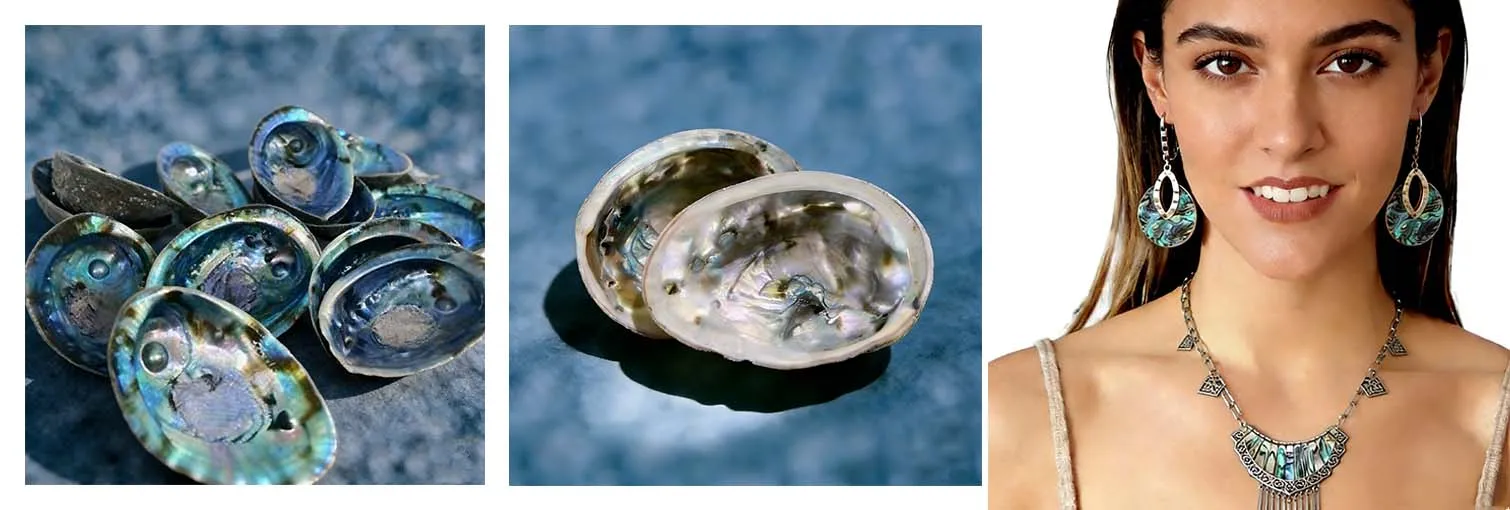
Abalone shell jewelry is widely used in necklaces, pendants, earrings, rings, y pulseras due to its unique iridescent colors and natural ocean-inspired appearance.
From classic round cuts to custom geometric designs, abalone shell can be crafted into a variety of jewelry components for fashion brands and private label collections.
In this guide, we explore the most popular abalone shell jewelry shapes and how they are used in commercial jewelry manufacturing.
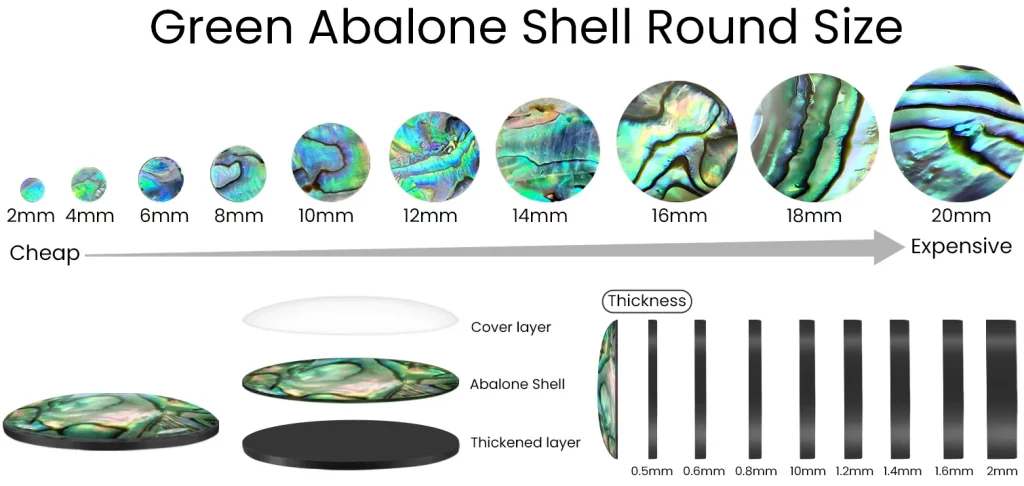
Basic Geometric Shapes: Green Abalone Shell Size
Round Abalone Shell Jewelry Designs
Round are the most fundamental geometric shapes, yet they demand high precision in manufacturing. We offer standard discs ranging from 2–20mm in diameter, with larger sizes requiring custom fabrication. Smaller discs (eg 2–3 mm) present cutting challenges, resulting in lower yield rates. Larger discs, while easier to cut, suffer from low material utilization, driving up costs.
In terms of thickness, 0.5–2mm is commonly used. Too thin and it becomes prone to cracking; too thick and it compromises aesthetics and wearing comfort.
| Cover Layer Type | Enamel Factes | Crystal Facets | Glass Facets |
|---|---|---|---|
|
Cutting Process |
Cabochon |
Cabochon / Faceted |
Cabochon / Faceted |
|
Size Range |
0-2.5mm |
0-6mm, available over 6mm |
0-6mm |
|
Cost |
Very Cheap |
Expensive |
Cheap |
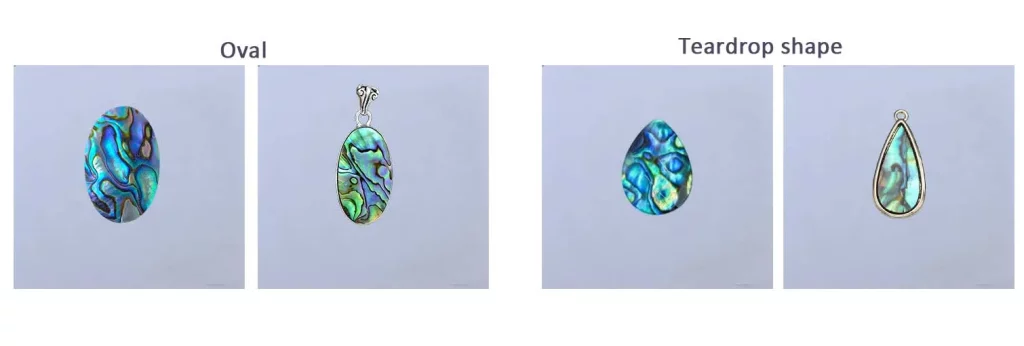
Oval and Teardrop-shaped Abalone Shell Jewelry Designs
Oval processing is more complex than round. The common length-to-width ratio is 1.5:1, which strikes a good balance between visual aesthetics and material utilization. For special ratios (eg 2.8:1), the cutting angle must be adjusted according to the direction of the abalone shell’s iridescent patterns to prevent uneven luster in the finished product.
As a variant of the oval, teardrop shapes require special attention to prevent tip chipping. This is typically addressed through micro-rounding techniques, which maintain visual lines while enhancing structural integrity.
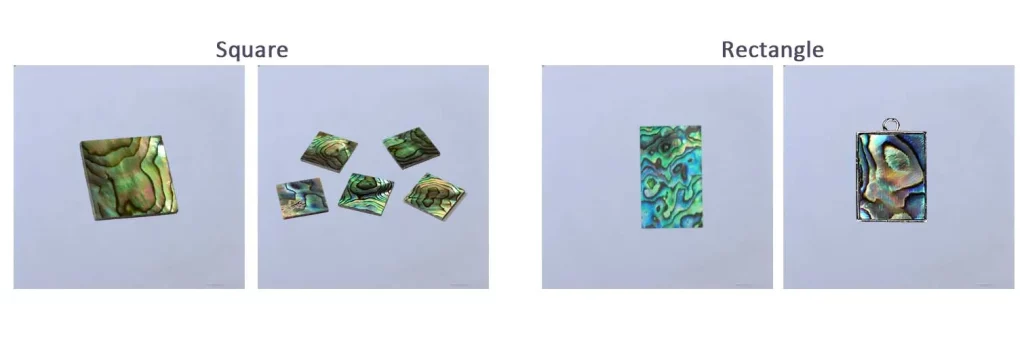
Square and Rectangle Abalone Shell Jewelry Designs
Right-angle designs in mother-of-pearl processing tend to cause stress concentration, increasing the risk of cracking. Therefore, during production, the four corners of squares are typically rounded to 0.5–1 millimeters. While pure right-angle designs are feasible, they generally yield lower production rates.
Rectangular products commonly feature aspect ratios between 1.5:1 and 2:1. This proportion aligns with visual aesthetics and enjoys strong market acceptance. Elongated products exceeding this ratio often face inventory challenges unless driven by specific design requirements.
Polygon-Shaped Abalone Shell Jewelry Designs
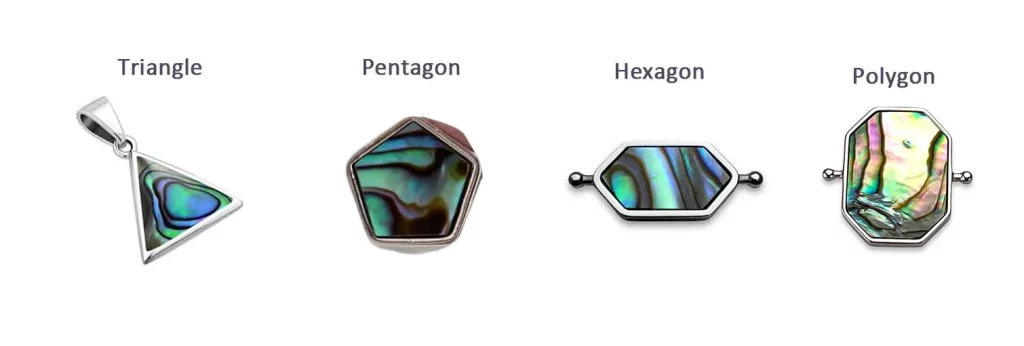
Triangles, pentagons, y hexagons are within the machinable range, but machining difficulty increases with the number of sides. Octagons and polygons with more sides present challenges due to their short side lengths and susceptibility to micro-cracks, demanding extremely high cutting precision. Yield rates are generally low, leading to increased costs.
How to Create 3D Abalone Shell Jewelry Designs
Form-Following Abalone Shell
Form-following design aims to preserve the natural grain and contours of mother-of-pearl, ensuring each piece is unique. However, standardizing production for such items proves challenging. They require manual selection and shaping to maintain natural forms while achieving a consistent overall style, resulting in extended processing cycles and higher costs.
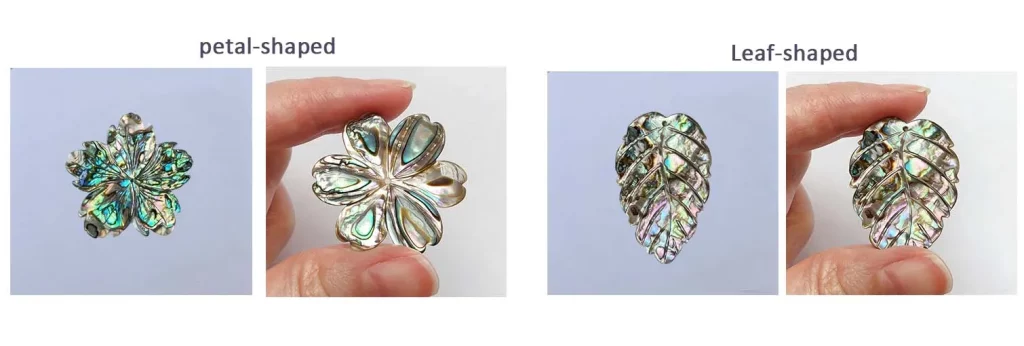
Petal-shaped and Leaf-shaped Abalone Shell
Petal designs require precise control of curve radii to achieve natural forms. Four- or five-petal designs are most common, while additional petals significantly increase manufacturing complexity.
When depicting leaf vein textures on leaf-shaped components, laser engraving is commonly employed. However, this process demands strict parameter control, as improper operation can easily cause material burn damage or cracking.
How Different Abalone Shell Shapes Are Used in Jewelry Design
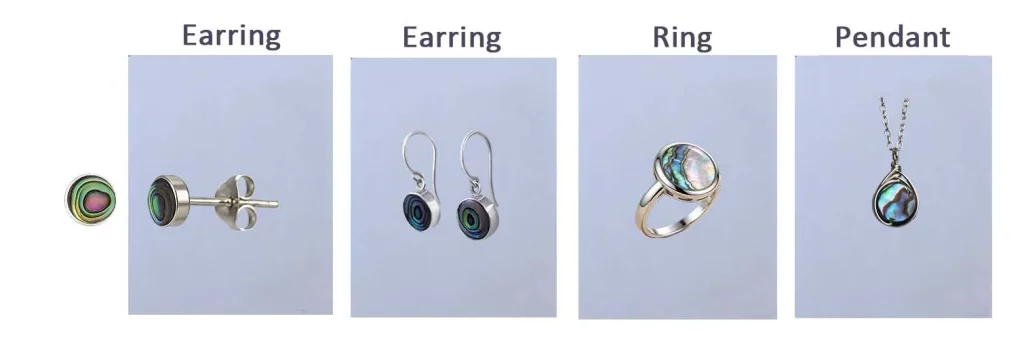
Round Abalone Shells for Jewelry
- Round abalone shells are commonly used for earrings, rings, y bracelet pendants.
The round cut is highly preferred for custom jewelry, valued for its structural stability y high manufacturing yield. Its circular geometry effectively minimizes stress points, making it an ideal choice for brands that require efficient, large-scale production without compromising on consistent quality.
Oval and Teardrop-shaped Abalone Shells for Jewelry
- Oval abalone shells are commonly used for rings, colgantes, earrings, y bracelet charms.
- Smooth lines create a visually enlarged effect, making them the mainstream choice for ring settings and pendants, particularly suited for highlighting iridescent patterns.
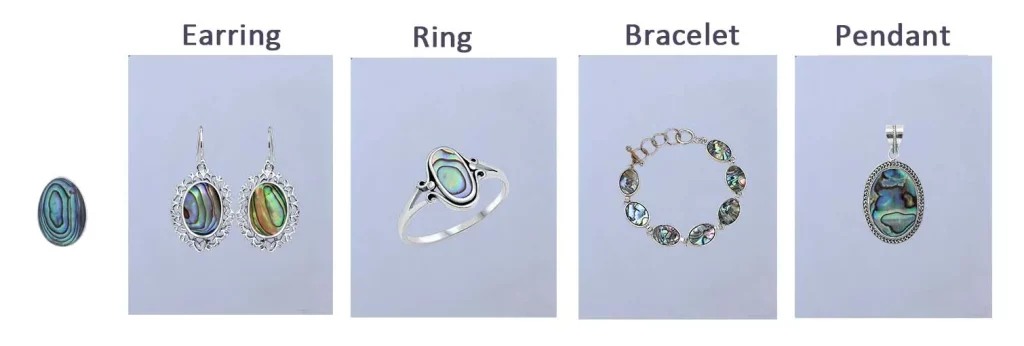
- Teardrop-shaped abalone shells are primarily used for colgantes, earrings (especially drop-style), pulseras y brooches.
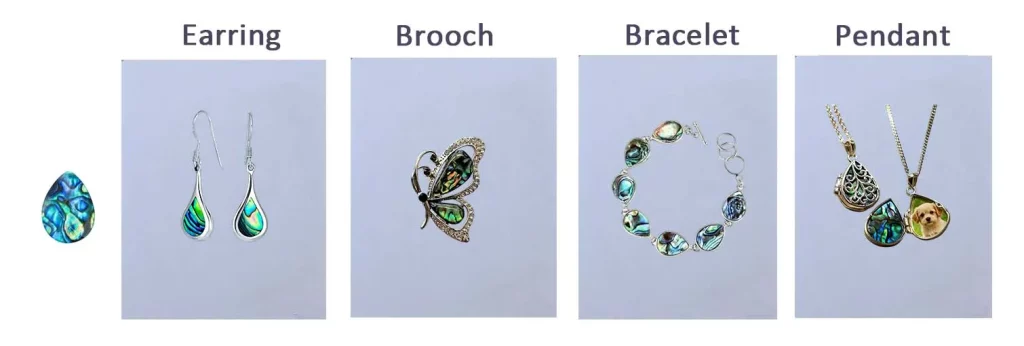
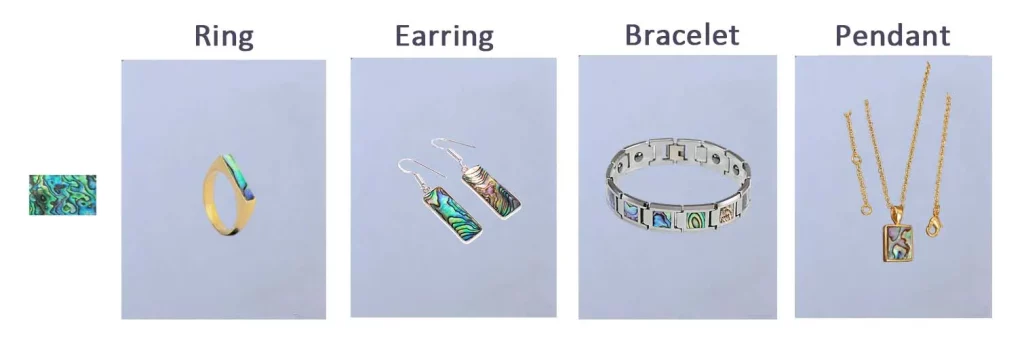
Square and Rectangular Abalone Shells for Jewelry
- Square/rectangular abalone shells are commonly used for rings, bracelet links, men’s jewelry, y geometric-style pendants.
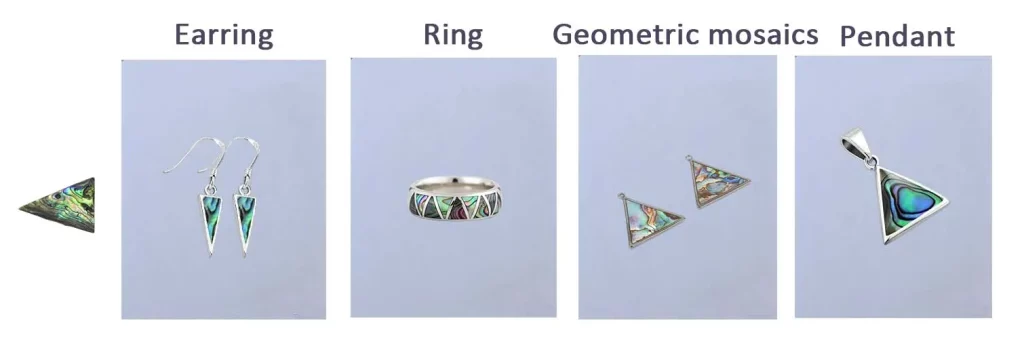
Triangular Abalone Shells for Jewelry
- Triangular abalone shells are commonly used for stud earrings, geometric mosaics, y modern-style pendants.
- For personalized designs o combination arrangements, commonly seen in fashion-forward earrings y abstract-shaped jewelry.
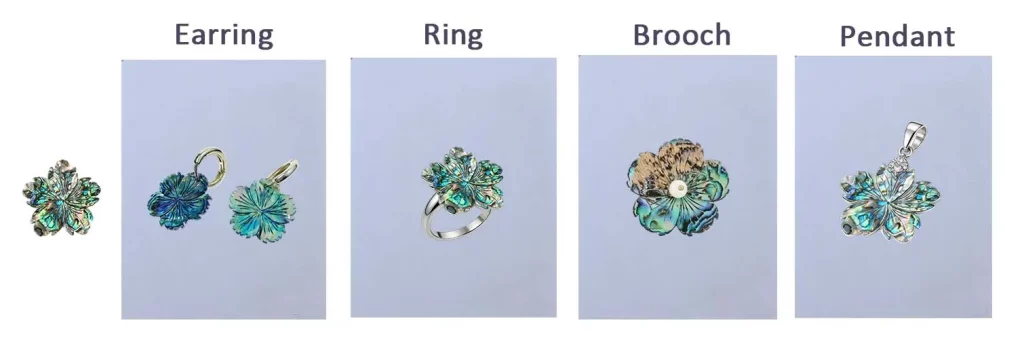
Petaled Abalone Shells for Jewelry
- Petaled abalone shells are primarily used for earrings, colgantes, brooches, y feminine-style rings.
- The 4–5 petal variety is most common, offering a soft and romantic aesthetic ideal for spring/summer collections, wedding jewelry, and similar themes.
Leaf-shaped Abalone Shells for Jewelry
- Leaf-shaped brooches are commonly used in pendants, earrings, brooches, and nature-themed collections.
- Often employed in naturalistic designs, they are well-suited for series of eco-themed jewelry.
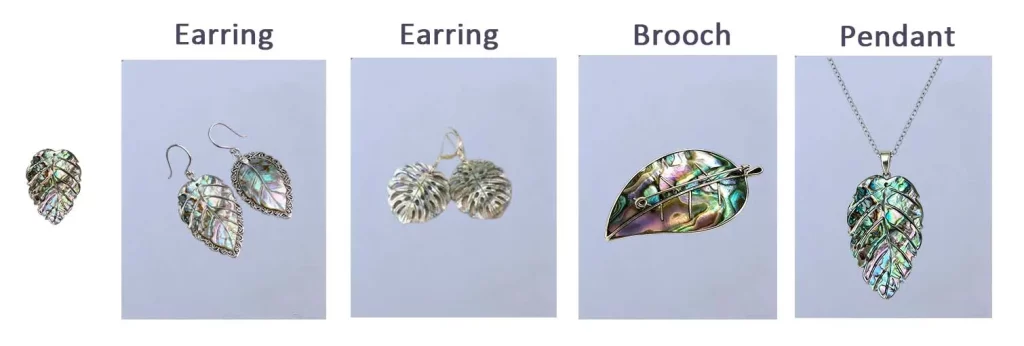
To see how these shapes come together in complete product lines, explore our full guide to metal-inlaid abalone shell jewelry categories.
Selecting the Optimal Metal Base for Abalone Shell Inlays
The visual impact of an abalone shell design is only half the story; the choice of metal base is equally critical in determining the jewelry’s durability, market suitability, y long-term performance. Haosen typically work with three primary metals:
- 316L Stainless Steel: Our primary recommendation. Renowned for its superior corrosion resistance y medical-grade, hypoallergenic properties, 316L stainless steel provides the most stable and secure foundation for natural stone inlays. It is exceptionally resilient to daily wear, making it the ideal choice for brands focused on reliability.
- Brass: A versatile option favored for projects that require intricate, complex shapes or a wide variety of plating finishes.
- 925 Sterling Silver: A classic alternative often chosen for specific brand collections where precious metal composition is a key design requirement.
To assist you in making an informed decision for your collection, we have compiled our technical expertise on material performance y compliance:
Technical Finishing: PVD Coatings for Stainless Steel Jewelry: Hardness & B2B Technical Specs
Quality & Compliance: Download Our Latest 316L Stainless Steel SGS & RoHS Test Reports
Final Thoughts
At Haosen Jewelry, we bridge the gap between creative design and manufacturing reality. With over 16 years of expertise in specialized inlay craftsmanship, we understand that successful abalone shell collections require more than just aesthetic appeal—they demand precision, durability, and strict quality control.
Understanding both the available shapes and the main product categories is key to developing a successful abalone shell jewelry line. Whether you are scaling an existing line or prototyping a new design, we rigorously control every step—from raw material selection to precision setting—ensuring quality and timelines meet commercial collaboration standards.
FAQs Regarding Abalone Shell Jewelry.
Can you reliably set abalone shells in metal for jewelry designs with complex surfaces and ultra-thin bezels? What's the yield rate?
Core Advantages:
- Durability and Low Maintenance: Stainless steel (especially 316L) offers corrosion resistance, hypoallergenic properties, and resistance to discoloration. It remains unaffected by prolonged sweat exposure, significantly reducing after-sales service rates.
- High Structural Strength:Stainless steel (especially 316L) offers corrosion resistance, hypoallergenic properties, and resistance to discoloration. It remains unaffected by prolonged sweat exposure, significantly reducing after-sales service rates.
- Cost Advantage: Material costs are lower than 925 sterling silver and comparable to high-quality eco-friendly alloys. Its durability provides brands with a compelling value proposition and quality selling point.
Relative Disadvantages:
- Processing Difficulty and Cost: Stainless steel’s high hardness causes greater wear on processing equipment and cutting tools. Setting costs may be approximately 15-25% higher than for alloys.
Weight Perception: Its higher density makes it heavier than alloys for the same volume. Design considerations are needed for lightweight earrings and necklaces.
How can damage to abalone shells be prevented during setting due to stainless steel's high hardness?
Implement a cushioning setting process:
- Precision pre-machining of settings: All inner contact surfaces of stainless steel settings undergo high-precision mirror polishing to ensure no burrs or sharp edges.
- Elastic bonding layer: Utilize specially formulated high-elasticity modified epoxy resin adhesive. Upon curing, it forms a flexible cushioning layer that absorbs stress between the stainless steel and mother-of-pearl.
- Zero-pressure snap-fit: For bezel designs, precisely calculate the bezel dimensions to ensure the abalone shell is “inserted” rather than “pressed in.” Rely solely on adhesive bonding to eliminate mechanical stress.
Which stainless steel surface finish pairs best with abalone shell for a premium look?
- Top Choice: PVD vacuum-plated gold/rose gold (matte finish). The matte texture accentuates the iridescence of abalone shell, creating a sophisticated contrast.
- Classic: High-gloss mirror polish. Complements the sheen of abalone shell, ideal for fashion-forward designs.
- Unique: PVD black plating (gunmetal). Creates a striking visual impact with vibrant abalone shells (e.g., peacock blue), exuding modernity and individuality.
Are ear needles/ear plugs hypoallergenic? Are the needles too thick?
- Material: All skin-contact parts are crafted from 316 or 316L stainless steel.
- Specifications: Standard needle diameter is 0.8mm—the optimal size for strength and comfort. We also offer 0.7mm (more comfortable) or 0.9mm (more secure) options. Ear plugs feature embedded silicone cushions for enhanced comfort.
How to manage weight in drop earrings?
- Lightweight structural design: Incorporate stainless steel components featuring “hollowed-out weight reduction” or “thin-walled hollow construction.”
- Material substitution: Non-load-bearing elements (e.g., decorative chains) can be crafted from lightweight alloys or silver components.
How are the edges of metal inserts processed? How do we ensure they won't scratch hands?
All metal inserts undergo a “three-step edge treatment process”:
1) Initial deburring after CNC machining.
2) Magnetic polishing to achieve naturally rounded edges and corners.
3) Manual fingertip inspection to guarantee no scratchy feel. We can provide “edge treatment comparison samples” to visually demonstrate the difference in craftsmanship.
We have a complex irregular design drawing. Can abalone shells achieve this shape? Does the metal inlay require a separate mold? What are the costs and lead times?
Abalone shells can achieve complex irregular cuts and carvings, but three key points require evaluation:
- Cutting Feasibility: We will analyze details such as edge sharp angles and inner arc radii based on your drawings. If extremely thin sections (<0.5mm) or deep sharp angles exist, minor design adjustments may be needed to prevent cutting fractures.
- Inlay Molding Matching: Irregular shapes typically require custom inlay molds to ensure perfect fit with the mother-of-pearl. Mold costs range from ¥800-3000 based on complexity, with a development cycle of 5-7 business days.
- Optimization Recommendations: We offer complimentary design optimization services to adjust local structures while preserving your design aesthetic, thereby improving yield rates and reducing costs.
Will selecting different metal plating colors (such as platinum, gold, rose gold, gunmetal black) affect the natural iridescence of the abalone shell? What color combinations do you recommend?
The plating color directly impacts the final visual effect of the abalone shell.The reason: The color of the metal base creates a “backlighting effect” through the shell’s translucent layer.
- Light-colored plating (e.g., platinum, bright silver): Maximizes the restoration and enhancement of the abalone shell’s natural iridescence, creating a fresh, translucent appearance. This is the safest and most versatile choice.
- Warm-toned plating (e.g., gold, rose gold): Adds a warm hue overlay to the shell’s iridescence. For example, pairing a peacock blue mother-of-pearl with a rose gold base may yield a unique purple-gold hue. This requires pre-production plating testing, as the outcome can be stunning or fall short of expectations.
- Dark plating (e.g., gunmetal black, antique bronze): Creates a dramatic high-contrast effect, emphasizing the pearl’s bright areas while sacrificing shadow details. Suitable for designs seeking individuality and a modern aesthetic.
How can we ensure that inlays do not discolor, detach, or lose their luster after prolonged wear?
To enhance your brand’s customer service and fundamentally reduce post-sale disputes caused by improper care, we recommend and support:
- Including a “Care Trio” as standard packaging: Consider including in each product box: a soft polishing cloth, a mini soft-bristle brush, and an elegant care card printed with the core maintenance points (can feature your brand logo).
- Establish clear post-sale responsibility boundaries: In your sales terms, kindly note: “Proper care is essential for maintaining your jewelry’s lasting beauty. Damage resulting from improper use (such as ultrasonic cleaning, impact, or exposure to chemicals) may not be covered under free warranty.”
Abalone shells are natural materials and may exhibit uneven textures or minor spots. How do you define “defects” in your quality inspection?
Confirm with you before shipment to avoid disputes over bulk orders.We categorize defects into three types and clearly define the handling procedures:
| Defect Grade | Defect Categories | Specific Description | Our Handling Standards |
|---|---|---|---|
|
A |
Critical Defects |
Penetrating cracks, chipped corners, holes severely compromising structural integrity. |
100% inspection required for rejection |
|
B |
Major Defects |
Visible surface blemishes: distinct black spots, white spots (area >0.1mm²), or dense grain breaks severely affecting aesthetics. |
Rejected during 100% inspection. Limited acceptance permitted with written client approval as unique characteristics. |
|
C |
Minor Defects/Natural Characteristics |
Minor clouding in grain patterns, uneven color transitions, natural specks <0.3mm² permitted. |
Permitted unless client specifically requests “Flawless Grade”
(significantly increasing costs and waste). |
Recent Articles
Author
-

Ertian Jiang (Jasper) is the founder of Haosen Metal Jewelry. Since the age of 26, he has combined deep roots in traditional craftsmanship with a sharp vision for the market to build the foundation of the company’s excellence.
Ertian Jiang started on the ground floor as a craftsman, specializing in semi-precious stones (agate, mother of pearl, tiger’s eye) and manual inlaying—perfecting how to fit natural stones into metal bases without gaps or glue failure. He also worked on the front lines of sales, speaking face-to-face with buyers and listening to their frustrations about fallen stones and fading colors.