

How to choose CZ stones, compare quality, and specify them for custom jewelry.
Cubic zirconia (CZ) is a manufactured gemstone made from zirconium dioxide. It is widely used to create a diamond-like appearance at an accessible cost. CZ is not a diamond, a lab-grown diamond, or natural zircon. [S1] [S2] For jewelry brands, its value depends on the stone’s appearance and how well it works in the finished design.
Choosing CZ for a collection starts with the look you want. Turning that choice into a repeatable product requires a few more decisions: stone dimensions, color consistency, setting construction, and the quality your customer expects at the intended price.
This guide explains the material first, then gives you a practical way to specify it before requesting samples or production quotes.
What does CZ mean in jewelry?
CZ stands for cubic zirconia. In a product description, it identifies the stone material; it does not describe the metal, plating, or setting quality.
CZ is produced through a controlled crystal-growth process involving molten ingredients, followed by cutting and polishing. The finished stones can be colorless or colored. [S1] Their manufactured origin makes a broad range of coordinated designs possible, but individual batches still need to match the agreed specification.
For a purchase order, write “cubic zirconia” in full. Terms such as “crystal,” “diamond-like stone,” or “white stone” leave too much room for different materials.
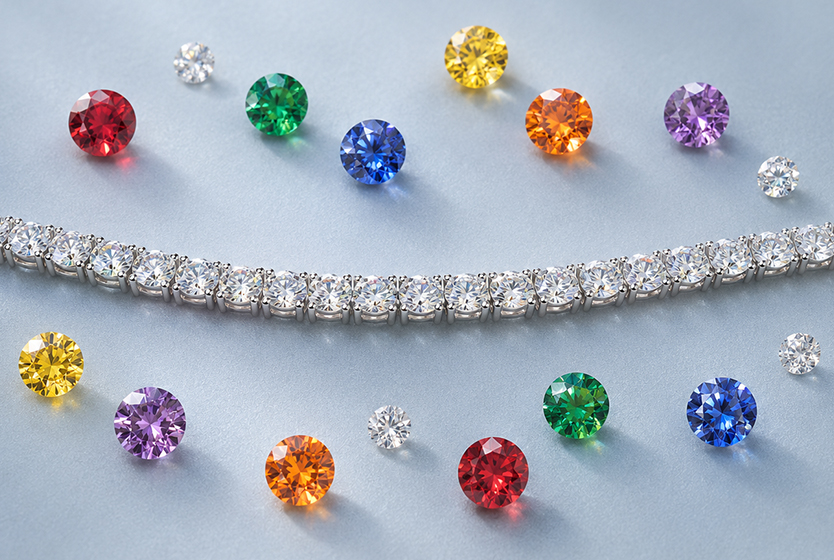
How does cubic zirconia compare with diamond, moissanite, and zircon?
These names are often grouped together because the stones can serve similar visual purposes. They identify different materials.
| Material | Identity | What a buyer should keep distinct |
|---|---|---|
| Cubic zirconia | Manufactured zirconium dioxide gemstone | A diamond simulant, not diamond |
| Natural diamond | Naturally formed carbon crystal | Natural origin and diamond identity |
| Lab-grown diamond | Manufactured diamond crystal | Diamond identity, with laboratory-grown origin |
| Moissanite | Silicon carbide; commonly lab-grown for jewelry | A separate gemstone with different optical properties |
| Natural zircon | Zirconium silicate mineral | Not another name for cubic zirconia |
GIA distinguishes diamond simulants from laboratory-grown diamonds: simulants resemble diamond but have different properties. [S2] Natural zircon is also chemically different from CZ. [S3]
CZ has a Mohs hardness of about 8.5, compared with diamond at 10. That describes resistance to scratching, not a guarantee against chipped corners or damage during setting. CZ is also denser than diamond, so a CZ of the same volume weighs more. [S1] [S4] For manufacturing, specify millimeters rather than relying on a diamond-equivalent carat description.
Choose the material that fits the product promise. If a collection is sold as diamond jewelry, CZ cannot substitute for the specified diamond. If the goal is an accessible fashion collection with a bright stone appearance, CZ may be worth sampling.
When is CZ a good choice for a fashion jewelry collection?
CZ is worth considering when the design needs visible sparkle, multiple coordinated stone sizes, or a stone look that fits an accessible retail price. That can include stud earrings, pendants, occasion pieces, and coordinated accessories for clothing collections.
The most useful question is how the stone will perform in this particular product.
| Design situation | Development priority |
|---|---|
| Matching stud earrings | Compare both stones together for size, color and setting height |
| A pendant with one prominent stone | Approve the center stone’s appearance in the actual setting |
| A ring with exposed corners | Review corner protection and likely contact during wear |
| A design with many small stones | Confirm stone count, setting access and inspection workload |
| A collection using several colors | Approve each color and define acceptable batch variation |
Consider another stone, or revise the design, when the customer’s material expectations cannot be met by CZ, when the setting leaves vulnerable areas exposed, or when the cost of securing many stones exceeds the product’s budget.
Does 5A cubic zirconia always mean better quality?
Treat AAA, 5A, and similar labels as supplier-specific descriptions until you have a written specification. A supplier’s higher tier may be meaningful within its own range, but the letters alone do not establish an equivalent standard across vendors. A CZ supplier’s published grading explanation explicitly describes this limitation. [S5]
Ask what changes between the quoted tiers. Is the difference in polish, symmetry, color selection, dimensional consistency, or the proportion of stones rejected during sorting?
Then compare samples under the same conditions. Keep the background, lighting, viewing distance, and stone size consistent. Approve a physical reference sample, and record the features that made it acceptable.
What should replace a grade-only purchase specification?
| Check | What to agree before ordering |
|---|---|
| Face-up appearance | Reference sample for brightness and overall visual character |
| Cut and polish | Acceptable facet finish and symmetry |
| Color | Approved color reference and matching expectations |
| Dimensions | Width or diameter, length where relevant, depth and agreed tolerances |
| Condition | How chips, scratches and visible defects will be assessed |
| Treatment | Whether the stone is coated or otherwise treated |
| Batch matching | How stones within one item, a pair, or a set should match |
“5A” can remain on the purchase order as the supplier’s product reference. It should sit beside these requirements, not stand in for them.
Which stone dimensions matter before the setting is designed?
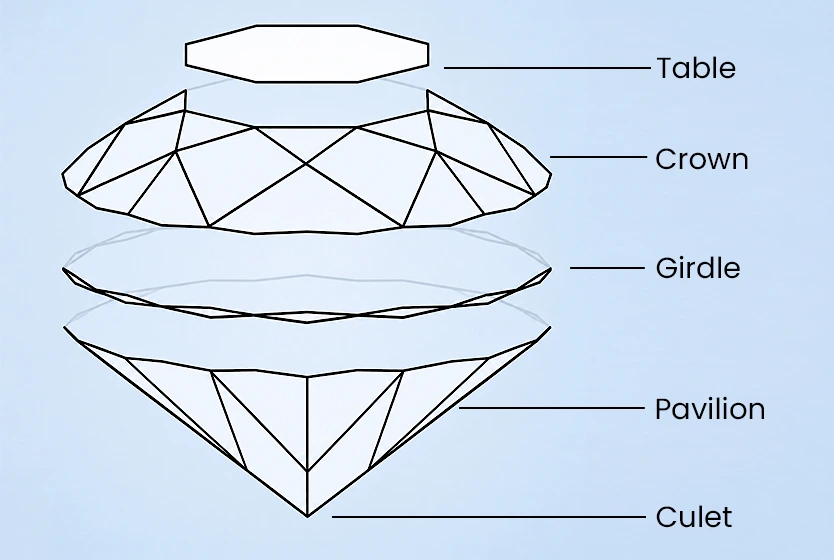
A stone can look correct from above and still be unsuitable for the planned setting. Face dimensions tell the designer how much space it occupies. Depth and edge profile affect how it sits in the metal.
For a round stone, request diameter and depth. For a princess, oval, pear, or other shaped stone, confirm the relevant length, width, and depth, together with the supplier’s dimensional range.
Why should the stone and metal sample be approved together?
The seat must support the intended stone, and the retaining metal must work with its shape. A deeper stone may require a different setting profile; a change in edge geometry may require adjustment even when the nominal face size stays the same.
Do not approve an overall jewelry height from a photograph alone. Review the stone and setting together in a sample or dimensioned drawing, including the space below the stone and the areas where the metal retains it.
How precise should the tolerances be?
There is no useful single tolerance for every CZ design. A small stone in a tightly defined setting and a larger stone in an adjustable setting present different constraints. Ask the stone supplier and jewelry manufacturer to agree on what the design requires and what they can repeatedly deliver.
If the proposed dimensions cannot be supplied consistently, resolve that before bulk stone purchasing or final tooling approval.
How do the setting and base metal affect the result?
The same CZ can produce different results in different constructions. Review the stone, setting, base metal, finish, and assembly sequence as one product.
| Setting approach | What to review in a sample |
|---|---|
| Prong setting | Stone alignment, retention, consistent prong appearance and snagging |
| Bezel setting | Even rim coverage, protected corners where relevant and visible stone area |
| Pavé or other multi-stone settings | Spacing, available retaining metal and consistency across the surface |
| Adhesive setting | Fit, adhesive visibility, cure conditions and retention under intended use |
For brass, stainless steel, silver, or another metal, ask the manufacturer how the proposed construction will be formed and finished. A design should be reviewed again when the base metal changes; a visually similar metal part does not automatically support the same setting method or dimensions.
Coated or colored stones also need compatibility review. Confirm whether stones will encounter heat, cleaning chemicals, polishing, or plating during production, and approve the actual sequence through sampling. Do not treat a successful trial with one stone color as proof for every color or coating.
See our jewelry manufacturing materials guide when comparing the metal options for your design.
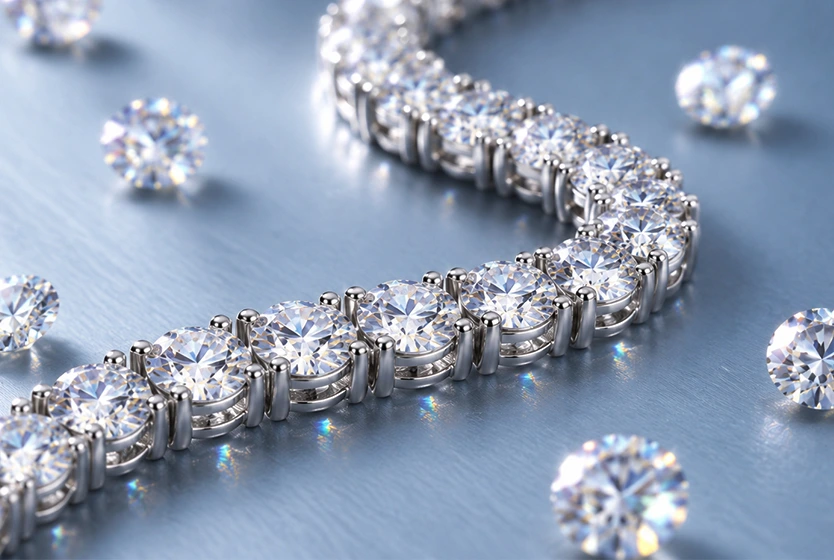
Why can jewelry with inexpensive CZ still cost more to manufacture?
The stone is only one part of the finished cost. A quote also reflects the metal component, forming, finishing, stone handling, setting, inspection, packaging, and the cost of developing the design.
Illustrative comparison — not an actual 96Jewelry order or quotation.
Imagine two pendant designs made in the same metal and finish, ordered at the same quantity. One contains a single center stone; the other contains 24 small stones. The second design may use inexpensive stones, yet require more individual setting and checking operations. Its finished price cannot be predicted from the raw stone cost alone.
A useful costing structure is:
Unit cost = metal and forming + finishing + stones + setting and assembly + inspection and expected production loss + packaging + allocated development costs.
The supplier’s commercial quotation may also include margin and other charges. Ask whether tooling, sampling, testing, freight, and taxes are included or separate, and confirm the quoted unit: piece, pair, or set.
Before comparing two quotations, align the stone dimensions, count, setting method, quantity split, finish, inspection requirements, and packaging. A lower total can reflect a different specification rather than a more efficient way to produce the same item.
For quantity planning, review our MOQ guidance. The applicable minimum still needs confirmation for the specific design and its variants.
What should you confirm in a CZ jewelry sample?
Approve the loose-stone appearance and the assembled jewelry. A loose stone does not show whether the final rim obscures too much of it, whether a row is aligned, or whether the reverse side is comfortable.
The following is a suggested approval checklist. Agree on the inspection conditions and acceptance criteria for your project rather than treating it as a universal testing standard.
| Sample check | Approval record |
|---|---|
| Material and stone reference | Confirmed CZ type, supplier reference and treatment information |
| Dimensions and fit | Drawing revision, key measurements and agreed tolerances |
| Color and appearance | Approved sample reference and comparison conditions |
| Stone count and position | Layout checked against the design |
| Retention | Agreed test method and acceptance result |
| Metal finish | Approved color and surface appearance |
| Contact and comfort | Review of edges, exposed points and snagging |
| Embalaje | Protection against rubbing and movement during handling |
Keep an approved sample with an identifiable revision. If the stone supplier, cut, size, color, metal, or finish changes, decide whether renewed approval is required before production continues.
Our quality control page gives broader context for discussing inspection requirements with the factory.
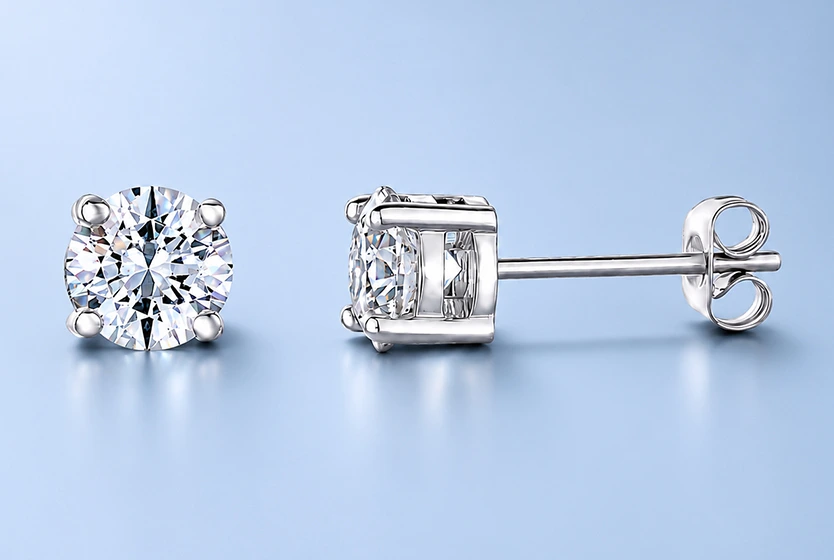
Does cubic zirconia become cloudy, and how should it be cared for?
A dull appearance can have different causes. Surface residue may respond to cleaning, while scratches or damaged facets will not be restored by washing. CZ is less scratch-resistant than diamond, so avoid promising permanent brilliance regardless of wear. [S6]
Care instructions should suit the entire item. For a mechanically set piece whose metal and finish permit wet cleaning, gentle cleaning with mild soap, lukewarm water, and a soft brush may be appropriate. Rinse and dry carefully. Follow the supplier’s specific instructions for glued, coated, or mixed-material jewelry; do not automatically recommend soaking, steam, or ultrasonic cleaning for every CZ product.
For a brand, the sample stage is a useful time to agree on the care instructions that will accompany the product.
What should you send a manufacturer for a CZ jewelry quote?
You do not need every technical answer before making contact. Send what is known, identify what is undecided, and ask for the remaining choices to be assessed.
| Information | What to provide |
|---|---|
| Diseño | Sketch, CAD, reference images or an existing sample |
| Intended product | Ring, earrings, pendant or other item, with key dimensions |
| Stone specification | CZ shape, size, color, count and any approved sample |
| Metal and finish | Preferred material, finish color and required performance |
| Quantities | Quantity per design, size and color; state pieces or pairs |
| Commercial brief | Target cost range, intended market and product positioning |
| Timing | Required delivery date and key approval deadlines |
| Packaging and checks | Branding, packing, inspection and testing requirements |
Planning a CZ jewelry collection? Send your design to 96Jewelry with your target quantity and preferred stone appearance. If the stone size, setting, or metal is undecided, include those questions in the inquiry so the project can be reviewed before sampling.
For scheduling context, see our production lead time guide.
Preguntas frecuentes
What should a brand include in a cubic zirconia jewelry product description?
Identify the stone as cubic zirconia (CZ), then state the verified metal, finish, stone color, shape and product dimensions. Include practical details such as the closure, earring backing or adjustable length. Keep the description consistent with the approved sample and product photographs. Ask the supplier to verify material and performance statements before publishing, rather than copying claims from another product.
What is the MOQ for custom CZ jewelry?
Haosen’s starting MOQ is 30 pieces. For a CZ jewelry project, confirm how this minimum applies to each design, size, stone color and finish before ordering. Special stone shapes, additional components or branded packaging may have separate minimums. Send your design reference and quantity breakdown so we can confirm the requirements for your project.
What should a brand include on a care card for CZ jewelry?
Include suitable cleaning and storage instructions, activities that require removal, and a contact point for after-sales support. Ask the supplier to review the wording against the finished piece, including its metal, plating, stone treatments and any adhesives. Keep the care card consistent with the product page, and review it whenever materials or construction change.
Keep this guide with your collection development notes. Reuse the specification and sample checklists when discussing your next CZ design, and visit the Centro de Recursos de la Marca de Joyería de Moda for related manufacturing guidance.
References
[S2] GIA — Man-made Diamonds: Questions and Answers
[S3] Geoscience Australia — Zircón
[S4] GIA — Cubic Zirconia: An Update
[S5] Diamond CZ — FAQ — How are CZ gems Graded?
[S6] GIA — What Are Simulated Diamonds?
Autor

Ertian Jiang (Jasper) es el fundador de Haosen Metal Jewelry. Desde los 26 años, ha combinado sus profundos conocimientos de la artesanía tradicional con una visión aguda del mercado para sentar las bases de la excelencia de la empresa.
Ertian Jiang comenzó desde cero como artesano, especializándose en piedras semipreciosas (ágata, nácar, ojo de tigre) y en la incrustación manual, perfeccionando la técnica para encajar piedras naturales en bases de metal sin que quedaran huecos ni fallara el pegamento. También trabajó en primera línea de ventas, hablando cara a cara con los compradores y escuchando sus quejas sobre piedras que se caían y colores que se desvanecían.