

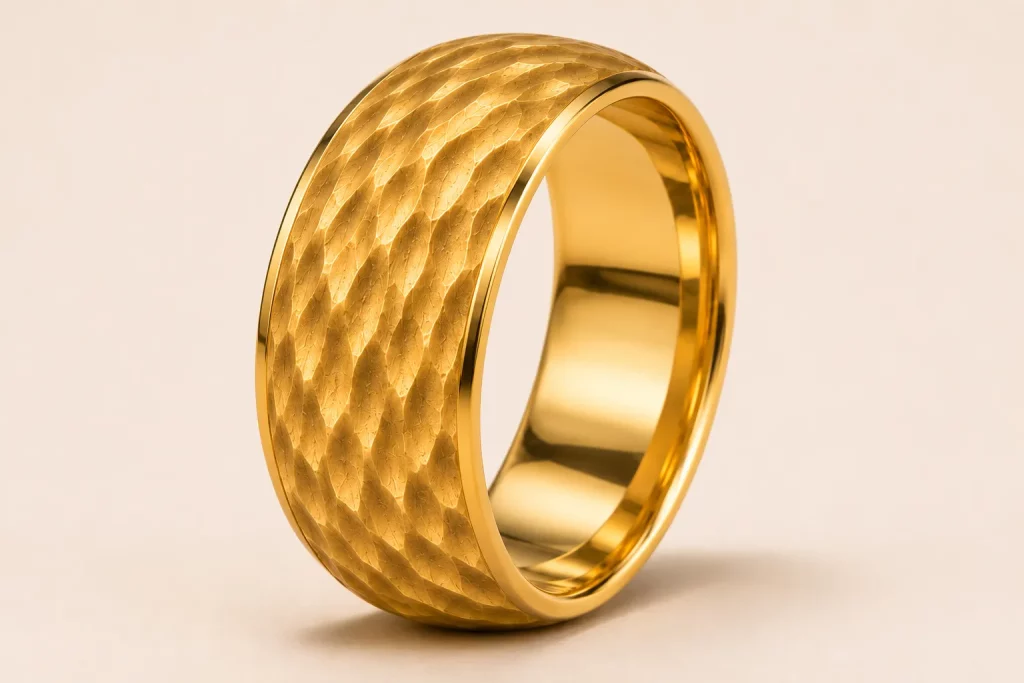
This development example concerns a brass ring with a handmade-looking hammered exterior, polished borders and a polished inner surface. The starting brief calls for “noticeable texture with a matte appearance.” The task is to turn that visual preference into a reference that the brand and factory can use consistently.
The proposed approval package combines a finished reference sample, texture limit samples and an annotated surface map. It preserves agreed natural-looking variation while defining the features that must remain consistent.
Why was the unfinished sample not enough?
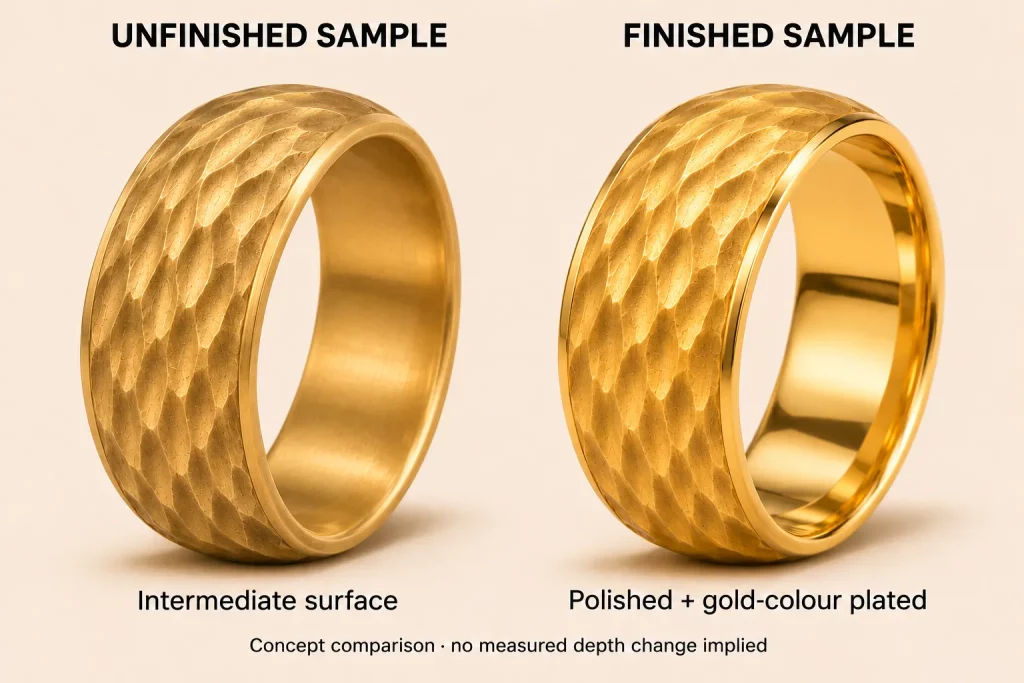
An unfinished sample records an intermediate appearance. It can help confirm shape or an earlier process, but does not establish the final combination of texture, colour, reflection and polished borders.
If the finished texture appears softer, review the polishing and finishing sequence before assigning a cause. A change in reflection can alter the perceived relief; photographs alone do not establish a measured depth change or prove that plating filled the recesses.
A second issue was the brief itself. “Noticeable hammered texture” did not show where the texture should stop on the sidewalls or how wide the polished border should be. Without a shared boundary map, both sides could accept the general design while expecting different details.
An unfinished sample can still help approve shape or an intermediate process. It should not be the only reference for a finished-surface decision.
Which approval approach was selected?
| Enfoque | What it established | Limitation |
|---|---|---|
| Unfinished sample only | The appearance at an intermediate stage. | Did not define the final plated surface. |
| Finished reference sample | The intended complete surface and region boundaries. | One example alone could leave acceptable variation unclear. |
| Finished reference plus limit samples | A target appearance and agreed visual limits for selected texture characteristics. | Needed matching regional specifications and a consistent comparison method. |
The selected approach combines a finished reference with limit samples. A brand may worry that tighter control will remove the handmade look. The practical answer is to specify which characteristics must match and which marks may vary.
Coverage, polished-border position and overall texture character needed to remain controlled. Individual marks did not have to be identical, provided the agreed appearance stayed within the reference range. Handmade-looking variation was not used as a reason to accept an undefined finish.
For other ring structures and finish options, see our custom brass ring manufacturing page.
What did the surface specification define?
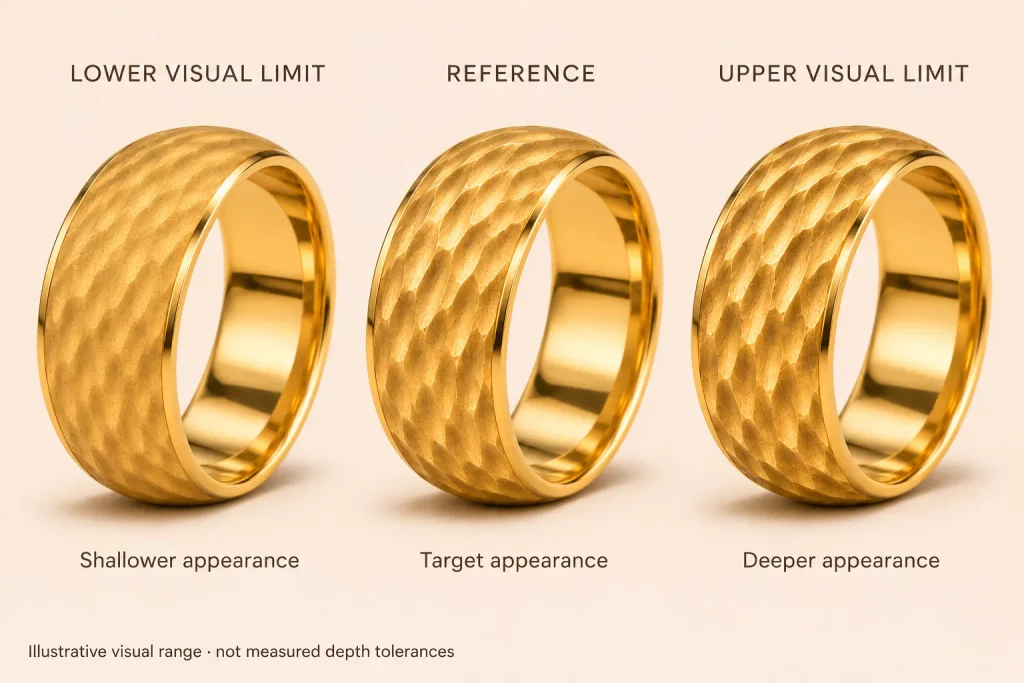
Use one fully polished and plated ring as the central reference. Add two finished examples showing the acceptable lower and upper limits of apparent texture depth. These are visual references; measured depth tolerances, if required, need a separate specification.
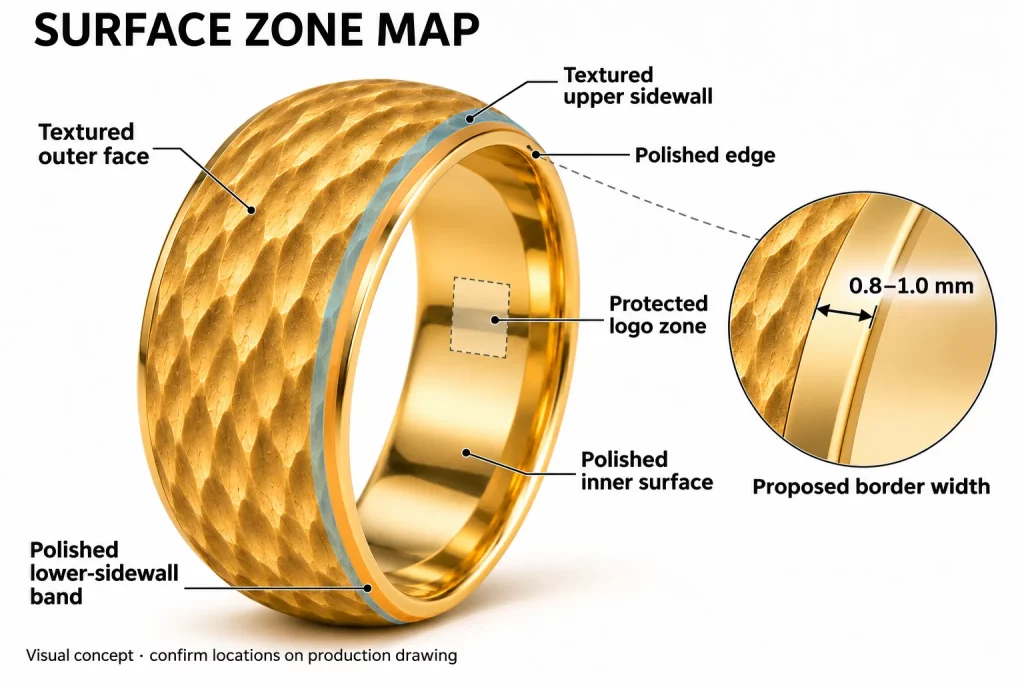
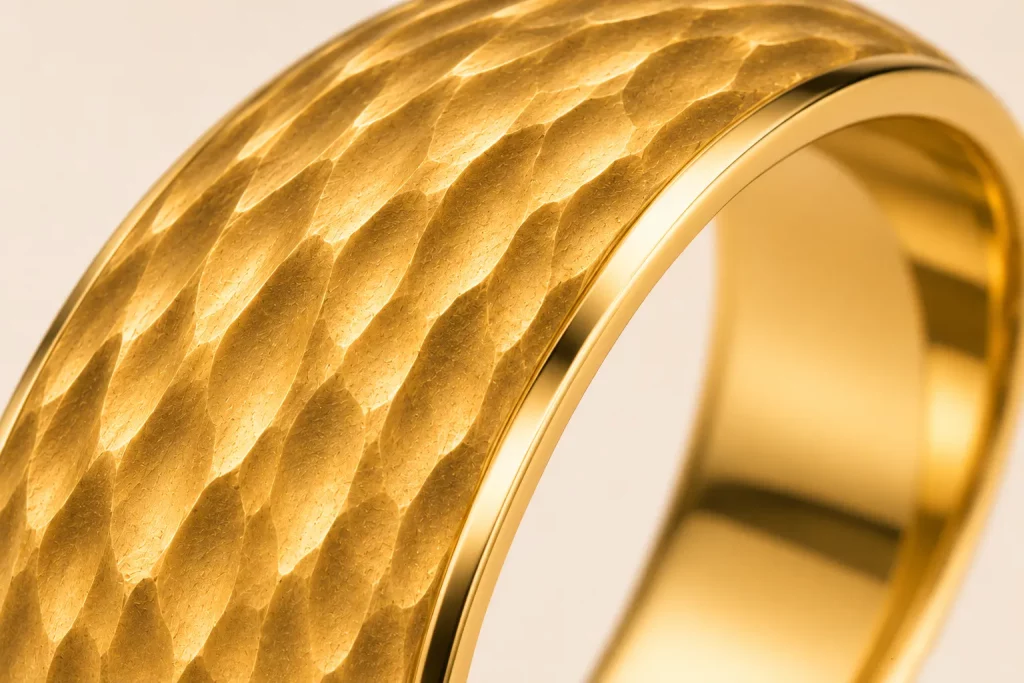
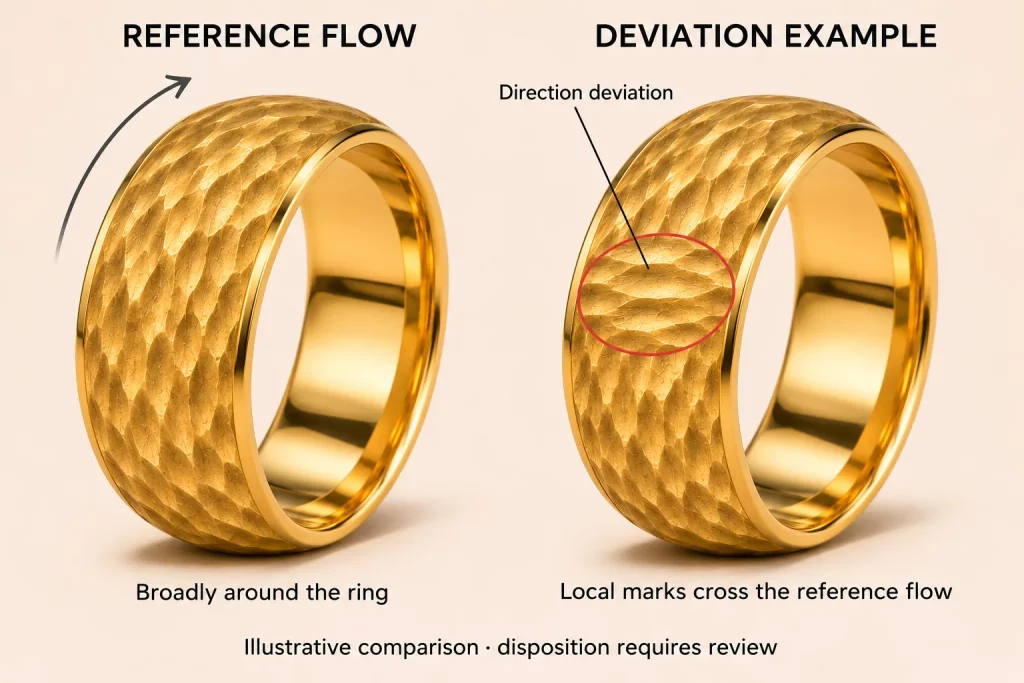
On the surface map, identify the texture coverage, overall flow of the marks and areas reserved for polishing. For this example, the flow runs broadly around the ring; individual marks do not have to form straight lines.
| Area or feature | Proposed specification |
|---|---|
| Outer face and upper sidewall | Hammered-look texture, with the overall flow mainly around the ring. |
| Specified lower-sidewall and edge zones | A polished band described as 0.8–1.0 mm wide, with its location to be shown on the drawing. |
| Inner surface | Polished. |
| Logo area | Protected from the surrounding texture or matte treatment as specified on the surface map. |
| Final appearance | Gold-colour plating with the agreed balance of matte recesses and brighter raised areas. |
The proposed polished band is 0.8–1.0 mm wide in the designated zones. Mark its location and measurement direction on the drawing, including how it continues around curves. This is a design requirement for this example, not a standard border width for textured rings.
Identify the logo as a protected region on the surface map. The approved process instructions should explain how that region is protected during the actual texturing and matte-finishing operations.
How were the reference samples used?
Photograph the finished references under consistent lighting and angles, and retain the physical samples. Images help identify locations and boundaries; the physical references are needed to compare reflection and surface feel.
The limit samples did not replace the surface map. A ring could look acceptable in overall depth yet still have texture outside the allowed region or a polished border in the wrong place. Likewise, a more reflective surface could appear deeper under one light without proving a change in its physical profile.
For repeatable comparisons, the factory and brand should identify the sample version, finish and approval date, protect the retained samples from damage, and agree the viewing conditions. If density or brightness also requires limits, those characteristics need their own clear references rather than being assumed to follow from the depth samples.
How should production appearance be judged?
Compare inspected pieces with the approved finished reference, the relevant limit samples and the surface map. Check apparent depth, density, coverage, polished borders and the balance of matte and reflective areas. Review edges for uncomfortable sharpness using the agreed handling check.
| Inspection point | Basis for comparison |
|---|---|
| Depth and overall character | Finished reference and approved visual limits. |
| Coverage and borders | Annotated regional map, including the specified polished band. |
| Direction and density | Agreed overall pattern and applicable reference details. |
| Reflection and colour | Finished references viewed under agreed conditions. |
| Edges | Documented appearance and handling check for the sample or inspected pieces. |
What should happen when a repeat order changes?
If polishing or plating conditions change, the previous approval should not automatically be treated as proof that the new surface will match. The changed route should be reviewed, and a finished sample should be reconfirmed before it becomes the reference for the repeat order.
Any new approved reference should be versioned so that the brand and factory are not comparing different generations of the finish. Photographs, the surface map and retained samples should be updated together.
What should brands prepare for a textured brass ring?
The practical lesson is to approve the complete surface and define where variation is acceptable. This gives a handmade-looking design a usable production reference without requiring every mark to be identical.
Send 96Jewelry close-up texture images, a physical reference or approved finished sample, and a marked view showing texture regions, polished borders, inner surfaces and logo areas. Include the intended finish, ring sizes and order quantity. If you want natural-looking variation, show which differences are acceptable and which details must remain consistent.
Autor

Ertian Jiang (Jasper) es el fundador de Haosen Metal Jewelry. Desde los 26 años, ha combinado sus profundos conocimientos de la artesanía tradicional con una visión aguda del mercado para sentar las bases de la excelencia de la empresa.
Ertian Jiang comenzó desde cero como artesano, especializándose en piedras semipreciosas (ágata, nácar, ojo de tigre) y en la incrustación manual, perfeccionando la técnica para encajar piedras naturales en bases de metal sin que quedaran huecos ni fallara el pegamento. También trabajó en primera línea de ventas, hablando cara a cara con los compradores y escuchando sus quejas sobre piedras que se caían y colores que se desvanecían.