

Surface Texture Guide
Explore jewelry surface finishes and define the right texture for your custom collection.
Define the Look and Feel of Your Jewelry
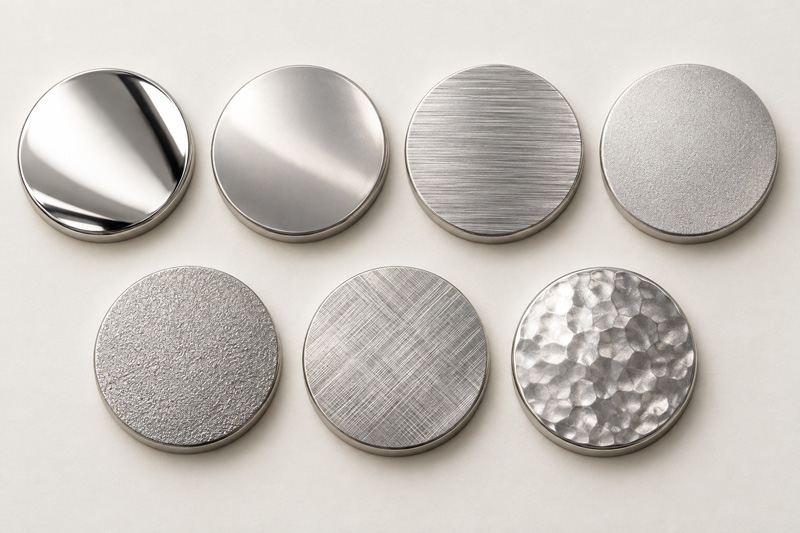
Surface texture describes the fine lines, grain, or relief on a jewelry surface. Together with the level of polish, it influences how the piece reflects light and feels to the touch.
Use this guide to compare visual directions for your design. Confirm the final result on a physical sample made with your chosen material and coating.
Compare Jewelry Surface Finishes
| Surface Finish | Visual Character | What to Confirm |
|---|---|---|
Brillante Pulido |
A smooth, highly reflective surface. |
Reflection quality and visible surface marks. |
Semipulido |
A softer shine than a bright polish. |
The intended gloss level, using an approved sample. |
Cepillado | Visible directional lines. | Grain direction, fineness, and coverage. |
Glass Bead Blasted |
A fine, evenly stippled appearance. |
Grain size and the desired sheen. |
Sandblasted |
A granular matte appearance. |
Texture coarseness and treated areas. |
Florentino |
Fine intersecting lines forming a crosshatched pattern. |
Line angle, spacing, and depth. |
Martillado |
Repeated indentations creating an irregular relief. |
Indentation size, depth, and distribution. |
Finish names describe a general direction. Terms such as “semi polished,” “satin,” and “matte” may be interpreted differently, so use an agreed physical sample as the visual reference.
Images illustrate possible appearances. Final texture depends on the material, process, geometry, and coating.
Specify Texture and Color Separately
Describe the surface pattern and sheen: polished, brushed, blasted, crosshatched, or hammered.
Color & Coating
Specify the required color and coating separately. A gold-tone finish, for example, can be paired with different surface textures.
Review both together on the finished sample. The same color can appear different on a reflective surface and a matte surface.
Example design brief:
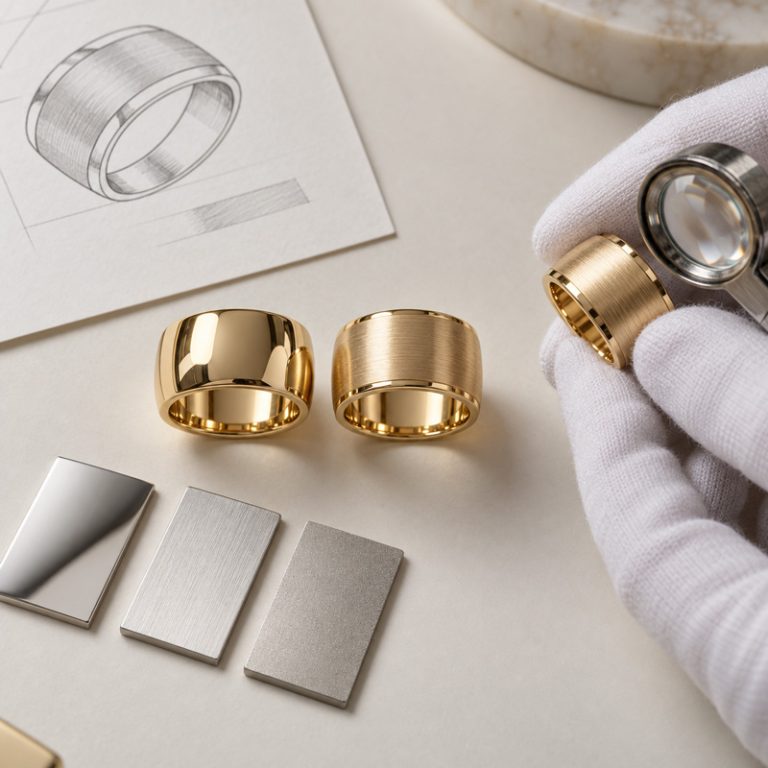
316L stainless steel ring with a fine brushed outer surface, polished edges and inner surface, and a gold-tone PVD coating. Confirm the color, coating specification, and texture on the finished sample.
Choose a Finish for Your Design
Highlight Shape & Subtle Detail
Consider bright polish when you want reflections to emphasize a clean silhouette. Review how the finish looks on both flat and curved surfaces.
Explore brushed or blasted effects when you want visible surface character with a more restrained shine. Specify how fine or pronounced the texture should be.
Create Pattern and Contrast
Consider Florentine or hammered effects for a more expressive surface. A textured face with polished edges is another direction to discuss during design review.
For mixed finishes, mark the boundaries clearly on your drawing, including the back, edges, and skin-contact areas.
Confirm the Surface Before Bulk Production
For your OEM/ODM jewelry project, send Haosen a reference image or sample together with your design drawing. Mark where each finish should appear and which areas should remain smooth or polished.
Please include:
Base material and product dimensions
Preferred texture and gloss level
Grain direction or pattern scale
Textured areas and finish boundaries
Color and coating requirements
Logo placement and details to preserve
Order quantity and any required performance tests
Confirm the finished sample and acceptance criteria before approving bulk production.
What to Check on Your Finish Sample
Texture Consistency
Compare the grain, pattern scale, and sheen across the visible surfaces.
Finish Boundaries
Check the transitions between polished and textured areas against the drawing.
Edges & Fine Details
Review edge comfort, logo clarity, and small features that must remain defined.
Final Color & Appearance
Review edge comfort, logo clarity, and small features that must remain defined.
Preguntas frecuentes
1. Are matte and brushed finishes the same?
Not necessarily. Matte describes a low-shine appearance, while brushed describes a surface with visible directional lines. Confirm the intended appearance with a sample.
2. What is the difference between glass bead blasting and sandblasting?
Glass bead blasting uses rounded glass beads. Abrasive blasting can use other media with different shapes and cutting characteristics. The resulting appearance depends on the media and processing conditions.
3.Can one piece have more than one surface finish?
Mixed finishes can be considered, such as a brushed face with polished edges. Feasibility depends on the design and access to the areas being treated.
4. Will the same texture look identical on stainless steel and brass?
Not necessarily. The base material, geometry, surface preparation, and coating can affect the result. Approve a sample in the intended production material.
5. Does a matte finish make jewelry scratch-proof?
No. A matte appearance does not establish scratch resistance. Agree on any wear or abrasion testing separately from the visual finish.
6.Can I use a photograph as the production reference?
A photograph is useful for discussing the design direction. Lighting and image processing can change the apparent texture, so a physical sample provides a stronger reference for final approval.
Bring Your Surface Finish Idea to Life
Send us your design, preferred texture, base material, and order quantity. Haosen can review the requirements and discuss suitable sampling options for your custom jewelry project.