
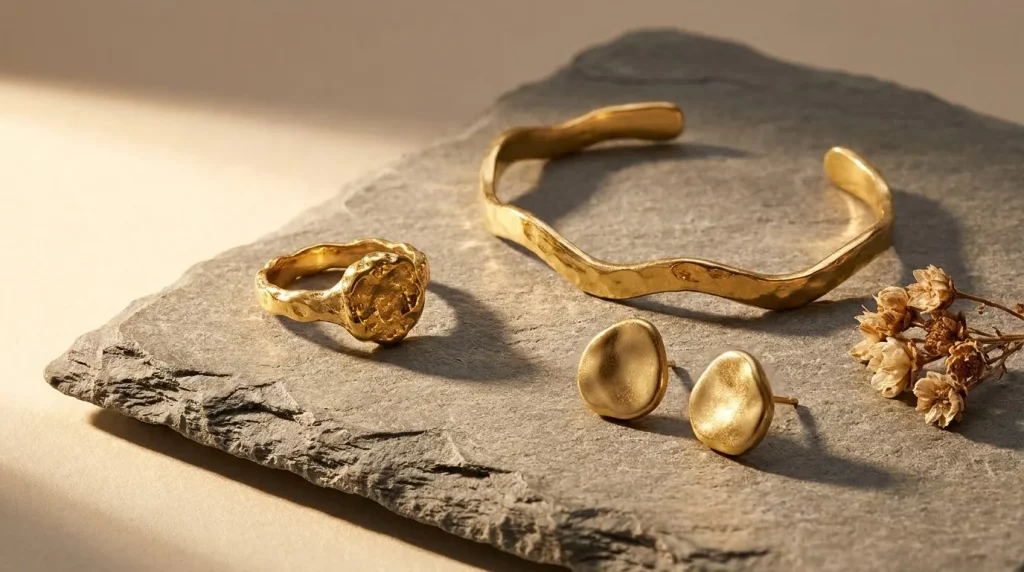
Organic and irregular jewelry moves from design to manufacturing through five stages: a 3D model, a master pattern, a mold, casting or forming, and hand finishing that keeps every piece matched to the approved sample. The look is free and natural. The process behind it is not. Uneven shapes, molten edges and pebble-like curves are harder to repeat than clean geometry. This guide explains irregular jewelry manufacturing for brands that want the artisan look without losing control over quality, weight or cost.
TL;DR
- Casting is the main process for organic shapes.
- A precise CAD file is needed, even for "random" forms.
- A golden sample and clear tolerances keep pieces consistent.
- Texture hides small marks and adds depth.
- Fewer molds and shared finishes keep costs down.
How Do You Turn an Organic Sketch Into a Production File?
You turn an organic sketch into a production file by building a 3D CAD model that fixes the size, thickness and weight of every curve. Even a "random" shape needs exact numbers before a factory can repeat it.
Start With References
Send sketches, reference photos or a physical sample. The design team then builds a CAD file. Free CAD revisions include up to three rounds, so use them to refine thickness and comfort.
Check Thickness Early
Thin, uneven sections can break or bend. Thick sections add weight and cost. A good CAD model balances both before any metal is used.
Which Process Is Best for Organic Shape Jewelry?
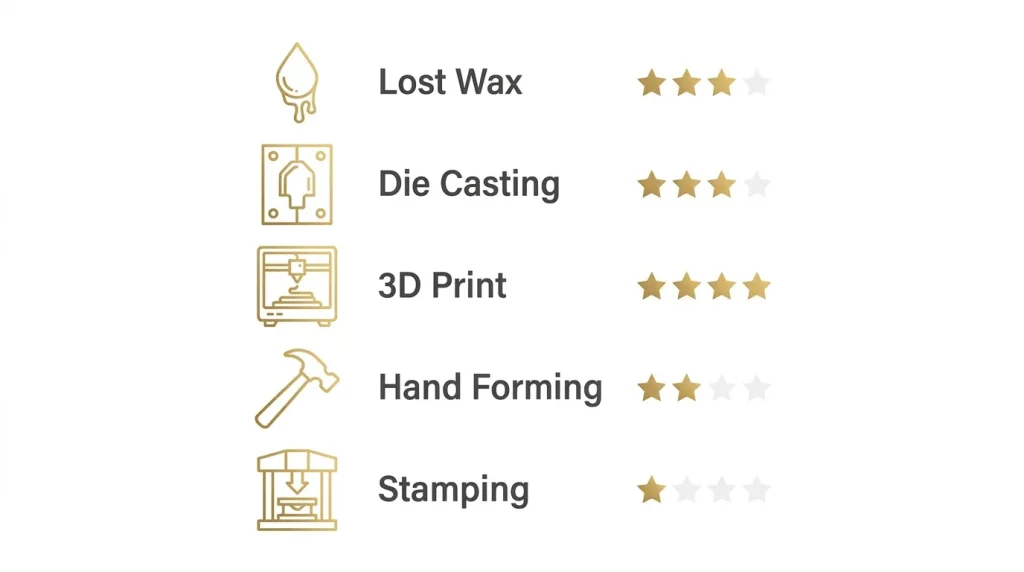
Casting is the best process for most organic shape jewelry, because liquid metal fills every curve, dip and texture in the mold. Other methods still play a role.
| Proceso | Ideal para | Limits |
|---|---|---|
| Lost wax casting | Detailed 3D organic forms in brass or silver | Slower for 316L stainless steel |
| Die casting | Zinc alloy pieces in higher volume | Higher upfront mold cost |
| Impresión 3D | Masters and test samples | Not a finished-metal method on its own |
| Hand forming and hammering | Wavy cuffs and soft bends | Harder to keep identical |
| Stamping | Flat organic outlines | Little depth or relief |
Fundición a la cera perdida
In lost wax casting, a wax model is coated in a heat-proof shell, the wax melts out and metal fills the space. It captures fine texture well. Learn more on our casting page.
What Jewelry Mold Decisions Matter Most?
The jewelry mold decisions that matter most are the mold type, the number of cavities and how many design variations you want. Each choice affects cost and consistency.
- One master mold keeps every piece the same.
- Several molds create planned variation within a style.
- Multi-cavity molds speed up larger orders.
- Separate molds may be needed for multi-part designs.
Some brands want each piece to look slightly different. In that case, decide in advance how many versions exist. Three planned variants are easier to control than true one-offs.
How Do You Keep Irregular Jewelry Consistent?
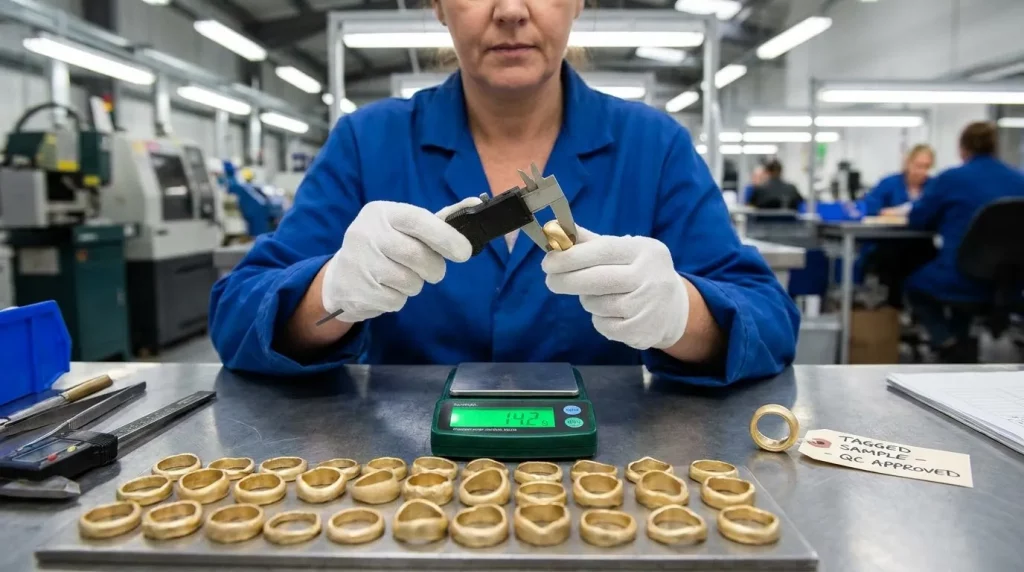
You keep irregular jewelry consistent by approving a golden sample, setting clear tolerances and checking every batch against that sample. "Irregular" should describe the design, never the quality.
Set Clear Tolerances
Agree on limits for size, weight and texture depth. For example, a pendant might allow a small weight range. Write these into your approval notes.
Validate Before Molding
Checking scale and proportion before cutting a mold saves money. This case study on charm size validation shows how small changes early prevent big fixes later.
Which Textured Jewelry Finishes Suit Organic Designs?
Hammered, sandblasted, satin brushed, matte and high polish finishes all suit organic designs. Texture adds depth and helps hide small tooling marks.
Matching Finish to Form
High polish shows off smooth, molten curves. Hammered and sandblasted textures suit rough, rock-like shapes. Mixed finishes, such as polished edges with a matte center, add contrast.
Plating on Uneven Surfaces
Deep recesses can plate unevenly. Ask your factory to check color in the hollows, not just on the high points. Brass and alloy plating can range from 0.03 to 3 μm, so choose a thickness that suits daily wear.
How Can Brands Control Costs in Organic Jewelry Design?
Brands can control costs in organic jewelry design by limiting variations, reusing base forms, keeping thickness even and sharing one finish across a collection.
- Limit the number of unique molds.
- Reuse one organic base for rings, earrings and pendants.
- Avoid very thick sections that add metal weight.
- Share one plating color across the full range.
Standard MOQ starts from 30 pieces per style per color. Custom samples take a minimum of 7–10 days after CAD approval. To compare metals by cost and behavior, see our material selection guide.
FAQs
How is irregular jewelry made?
Irregular jewelry is usually made by casting a 3D organic model in metal, then finishing it by hand. Hammering and hand forming are also used for simpler shapes.
Can organic jewelry be mass produced?
Organic jewelry can be mass produced when each design has a fixed master and clear tolerances. Every piece is then checked against an approved sample.
Is 3D printing used for organic jewelry?
3D printing is often used to make masters and test samples for organic jewelry. The final pieces are then cast in metal.
Which metal works best for organic shapes?
Brass works very well for organic shapes because it casts detail cleanly and plates evenly. Zinc alloy suits higher volumes at lower cost.
Do textured finishes cost more?
Textured finishes can add some finishing time. They can also save cost by hiding small casting marks that would need extra polishing.
Final Thoughts on Irregular Jewelry Manufacturing
Organic jewelry looks effortless, but it relies on careful planning. A precise CAD file, the right process, smart mold choices and a firm golden sample turn free-flowing designs into repeatable products. Texture and finish then bring each piece to life. Haosen Jewelry has 16+ years of experience casting and finishing custom designs for fashion brands. Ready to bring your organic collection to production? Contact our team and share your sketches today.
Autor

Ertian Jiang (Jasper) es el fundador de Haosen Metal Jewelry. Desde los 26 años, ha combinado sus profundos conocimientos de la artesanía tradicional con una visión aguda del mercado para sentar las bases de la excelencia de la empresa.
Ertian Jiang comenzó desde cero como artesano, especializándose en piedras semipreciosas (ágata, nácar, ojo de tigre) y en la incrustación manual, perfeccionando la técnica para encajar piedras naturales en bases de metal sin que quedaran huecos ni fallara el pegamento. También trabajó en primera línea de ventas, hablando cara a cara con los compradores y escuchando sus quejas sobre piedras que se caían y colores que se desvanecían.