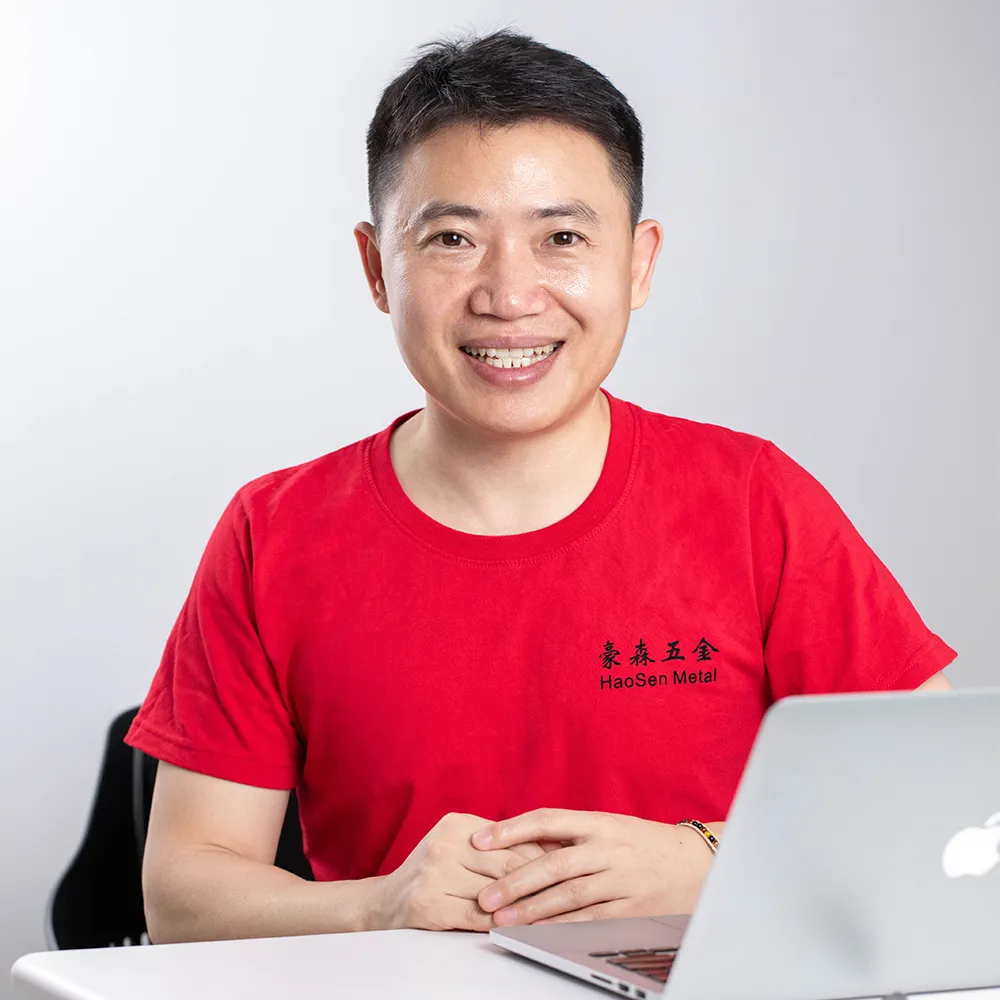

The Canton Fair (officially the China Import and Export Fair), held in Guangzhou, is one of the world’s largest trade shows, with an exhibition area equivalent to 1.55 million square meters. For buyers of garment accessories and fashion jewelry, it is the “heart” of the global supply chain — but finding truly reliable suppliers efficiently and precisely is no easy task.
As the founder of a Chinese factory with 16 years of OEM/ODM jewelry manufacturing experience and more than 10 consecutive years exhibiting at the Canton Fair, what I want to share in this article is not the official zone descriptions, but the practical screening logic and industry truths that only someone long “immersed” on the front lines of the fair would know.
Whether you are a brand owner, a cross-border e-commerce seller, or a wholesaler, I hope this supplier-side guide helps you avoid detours and find a partner that truly fits.
Know the Phases: Why I Suggest You “See Both Phases”
The Canton Fair is held in three phases, with garment accessories and fashion jewelry concentrated mainly in Phase 2 (April 23–27) and Phase 3 (May 1–5).
Since the 139th Canton Fair, Phase 2 has included a dedicated Fashion Accessories Zone in Hall 21.2 of Zone D, featuring categories such as lab-grown diamonds, pearl jewelry, crystal jewelry, and artificial gemstones. Phase 3 features a “Garment Accessories and Fittings” exhibition area displaying the various accessories that accompany clothing.
That is the official plan, but my first-hand experience is this: if your product line covers fashion jewelry, I strongly recommend attending both phases.
Why? Because the real “garment accessories” supply chain is often hidden in the accessory booths surrounding the Phase 3 apparel area. Many factories that supply buttons, zippers, and waist belts for fast-fashion brands are equally capable of producing metal jewelry. In Phase 3, you can directly reach the brands and designers who need accessories deeply integrated with their apparel style, and understand their complete needs for the next season — this gives you a far better grasp of market trends than simply visiting jewelry booths.
Pre-Fair Preparation: Enter with a “Precise List”
The Canton Fair complex is enormous; wandering without a plan could leave you unable to cover even half a zone in a day. Here are my specific suggestions from an exhibitor’s perspective.
Lock in target exhibitors in advance. Use the official online exhibitor directory on the Canton Fair website, and filter by product category, export destination country, and minimum order quantity (MOQ). For each of the two phases, lock in 15–20 target exhibitors and record their booth numbers, company names, and contact details.
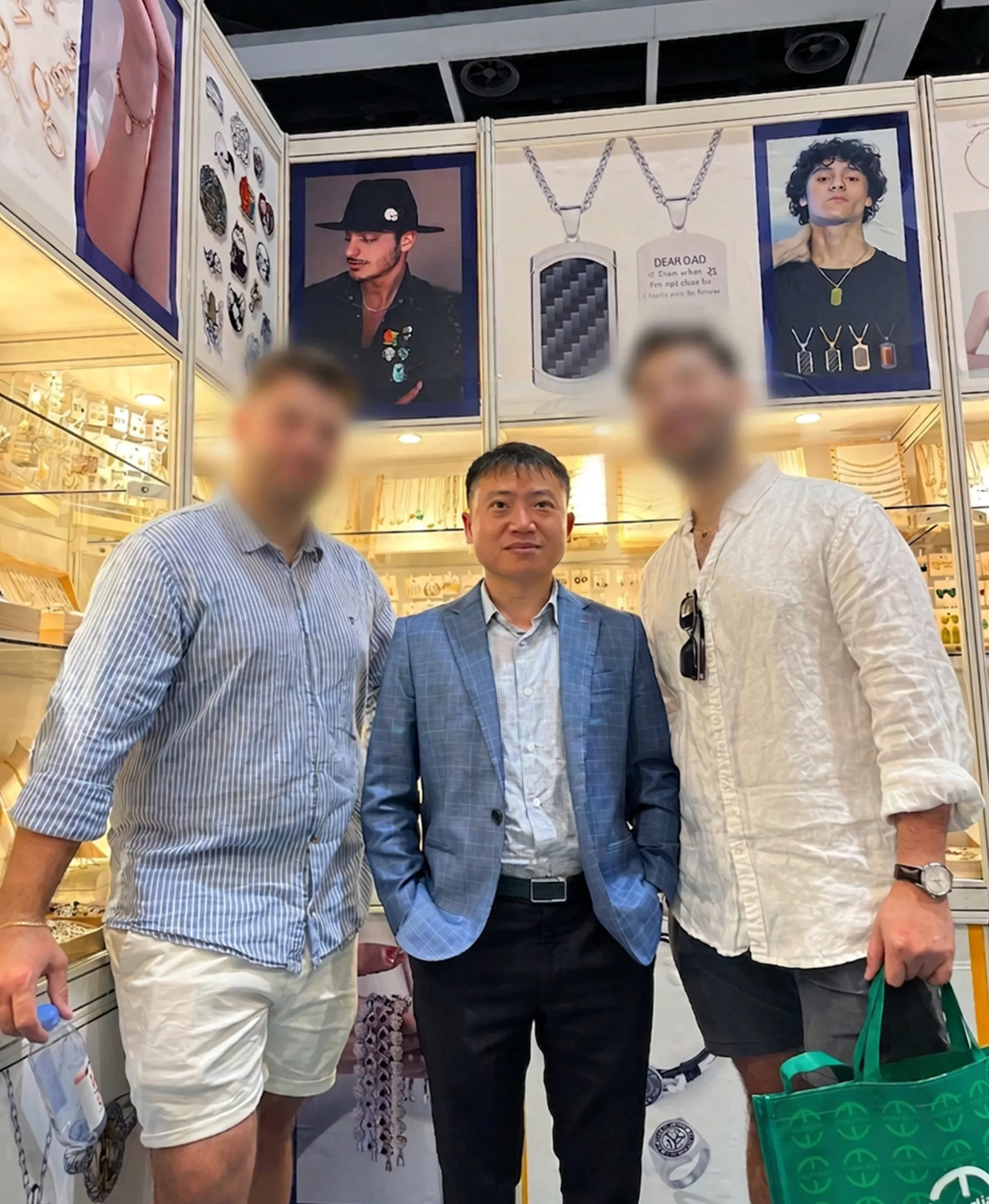
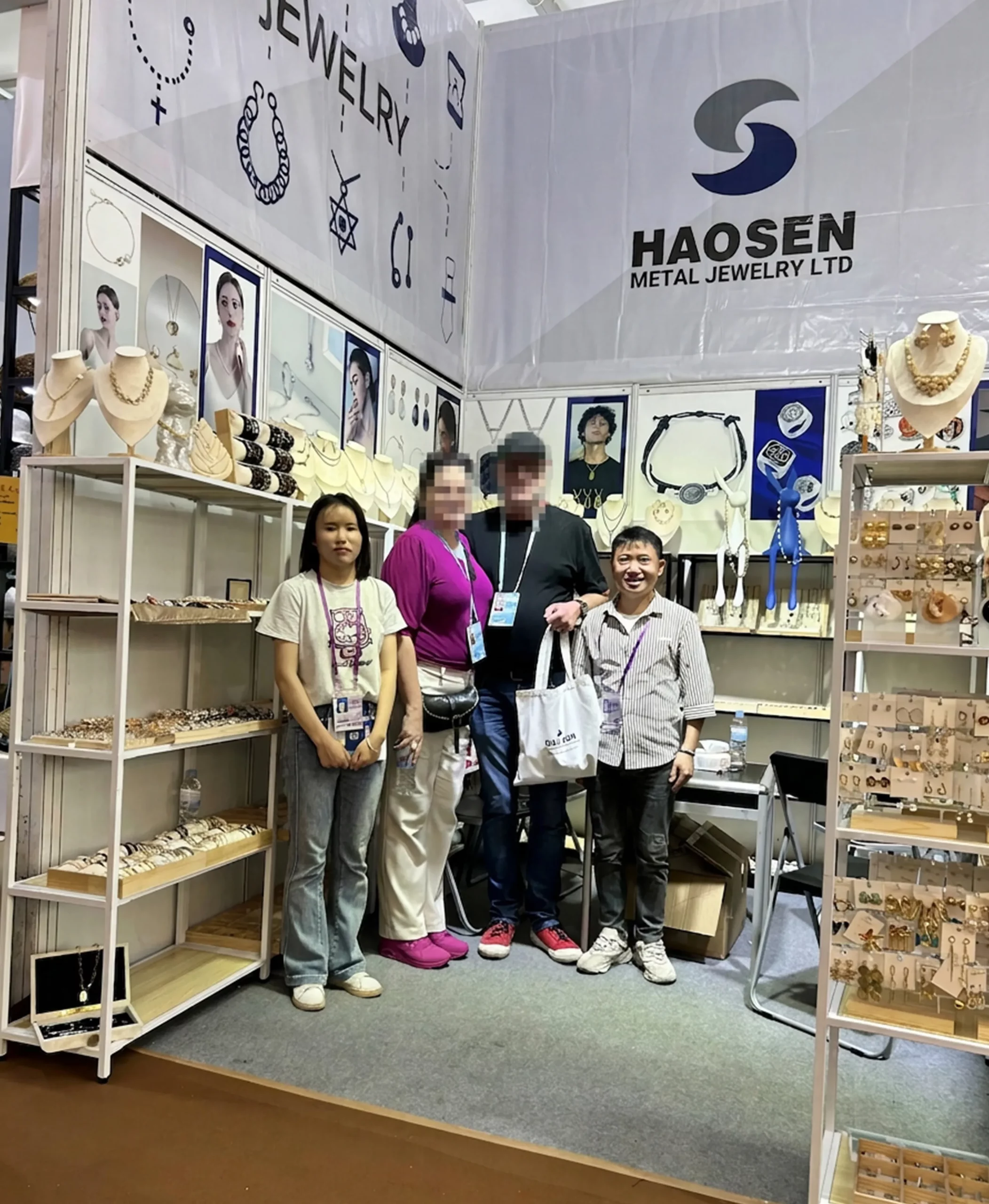
Book meetings in advance. Contact your target exhibitors through the official website or other channels and tell them your arrival date. Take Haosen Jewelry as an example — every year our booth receives a large number of buyers who have booked in advance. For clients with appointments, we usually arrange for a sales manager or even the factory head to receive them personally, which makes a completely different depth of communication possible — you can discuss craftsmanship details, development lead times, certification requirements, and other substantive matters, rather than merely exchanging business cards.
Bring the essentials:
- 150–200 business cards, ideally printed with your WeChat ID (Chinese suppliers are accustomed to communicating via WeChat)
- A reference catalog and specification lists (including target materials, sizes, and budget range)
- Baidu Translate or a similar app (supports real-time camera translation of product labels)
- Alipay / WeChat Pay (for conveniently paying for taxis, meals, and other daily expenses)
Beware of fraud. During the Canton Fair, both buyers and exhibitors are high-risk targets for scams. When meeting new clients, always verify the buyer’s identity through independent channels, and be wary of orders that demand 100% credit terms or “ship first, pay later” on a first-time deal.
On-Site Screening: Distinguishing Factories from Trading Companies with a “Keen Eye”
This is the part buyers care about most. From the supplier’s side, here are a few methods that work every time. If you want a more detailed framework beyond the trade-show environment, see our jewelry manufacturer buyer’s checklist.
Method 1: Look at the “Purity” of the Exhibits
A real factory usually focuses on a single material or process category. In our case, the booth focuses only on metal jewelry (stainless steel, brass, alloy) and its combined processes with leather, acrylic, and semi-precious stones.
If a booth displays jewelry, bags, hats, silk scarves, and other highly varied categories all at once,it may indicate that the exhibitor operates primarily as a trading or sourcing company rather than a specialized manufacturer. A factory’s energy is limited, and it cannot hold production capability across so many entirely different categories.
Method 2: Inspect the Craftsmanship Up Close
This is the key step in distinguishing a “real factory” from a “reselling trader.” As a factory that started from hand-inlaying semi-precious stones, I understand deeply the difficulty and threshold of hand inlaying — securely setting agate, mother-of-pearl, and tiger’s-eye into metal mounts.
At the booth, you can pick up a piece of inlaid jewelry and examine it closely against the light:
- Is the fit between the stone and the metal mount seamless and exact?
- Is there any glue overflow or residue?
- Is the stone surface flat, or tilted?
- Are the metal edges smooth, or are there burrs?
An exhibitor that can withstand this kind of close scrutiny is very likely a factory with genuine craftsmanship. Trading companies usually cannot reach this standard in the details, because the products are not self-manufactured.
Method 3: Ask “Cost-Oriented” Technical Questions
Do not ask basic questions like “Can you use stainless steel?” Try asking instead:
- “What is the thickness of the PVD vacuum plating on this stainless-steel jewelry, in microns? Can it pass a 72-hour salt spray test?”
- “After plating brass, do you apply an e-coating (electrophoretic coating) to prevent oxidation?”
- “Between 316L stainless steel and 304 stainless steel, which do you mainly use? Why?”
The answers to these questions bear directly on cost and quality.
Take our factory’s processes as an example: for stainless-steel necklaces customized for high-end brands, we use thick-gold PVD plating of 0.05 μm–0.1 μm(Standard plating: 0.03μm) to ensure they pass the strict 72-hour salt spray test; and on brass products, we add a professional “invisible protective layer” of e-coating over the real-gold plating to effectively seal out air and moisture and prevent oxidation of the base material.
A factory representative who truly understands manufacturing can immediately state these figures, process names, and their impact on cost and durability. If the other party is vague or evasive, you should be on alert.
Method 4: Verify Qualifications and Certificates
Ask to see certification documents such as ISO, SEDEX, and SGS, and make sure the company name on the certificate matches the exhibitor’s name. If the certificate shown belongs to another company, verify the cooperative relationship carefully.
The Invisible “Hard Strength”: Compliance, Team, and Capacity
Samples at a fair are often polished and glamorous, but what determines the quality of a long-term partnership is the invisible supporting system behind them. As a buyer, you need to quickly assess this “hard strength” in just a few minutes of conversation.
Compliance Is the Baseline, Not a Selling Point
For products exported to Europe and the US, compliance is a non-negotiable red line. Rather than accepting verbal promises, ask directly: “Can you provide the latest SGS heavy-metal test report or a SEDEX ethical audit report? What is the report date?”
Take us as an example: we have maintained our SEDEX (SMETA) ethical audit report every year since 2012, and regularly update REACH and California Proposition 65 test reports for all our materials (316L stainless steel, brass, zinc alloy, titanium steel), with the latest reports updated as recently as April 2026. The lead, cadmium, and mercury test results for all our materials are “ND” (not detected). You can also review our jewelry compliance and testing reports.
An exhibitor that can show these specific documents on the spot (rather than a product brochure) demonstrates a rigorous internal management system that can withstand scrutiny.
Assessing “Stable Delivery” Capability
You can ask two key questions directly:
- “What is the average tenure of your core production team?”
- “What is your monthly production capacity ceiling, and how high is your current capacity utilization?”
For an experienced factory, a stable team is the guarantee of quality. Let me share our data for reference: our department supervisors all have 5–10 years of experience, and more than 70% of our front-line skilled workers have been with us for over a year. This is the foundation that allows us to ship more than 100,000 pieces per month, deliver 98% on time, and keep our overall defect rate below 1%.
If the other party is evasive about these figures, it may signal unstable capacity or high staff turnover, which will directly affect bulk-order quality and delivery times.
Match Your Sales Channel: You Need a Supplier That “Fits”
Different sales platforms require suppliers with different capabilities. From the factory side, let me add some insider perspectives.
Amazon / Mercado Libre Sellers (Quality and Uniqueness)
You need a factory that offers original-design protection, complete material certifications, and low-MOQ trial orders. A key question to ask: “Do you provide end-to-end service covering design development, 3D modeling, material recommendations, and packaging design?”
Many brand clients initially come to our booth with sketches, and use our 3D modeling and feasibility-analysis services to turn designs into products and launch them successfully. The ability to develop 300–500 new styles per month is the core value of this type of supplier.
Temu / Coupang Sellers (Extreme Value and Quick Response)
You should focus on the factory’s large-scale production capability and cost-control advantages. You can ask: “For this basic stainless-steel necklace, if I order 10,000 pieces, what are the best price and the shortest lead time?”
A factory with long-term stable raw-material supply and mature processes can offer competitive prices through scaled production. Take 316L stainless steel as an example: with stable raw material and mature processes, it is well suited to large-volume, quick-response orders.
Brand Owners and Independent Designers (Craftsmanship and Differentiation)
You need a partner with “craftsman genes.” Show your design directly and ask: “Can you do this kind of semi-precious stone hand inlaying or complex twisted-metal craft? Where are the technical difficulties?”
A factory like ours, built up from hand craftsmanship, has a natural advantage and enthusiasm for such complex processes. Our 16 years of hand-inlaying experience (agate, mother-of-pearl, tiger’s-eye, and more) and our obsession with detail are precisely the core reasons brand clients choose us.
Trend Insights: Four Judgments from the Canton Fair Front Line
The following trends can help you assess the technical capability and market direction of Chinese jewelry suppliers.
Lab-grown diamonds gained greater visibility at the 139th Canton Fair. The newly established Fashion Accessories Zone specifically showcased lab-grown diamonds alongside pearls, crystal jewelry, and artificial gemstones, reflecting their growing importance within China’s fashion-jewelry supply chain.
The “budget-substitute” strategy against raw-material volatility. With precious-metal prices such as gold and silver running high, some companies have applied precious-metal craftsmanship to materials like 316L stainless steel, achieving “lower price without lower quality.” Wholesale prices can be pushed down to the RMB 200–400 range, an important sourcing direction for price-sensitive markets.
Intangible cultural heritage crafts meet modern design. Crafts such as national-level copper carving and silver filigree are being transformed into wearable fashion pieces, favored by Southeast Asian and Middle Eastern markets. If your target market has demand for “Oriental aesthetics” elements, such products offer a differentiation advantage.
Extremely fast product iteration. For example, one fashion-jewelry exhibitor interviewed during the 139th Canton Fair reported developing 300–500 new styles per month, illustrating how quickly some Chinese suppliers are iterating their collections.
Expanding Your Sourcing Map: The “Hidden Treasure Troves” Beyond the Canton Fair
Guangdong has the most complete jewelry and garment-accessory supply chain in the country. After the fair, I recommend setting aside time to visit the surrounding specialized markets:
| Market | Address | Specialty |
|---|---|---|
Shenzhen Shuibei International Jewelry Trading Center |
No. 99 Beili North Road, Luohu District, Shenzhen |
The national gold and jewelry industry leader; comprehensive categories, wholesale and retail |
Guangzhou Panyu Jewelry Industrial Cluster |
Panyu District, Guangzhou |
A global jewelry-processing powerhouse, known for “Panyu workmanship” |
Guangzhou Baima Garment Market |
No. 16 Zhannan Road, Yuexiu District, Guangzhou |
Mid-to-high-end women’s apparel and matching accessories |
Guangzhou Hualin Jade Street |
Kangwang Middle Road, Liwan District, Guangzhou |
Jade and jadeite specialized market |
Panyu deserves special attention: Guangzhou Panyu is an important cluster for the global jewelry industry, with more than 10,000 market entities and a reputation for “Panyu workmanship.” If you have long-term jewelry sourcing needs, it is worth making a dedicated trip to Panyu to visit factories.
The Last Line of Defense: Sample Testing Decides Everything
Regardless of whether you meet a supplier at the fair or in a wholesale market, always require them to send production-grade samples to your address in your home country, and test the quality before signing a formal order.
A piece of industry common sense: samples shown at a fair are often carefully “dressed up” and represent only the highest standard. Only samples randomly drawn from the very production line you will place your order with, and sent to you, can truly reflect bulk-order quality.
As an exhibitor, we are very happy to provide this service to potential clients — because it is the first step in building long-term trust. If the other party refuses to send samples or is vague about the sample process, that is a strong danger signal.
Core Advice Recap
- Prioritize the Fashion Accessories Zone in Phase 2 (April 23–27), and also visit the garment-accessory booths in Phase 3
- Lock in 20 target exhibitors in advance and book meetings
- On-site, distinguish factories from trading companies through craftsmanship details and technical questions
- Assess the invisible hard strength: compliance documents, team stability, and capacity data
- Choose a supplier whose capabilities match your sales platform
- After the fair, visit Shenzhen Shuibei, Guangzhou Panyu, and other areas for deeper inspection
- Always require production-grade samples to be tested before placing a formal order
I wish you, at the Canton Fair, efficient success in finding an ideal partner and a great sourcing journey ahead!
Autor

Ertian Jiang (Jasper) es el fundador de Haosen Metal Jewelry. Desde los 26 años, ha combinado sus profundos conocimientos de la artesanía tradicional con una visión aguda del mercado para sentar las bases de la excelencia de la empresa.
Ertian Jiang comenzó desde cero como artesano, especializándose en piedras semipreciosas (ágata, nácar, ojo de tigre) y en la incrustación manual, perfeccionando la técnica para encajar piedras naturales en bases de metal sin que quedaran huecos ni fallara el pegamento. También trabajó en primera línea de ventas, hablando cara a cara con los compradores y escuchando sus quejas sobre piedras que se caían y colores que se desvanecían.